Best Off-Road GPS by Vehicle Type: 5 Units Compared on Specs
Last updated on October 29th, 2026 at 07:39 pm
This post contains Amazon affiliate links. As an Amazon Associate I earn from qualifying purchases, at no extra cost to you.
For a Jeep, truck or overland rig, the best dedicated off-road GPS on paper is the Garmin Tread 2 Overland Edition, an 8-inch unit with a suction-cup dash mount. For a side-by-side it is the Tread 2 SxS Edition, or the Trail Tech Voyager Pro4 if your group rides Polaris Ride Command vehicles. ATV, dirt bike and snowmobile riders should look at the 6-inch Tread 2, and anyone who also hikes should look at the Garmin Montana 710i.
How we compared: we haven't trail-tested these units ourselves. This comparison uses the makers' published specs, manuals and press releases plus owner reports, all linked below, and sorts the units by the vehicle you drive.
If you only drive well-known trails with cell coverage, a phone with downloaded offline maps costs far less. Several units that older lists still recommend are no longer sold new or were never made for vehicles: the Magellan TRX7 CS Pro, the Garmin Oregon series, the Garmin Overlander (discontinued after about ten years, per this Expedition Portal thread) and the Lowrance HDS boat chartplotter. They are left out here.
Best off-road GPS units compared
| Model | Best for | Screen and mount | Satellite messaging | Suggested retail |
|---|---|---|---|---|
| Garmin Tread 2 Overland Edition | Jeeps, trucks, overland rigs | 8 in, glove-friendly, IP67; suction-cup dash mount with magnetic-assisted lock | Pairs with a compatible inReach device (not built in) | $999.99 (Garmin, Jun 2025) |
| Garmin Tread 2 SxS Edition | UTVs and side-by-sides | 8 in, glove-friendly, IP67; tube mount kit for roll cages | Pairs with a compatible inReach device (not built in) | $999.99 (Garmin, Jun 2025) |
| Garmin Tread 2 (6 in) | ATVs, dirt bikes, snowmobiles, lighter side-by-side use | 6 in, glove-friendly, IP67; roll-tube and handlebar mounts; handlebar controller sold separately | Pairs with a compatible inReach device (not built in) | $699.99; controller $149.99 (Garmin, Nov 2024) |
| Garmin Montana 710i (handheld) | Hiking plus ATV, UTV or vehicle use; remote travel | 5 in, glove-friendly, IPX7; mounts sold separately | Built-in inReach (subscription required); up to 24 h in GPS mode, up to 440 h in expedition mode | $649.99 to $899.99 for the 710, 710i and 760i series (Garmin, Jan 2025) |
| Trail Tech Voyager Pro4 | UTVs, ATVs, dirt bikes; mixed groups with Polaris Ride Command vehicles | 4.3 in, 1000 nit, IP67; operating range -10 to 45 °C; 410 g | None listed in the launch specs; sub-GHz buddy tracking for up to 20 riders | $799.95 (ADV Pulse, Jul 2026) |
Prices change, so check the current price on Amazon and whether a newer model has replaced the one you are looking at. Garmin's three 2022 Tread models (the 10-inch Tread XL Overland Edition, the 8-inch Overland Edition and the 8-inch SxS Edition) launched at $1,299.99 to $1,499.99 with inReach built in, per Garmin. The Tread 2 line costs less but dropped the built-in satellite link.
Trail Tech's original Voyager Pro (2018, 4-inch screen) was replaced by the Voyager Pro4 in July 2026. Many online lists and some retailer pages still describe the older unit, so check the model name before you order.
Which GPS fits your rig?
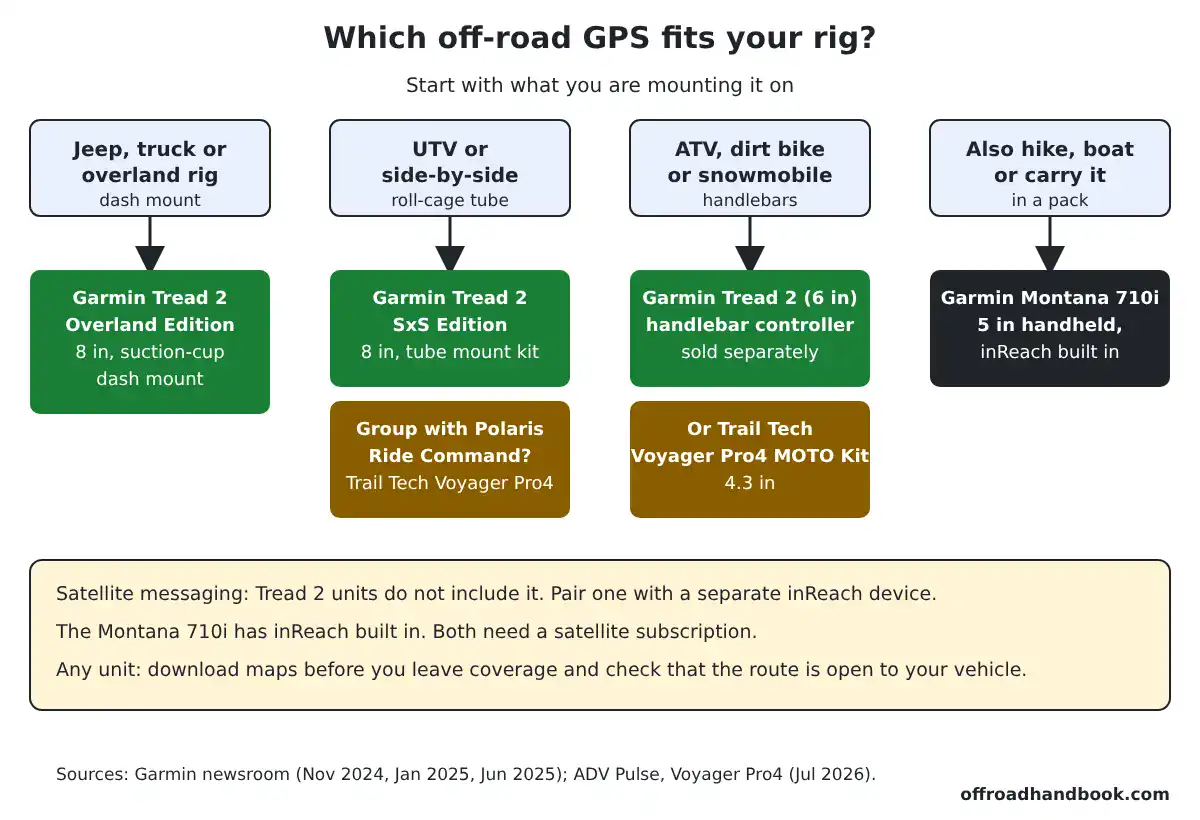
The mount decides more than the screen. A suction-cup dash mount works in a Jeep or truck, but it is no use on a roll cage or handlebar, and a tube mount does not help on a dashboard.
Pick your setup below and the tool names the unit from the table that matches.
The tool uses only the table above: mounts, prices and satellite features come from the Garmin releases and the ADV Pulse launch article.
Satellite messaging, group tracking and maps
All three Tread 2 models run turn-by-turn navigation on unpaved roads and trails using OpenStreetMap, US Forest Service Motor Vehicle Use Maps and Adventure Roads and Trails content, per Garmin. Garmin notes that map data can have gaps for some roads and trails and that OpenStreetMap data is a supplementary travel aid, so posted signs and conditions always win.
The 8-inch Tread 2 units also show public land boundaries and private parcels larger than four acres, plus a directory of more than 46,000 US campgrounds. Custom street routing uses the size and weight of your vehicle, though Garmin says it is not available in all areas and does not guarantee your vehicle's dimensions are accounted for on every route.
Satellite messaging
None of the Tread 2 models has satellite messaging built in. Garmin's releases say they pair with a compatible inReach device for two-way texting and SOS, and that needs an active subscription. The Montana 710i has inReach built in, with the same subscription requirement.
Group riding
Garmin's Group Ride Radio accessory adds location sharing and push-to-talk voice between Tread units. Trail Tech's Voyager Pro4 uses sub-GHz radio for a private network of up to 20 riders with no cell service, with a typical range of 0.5 to 1.5 miles depending on terrain and line of sight, per ADV Pulse. It is also listed as compatible with Polaris Ride Command Group Ride vehicles.
Dedicated GPS, phone or built-in screen?
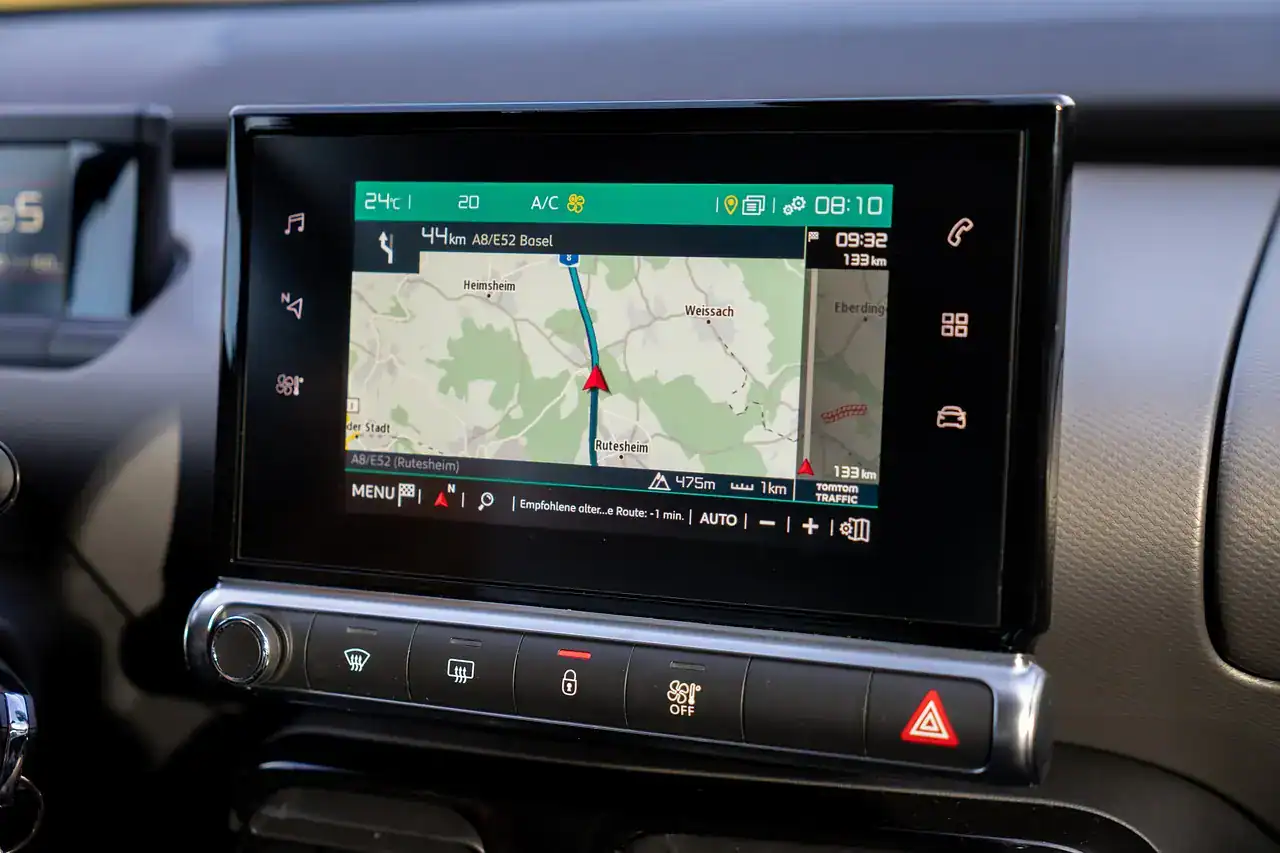
- Dedicated off-road units (Garmin Tread 2, Trail Tech Voyager Pro4): rugged, bright in sunlight, built for mounting and offline use, but the most expensive option.
- Handhelds (Garmin Montana 710i): carry anywhere on a rechargeable battery, but the screen is smaller than the 8-inch Tread 2.
- Phones and tablets with apps: cheap and flexible, but they depend on battery life, heat and a screen that may wash out in sun. See our onX Offroad vs Gaia GPS comparison and best off-road navigation apps.
- Built-in dash systems: usually tied to the maker's road maps and not designed for trails.
A dedicated unit does not need your phone battery or a signal, and it is easier to read with gloves on. A phone is a sensible backup, not a replacement, on any trip beyond cell coverage.
Voyager Pro4's spec list shows only about 2 hours of battery life on its own, per ADV Pulse, so plan on wiring it to vehicle power.
Before you rely on any GPS
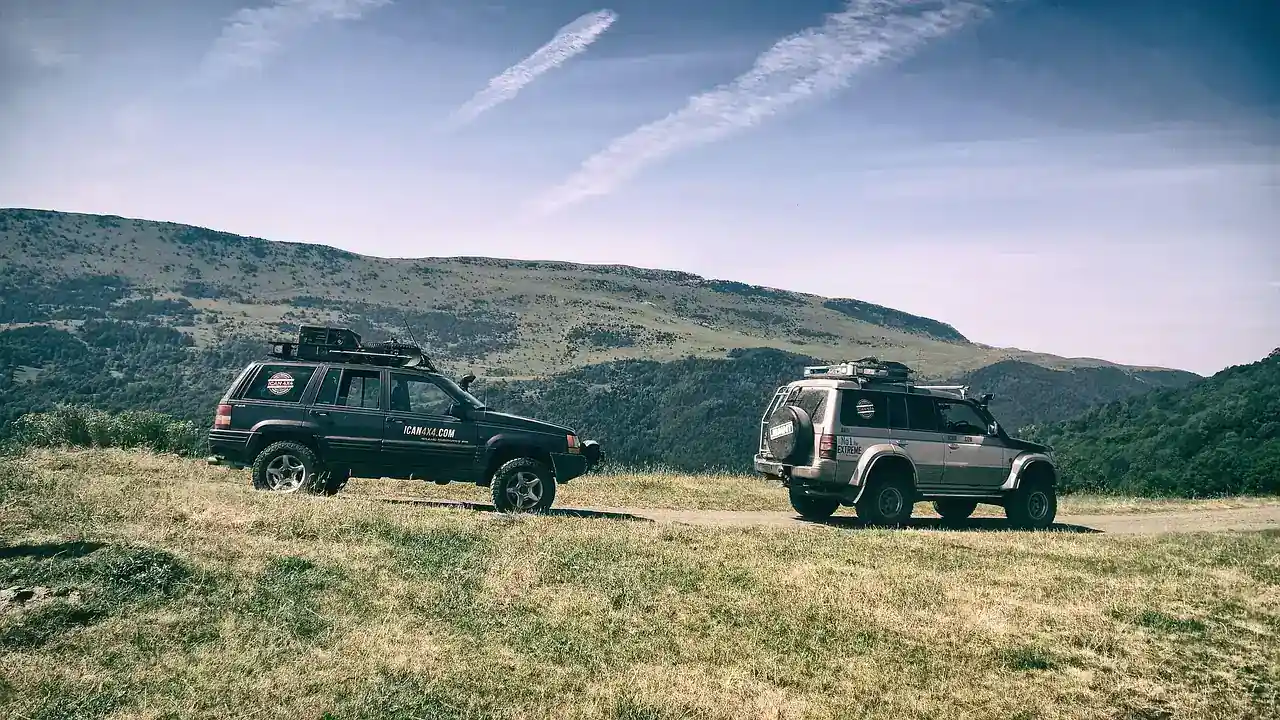
- Download maps and routes before you leave coverage.
- Carry a paper map or second device, and tell someone your route and return time.
- Check with the land manager (BLM, US Forest Service or the state OHV program) that the route is open to your vehicle, and for fire, season or gate restrictions.
- Scout obstacles on foot when unsure. A GPS shows a line on a map, not whether it is safe for your vehicle.
Our free off-road checklist covers the rest of the kit, and the free off-road calculators help with tire size, winch and angle questions before the trip.
FAQ
What is the best GPS for off-roading?
For overland vehicles, the Garmin Tread 2 Overland Edition. For UTVs, the Garmin Tread 2 SxS Edition, or the Trail Tech Voyager Pro4 if you ride with Polaris Ride Command vehicles. For hiking plus driving or built-in satellite messaging, the Garmin Montana 710i.
Can I use Google Maps for off-roading?
Only in a limited way. You can download offline areas, but it does not show trail status, land ownership or off-road routing, and many trails are not mapped. Use it as a backup, not your main navigator.
Do I need a dedicated GPS if I have a phone?
Not always. A phone with offline maps works for many drivers, but a dedicated unit is more rugged, easier to see in sun and does not depend on your phone battery.
Does the Garmin Tread 2 have satellite messaging?
Not built in. Garmin says it pairs with a compatible inReach device, and inReach needs an active subscription. The Montana 710i has inReach built in.
How do I know my GPS has failed?
Signs include a position that jumps or lags, no satellite lock, or a screen that freezes. Restart it, check the mount and power, update maps and software at home, and keep a backup navigation method on every trip.

I'm Suryashankar Dasgupta, the founder of Off-Road Handbook. I've been off-roading for years on mountain and desert terrain. I've also driven a Jeep Compass for more than seven years, so I know the day-to-day side of Jeep ownership first-hand, from the Uconnect screen to the warning lights. Every guide here is researched from manufacturer owner's manuals, NHTSA recall and service-bulletin records and other trusted sources, checked against them before it is published, and corrected when we find a mistake. You can read how we work in our editorial policy: https://offroadhandbook.com/editorial-policy/
Like our off-road guides? Add Off-Road Handbook as a Google Preferred Source so our latest Jeep, ATV, UTV, trail, recovery, and off-road troubleshooting articles can appear more often in your Google Search experience.
Add us as a Preferred Source