Why Does My Jeep Shake at 40 MPH? Common Causes and How to Fix
Last updated on October 20th, 2026 at 03:58 am
This post contains Amazon affiliate links. As an Amazon Associate I earn from qualifying purchases, at no extra cost to you.
A Jeep that shakes around 40 mph most often has an out-of-balance or damaged tire or wheel, mud packed in a wheel, or loose lug nuts. Stellantis's own diagnostic case for a 40 to 50 mph vibration starts with the tires and wheels, and prefers road-force balancing.
A violent shake that starts right after a bump is death wobble. Slow down gradually, pull over, and have the front end inspected before highway driving.
Check these in order
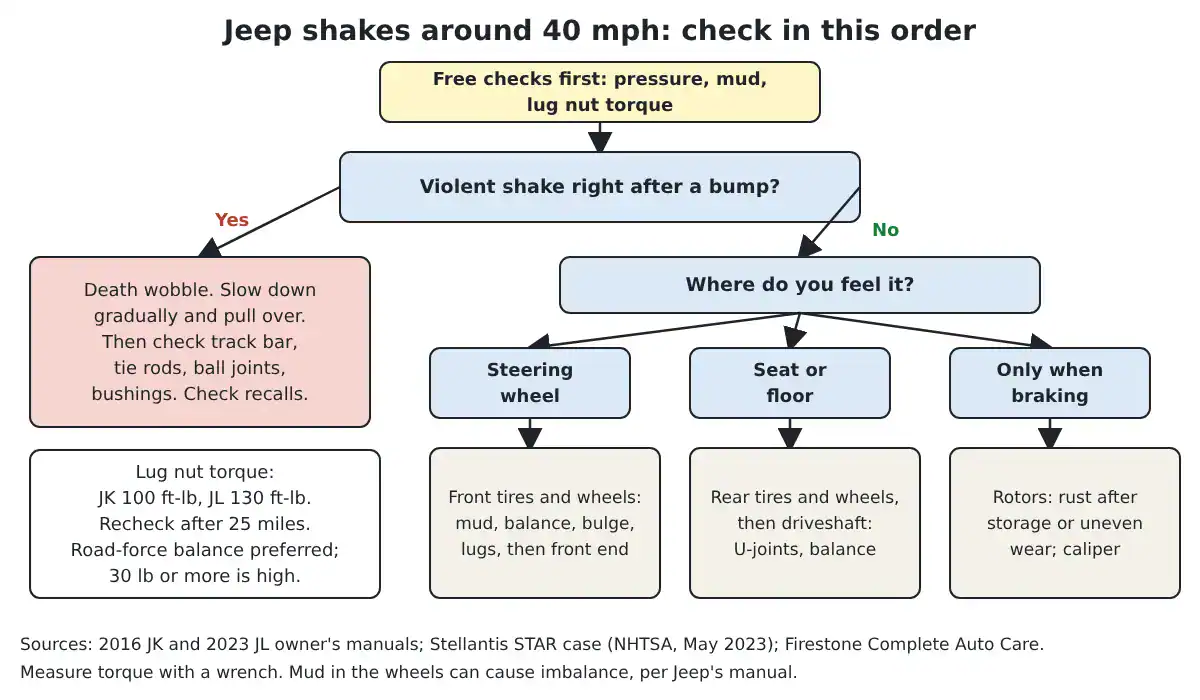
Free checks come first. Where you feel the shake narrows the search: Firestone says a front tire wobble is usually felt through the steering wheel, and a rear one in the seat or floorboard.
| What you feel | Check first | Likely cause | DIY or shop |
|---|---|---|---|
| Steady shake in the steering wheel around 40 to 60 mph | Tire pressure, mud in the wheels, then a road-force balance | Out-of-balance or damaged front tire or wheel | DIY checks, shop balance |
| Shake felt in the seat or floor | Rear tires and wheels, then the driveshaft | Rear tire imbalance, driveshaft imbalance or worn U-joint | DIY checks, shop repair |
| Shake only when braking | Rotors and calipers | Uneven rotors, or rust on the rotors after storage | Shop |
| Violent shake after hitting a bump | Front end: track bar, tie rods, ball joints, bushings. Check recalls | Death wobble | Shop |
| Started after a wheel was removed | Lug nut torque | Loose lug nuts | DIY |
| Started after a trail run | Look inside each wheel for packed mud | Impacted material causing imbalance | DIY |
Tires and wheels come first
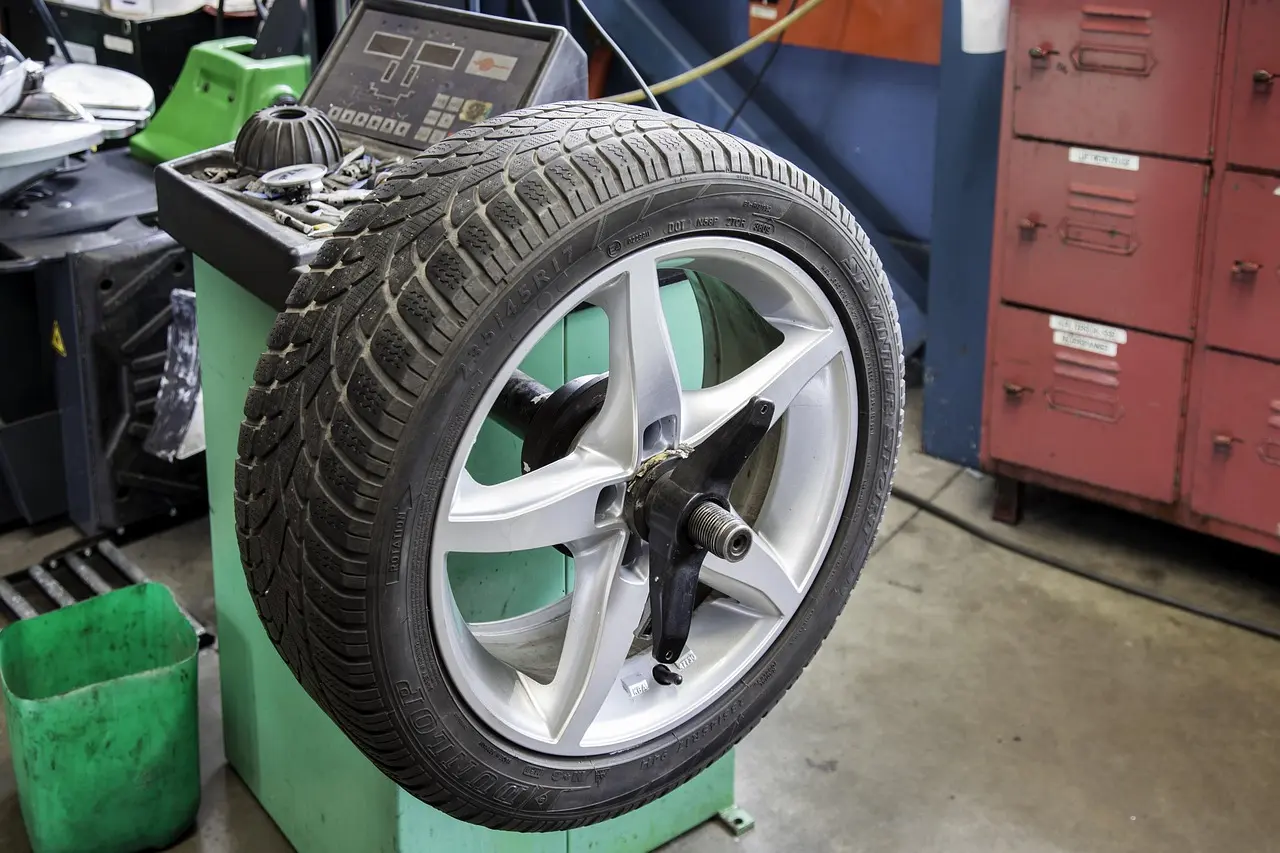
Jeep's manual has a one-line fix for a common trail problem. If you feel unusual vibration after driving in mud or slush, check the wheels for impacted material. Freeing the wheels of it corrects the imbalance.
- Set pressures to the placard on the door jamb.
- Inspect every sidewall for cuts, cracks and bulges, and the tread for uneven wear. A bulged tire needs replacing, not balancing.
- Clean packed mud from inside each wheel and look for a missing wheel weight.
- Have the wheels road-force balanced. Stellantis says road-force balancing is the preferred method, and that a reading of 30 lb or more is high and the tire should be evaluated for replacement.
Stellantis also says to put the lowest road-force tires on the front and the highest away from the driver in the rear. If it is still not fixed, it suggests swapping wheel assemblies with a known good vehicle that has the same tire.
Lug nut torque
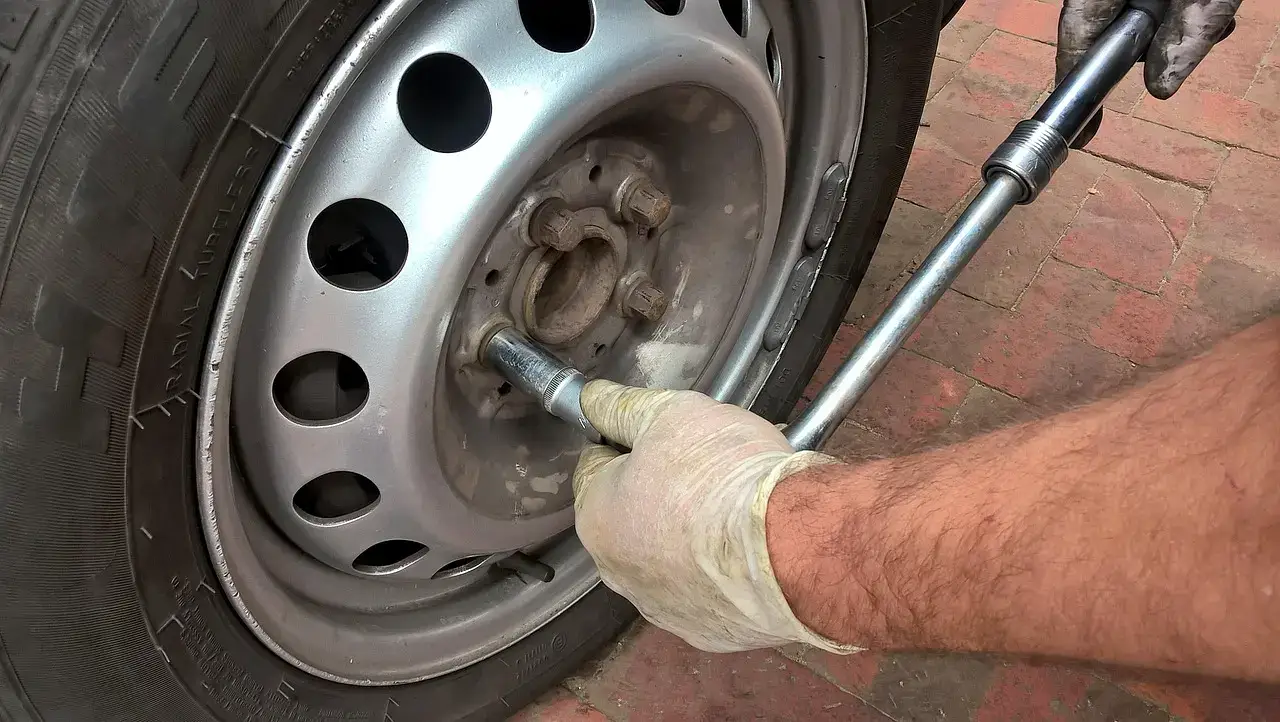
Loose lug nuts cause a wobble and are dangerous. The factory spec depends on the generation, and the old rule of thumb to recheck after 50 miles is not what Jeep says.
| Wrangler | Torque | Thread and socket | Recheck |
|---|---|---|---|
| JK (2016 manual) | 100 ft-lb (135 N·m) | ½"-20, 19 mm | After 25 miles |
| JL (2023 manual) | 130 ft-lb (176 N·m) | M14 x 1.50, 22 mm | After 25 miles |
Use a torque wrench and a deep socket in the right size. Search Amazon for a 22 mm deep socket or a 19 mm deep socket.
Death wobble
Death wobble is a violent shake of the front end, usually after a bump at highway speed. It is not a tire problem, and balancing will not cure it.
Parts retailer 4 Wheel Parts calls worn track bar bushings one of the most common causes. Two NHTSA recalls also involve the front axle area on newer Wranglers.
- Recall 18V675: certain 2018 to 2019 Wranglers may have improperly welded front track bar brackets that can separate from the frame, reducing steering ability. Dealers inspect and repair the welds free.
- Recall 20V042: certain 2020 Wranglers may have a lower control arm bracket and weld that is not correctly positioned. Dealers inspect the front axles and replace them as needed.
Enter your VIN at NHTSA's recall page to see what applies. A Stellantis bulletin on 2018 to 2020 JL steering feel (08-074-20) also states that its steering gear repair will not correct a sustained steering shake, shimmy or vibration.
If it starts while driving, slow down gradually and pull over safely. Avoid sudden steering and hard braking. Then have the track bar, tie rod ends, ball joints and bushings checked for play before you drive on the highway.
Decode the shake with a little math
Every tire and wheel turns at a speed set by its diameter. First-order vibration from an out-of-balance tire happens once per turn, and a driveshaft turns at wheel speed times the axle ratio, so the two show up at different frequencies. Tire Review shows the method.
At 40 mph, the first-order frequency is about 7.2 Hz on a 31 inch tire and about 6.4 Hz on a 35 inch tire. A driveshaft with 3.73 gears runs 3.73 times faster than that.
| Tire diameter | First-order Hz at 40 mph | Second-order Hz | Speed with the same wheel speed as 40 mph on 31 in tires |
|---|---|---|---|
| 31 in | 7.2 | 14.5 | 40.0 mph |
| 33 in | 6.8 | 13.6 | 42.6 mph |
| 35 in | 6.4 | 12.8 | 45.2 mph |
| 37 in | 6.1 | 12.1 | 47.7 mph |
This is why a shake that used to appear at 40 mph on stock tires moves higher after a tire swap. Use the decoder below to enter your own numbers.
Measure the real diameter of your tires, or use the tire size calculator to convert a tire size. Your axle ratio is on the regear calculator page.
Shake decoder
Based on the Tire Review method and Stellantis's published 4 to 7 Hz range. A shop vibration analyzer is needed to measure the real frequency.
Brakes and other causes
A shake only when braking points at the brakes. Jeep's manual notes that after you clean wheels with wheel cleaner and park for a long time, water droplets can leave red rust on the rotors, which causes vibration when braking. Drive and apply the brakes to remove it.
A lift or bigger tires change driveline angles and wheel balance. See Jeep problems after a lift kit. If you only shake in four-wheel drive, read why a truck shakes in 4WD.
Is it safe to drive?
A mild shake from tire imbalance is not an emergency, but it wears tires and steering parts, so fix it soon. Do not keep driving with loose lug nuts, a bulging tire or death wobble.
FAQ
Most often an out-of-balance or damaged tire or wheel, mud packed in a wheel, or loose lug nuts. A shake right after a bump is death wobble and needs the front end inspected.
Jeep's manuals give 100 ft-lb for the 2016 JK and 130 ft-lb for the 2023 JL. Recheck after 25 miles.
No. Death wobble comes from looseness or wear in the front end. Balancing helps a tire or wheel shake, not that.
Larger tires turn more slowly at the same speed, so a wheel-speed shake appears at a higher speed. A 33 inch tire moves a 40 mph shake on 31 inch tires to about 42.6 mph.
Related guides
- Jeep problems after a lift kit
- Jeep noises after off-roading
- Why a truck shakes in 4WD
- Tire size calculator

I'm Suryashankar Dasgupta, the founder of Off-Road Handbook. I've been off-roading for years in the USA, including California and Texas, and have ridden mountain and desert terrain abroad. I've also driven a Jeep Compass for more than seven years, so I know the day-to-day side of Jeep ownership first-hand, from the Uconnect screen to the warning lights. Every guide here is researched from manufacturer owner's manuals, NHTSA recall and service-bulletin records and other trusted sources, checked against them before it is published, and corrected when we find a mistake. You can read how we work in our editorial policy: https://offroadhandbook.com/editorial-policy/
Like our off-road guides? Add Off-Road Handbook as a Google Preferred Source so our latest Jeep, ATV, UTV, trail, recovery, and off-road troubleshooting articles can appear more often in your Google Search experience.
Add us as a Preferred Source