Odes Dominator 800 Problems: Causes, Fault Codes and Fixes
Last updated on October 17th, 2026 at 12:32 pm
The most common Odes Dominator 800 problems are overheating, hard starting or a fuel pump circuit that won't prime, CVT belt slip, brake squeal, tire leaks, worn wheel bearings and a weak starting circuit. Start with the coolant level, radiator fins and fan, because heat does the most damage. ODES's own manual says to stop the engine when the coolant light comes on, which means the coolant is above 102°C (216°F).
The checks below come from the ODES owner's manual for the 800cc Dominator X (2-door and 4-door), UTVGuide's archived spec sheet and owner reports where noted. The manual copy is hosted by a New Zealand ODES dealer, and details can differ by model year, so match every step to the manual that came with your machine.
Odes Dominator 800 problems at a glance
This table is the quick version. Each row is covered in the sections that follow, with free checks first and dealer-only work last.
| Symptom | Most likely cause | First check | Fix or next step |
|---|---|---|---|
| Coolant light on, hot cab, boiling over | Low coolant, mud-packed radiator, fan circuit, trapped air | Cold coolant level between MIN and MAX | Top up, rinse fins, check fuse 3, bleed air; dealer pressure test if it repeats |
| Cranks, won't start or stalls | Fuel pump circuit, main relay, plugs, air filter | Pump hum at key-on, then fuse 6 | Replace fuse or relay; dealer reads fault codes if the check-engine light stays on |
| Clicks or dead dash | Weak battery, dirty or loose cables | Battery voltage and cable ends | Charge or replace, clean terminals, jump-start per manual |
| Won't shut off | Possible stuck relay (owner reports) | Key counterclockwise to the off position | Pull the negative battery cable to stop it, then dealer |
| Won't pass about 25 mph | Owner-reported low-speed (LSV) connector, or belt and fuel problems | Connector under the hood | Confirm with a dealer before changing any wiring |
| Slipping, jerky, slow in High | Worn or glazed belt, water in the CVT, wrong range | CVT cover drain screw, range used | Drain water, use Low for loads, dealer belt check |
| Brake squeal or grind | Worn or glazed pads, wet brakes after washing | Visual pad check | Replace pads; dry the brakes with slow stops after washing |
| Slow tire leak | Bead, valve stem or puncture | Soapy water on the bead and valve | Reseat, replace the valve stem or plug |
| Wheel hum or play | Water-washed wheel bearing | Wheel play with the wheel lifted | Replace the bearing (press needed) |
Anything marked as an owner report comes from forum threads, not from ODES. Those are leads to check, not confirmed factory fixes.
Odes Dominator 800 symptom checker
Pick what your Dominator 800 is doing. The tool lists the checks in order: free ones first, dealer work last.
Every line in the tool comes from the manual or the owner threads cited in this guide. It is a diagnosis order, not a repair manual, so stop and call a dealer when a step says to.
"Dealer" in the checker means work that needs the ODES diagnostic tester, a pressure tester or a bearing press. Everything above that line you can do in the driveway with a hose, a wrench and a multimeter.
Overheating: the problem to fix first
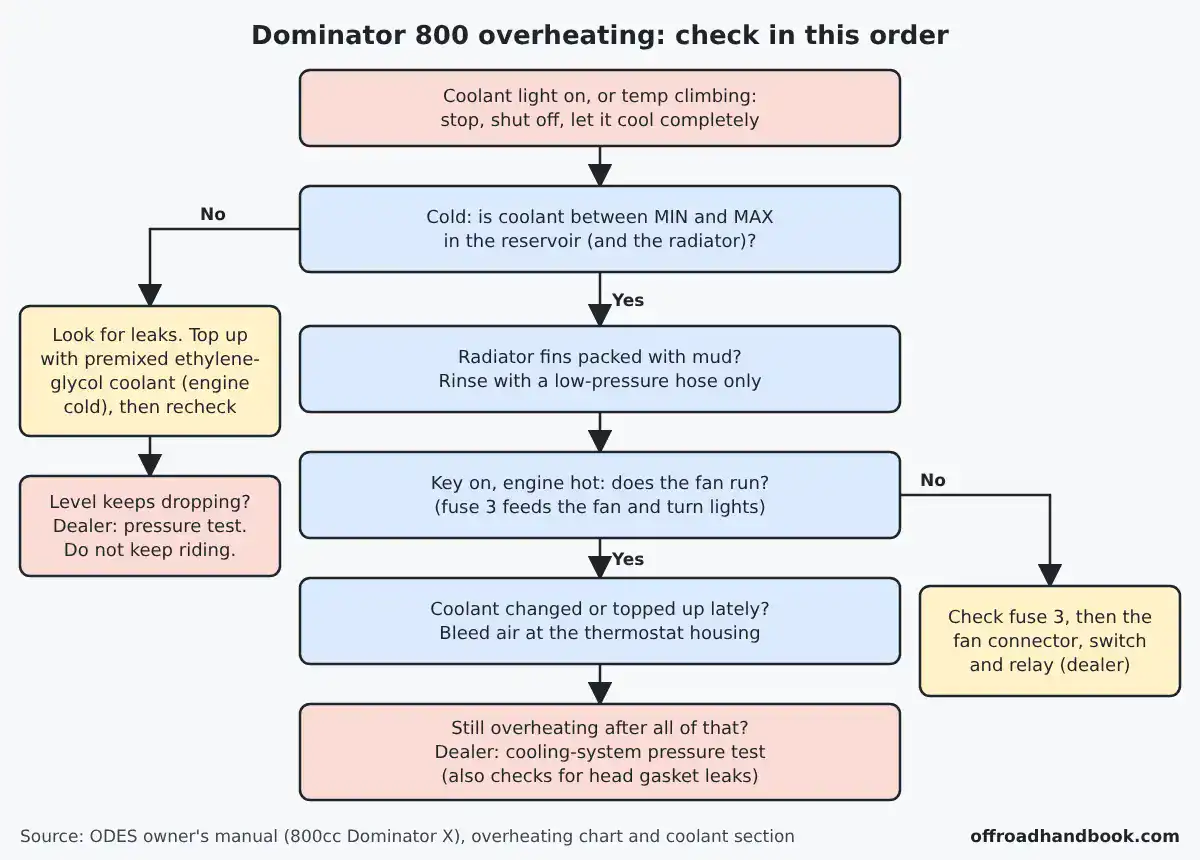
The dash coolant light comes on when coolant temperature passes 102°C (216°F). ODES says to stop the engine right away, check the coolant level and add coolant if it is low. If the light stays on with a full overflow tank, the manual says to see a dealer.
Check the coolant level cold
Wait until the engine is cold. The reservoir level should sit between MIN and MAX on a level surface. The manual says it can read slightly below MIN when it is colder than 20°C (68°F), so top up to MAX only if needed.
Use premixed ethylene-glycol antifreeze with corrosion inhibitors for aluminum engines. Never open the radiator cap on a hot engine. ODES says to use a thick rag and let pressure escape first. A system that keeps needing coolant has a leak or an engine problem.
Clean the radiator fins
Mud, leaves and grass block airflow. Pull off what you can by hand, then rinse with low-pressure water only. The manual warns not to use tools that bend the fins and not to clean a hot radiator.
Confirm the fan runs
With the engine hot, the fan should cycle on. The manual's fuse chart shows the fan sharing fuse 3 with the turn lights, so a dead fan with working turn signals points away from that fuse. The fan switch temperature isn't published in the manual copy opened for this guide.
Some owners add a manual fan switch. ODES doesn't document one, and bypassing the ECU-controlled circuit hides the real fault, so find the cause instead.
Bleed air after a coolant change
The manual's refill method: drain through the plug, open the bleed screw on top of the thermostat housing, and fill until coolant flows out of that hole. Then fill the radiator, run the engine at idle with the cap off and blip the throttle two or three times. Top up and refit the cap.
When to stop and see a dealer
Repeated overheating with a full system, steady coolant loss with no visible leak, white exhaust smoke or milky oil all call for a cooling-system pressure test. ODES lists that test as dealer work. Riding on an overheated engine is how a head gasket or cylinder gets ruined.
Won't start, stalls or hard starting
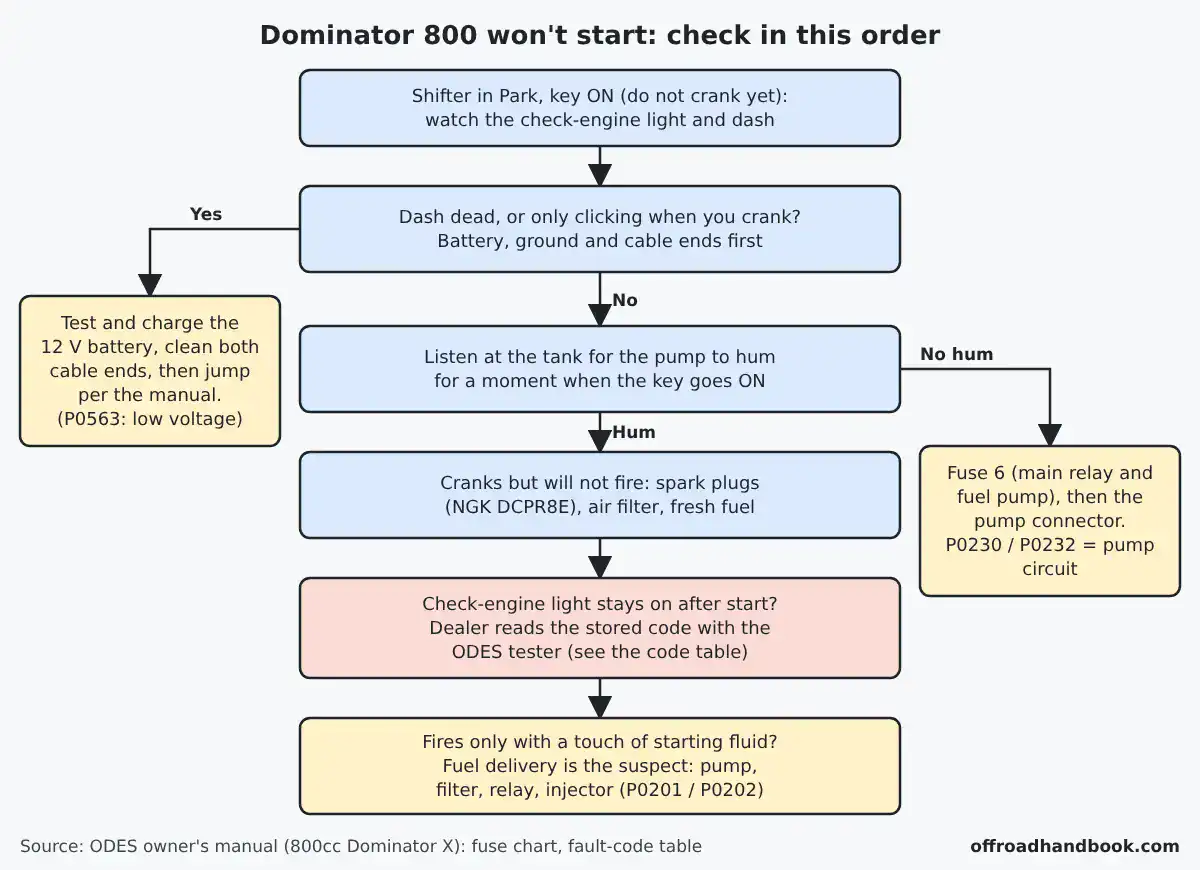
Start in Park only, as the manual says. Turn the key to ON without cranking. The check-engine light should come on, then go out after the engine starts. If it stays lit while running, the ECU has stored a fault.
Fuel pump and relay
Listen near the tank for the pump to hum for a moment at key-on. That prime sound is typical of fuel-injected engines, though the manual doesn't describe it. No sound means checking fuse 6, which the manual's chart shows feeding the main relay and the fuel pump.
Don't test the pump by pulling a fuel line and cranking. Spraying gasoline near a hot engine is a fire risk, and the fault-code table below can flag a pump circuit fault without it.
| Fuse (manual's number) | Circuits it protects |
|---|---|
| 1 | Headlights, 2/4 conversion motor, gear indicator, display |
| 2 | Brake light, ECU, speed sensor, 2/4 relay |
| 3 | Fan, turn lights |
| 4 | ECU, EPS (power steering) |
| 5 | Headlight, top light |
| 6 | Main relay, fuel pump |
| 7 | Emergency power supply, electric bed lifter, horn |
Fuse 4 feeds the ECU and the power steering together. A steering problem and a no-start at the same moment often trace back to that one circuit, which is worth a look before anything expensive.
Spark, air and fuel quality
If the pump hums and the engine cranks without firing, check the plugs (the manual lists NGK DCPR8E), the air filter and the fuel. The manual calls for unleaded gasoline rated '93# or higher'. That is an international octane label, so use the octane your dealer confirms.
One UTV Board owner whose 2013 machine started only with a touch of starting fluid had already replaced plugs and filters. That pattern points to fuel delivery, not spark, but the thread never reached a confirmed fix (owner thread).
Cranking limits and weak batteries
The manual limits cranking to 5 seconds at a time, with at least 5 seconds between tries, to protect the starter. The battery is sealed, so there is no water to add. If it is flat, charge it or jump-start it as the manual describes.
Clicking with a dead dash points to the battery, the ground or the cable ends before it points to the starter. Clean and tighten both cable ends first.
It won't shut off
The manual's pre-ride check is to turn the key counterclockwise and confirm the engine stops. Two owners of 2015 and 2016 X models reported engines that kept running with the display on, one suspecting a stuck relay (owner thread). That is unconfirmed. Disconnecting the negative battery cable stops the engine; then have the circuit tested.
Fault codes and the check-engine light
The Dominator 800's ECU stores codes, and the manual lists them. To read them, remove the upper engine hood cover, find the diagnostic connector beside the ECU, unplug its protector and connect ODES's fault diagnosis tester with the special data cable.
The manual doesn't say a generic OBD-II scan tool will work, so confirm that with a dealer before buying one. Clear codes only after the repair is done.
| Code | What the manual says it means |
|---|---|
| P0031 / P0032 | Cylinder 1 oxygen sensor heater: short to ground / short to power |
| P0037 / P0038 | Cylinder 2 oxygen sensor heater: short to ground / short to power |
| P0107 / P0108 | Intake manifold pressure sensor: short to ground or disconnected / short to power |
| P0112 / P0113 | Intake air temperature sensor: short to ground or disconnected / short to power |
| P0117 / P0118 | Coolant temperature sensor: short to ground / short to power or disconnected |
| P0122 / P0123 | Throttle position sensor: short to ground or disconnected / short to power |
| P0131 / P0132 | Cylinder 1 oxygen sensor: short to ground / short to power |
| P0137 / P0138 | Cylinder 2 oxygen sensor: short to ground / short to power |
| P0201 / P0202 | Injector, cylinder 1 / cylinder 2, damaged |
| P0230 / P0232 | Fuel pump: short to ground or disconnected / short to power |
| P0336 / P0337 | Crankshaft position sensor: signal disturbed / no signal |
| P0351 / P0352 | Ignition coil, cylinder 1 / cylinder 2, damaged |
| P0505 | Air bypass valve damaged |
| P0562 / P0563 | Power supply voltage too high / too low |
| P0650 | Engine indicator lamp damaged |
| P1693 / P1694 | Speed gauge signal: short to ground / short to power |
A coolant temperature sensor code (P0117 or P0118) matters on an overheating machine, because a bad sensor can leave the fan without a correct signal. Test the sensor circuit before replacing the fan.
CVT slipping, jerky shifts and slow acceleration
The shifter runs L, H, N, R, P. The manual says to start only in Park and to stop fully before shifting to reverse. For heavy loads or towing, it says to stay in low range.
Slipping or weak pull in High usually comes from a worn or glazed belt, a wet CVT or the wrong range for the load. ODES says to have a dealer check the width and condition of the drive belt. It doesn't publish a belt-width limit in the copy opened here.
A 2016 owner described a knock at idle with jerky forward and reverse motion and wondered about the belt. The thread had no confirmed answer. Treat that combination as a dealer inspection, not a guess.
After mud or water: CVT, radiator and bearings
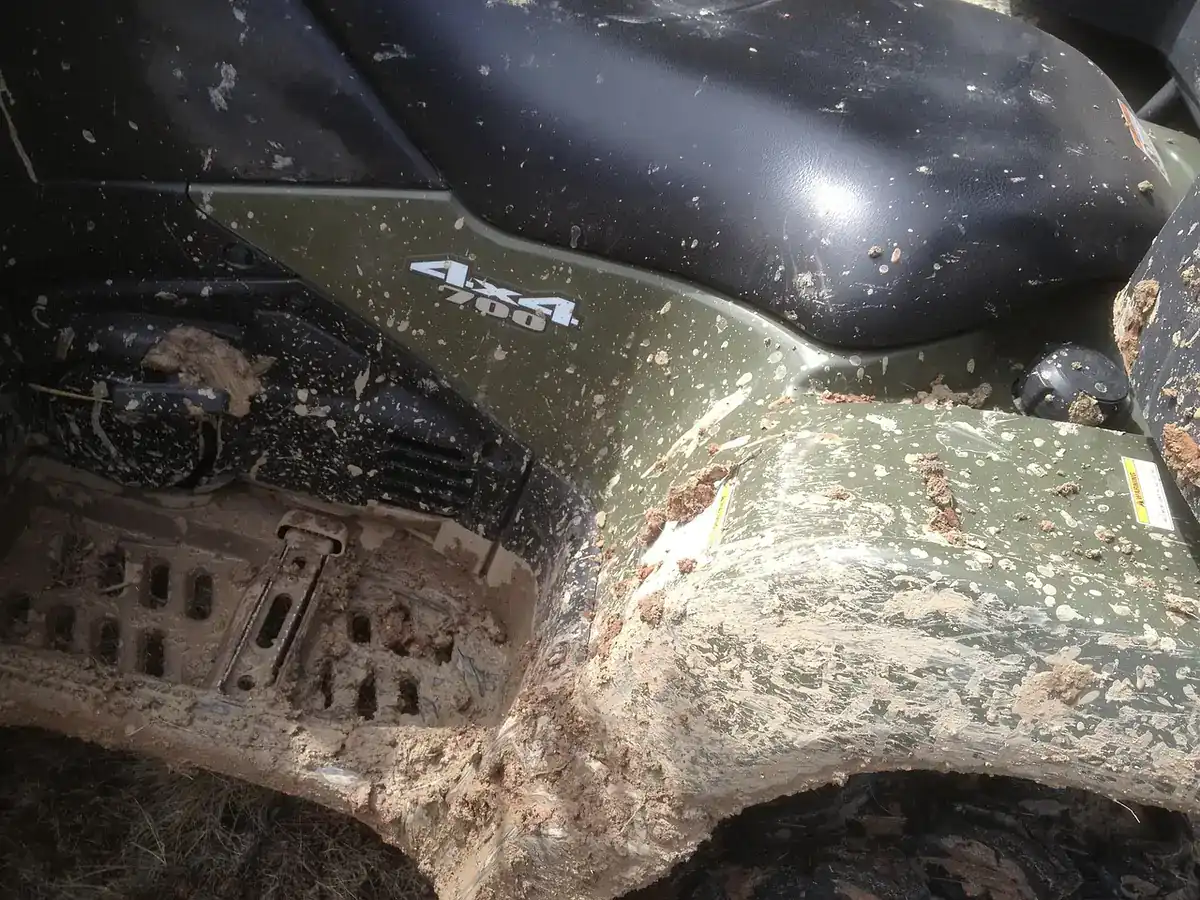
Any time you suspect water got into the CVT cover, ODES says to drain it by removing the CVT cover drain screw. Do that after every deep crossing. For an engine that swallowed water, see our hydrolock guide before cranking it.
The manual's cleaning section warns that high-pressure washing pushes water past wheel bearings, brake parts, transmission seals and electrical connectors. Wash with a garden hose and warm soapy water, plug the exhaust outlet first, and test the brakes at low speed afterward.
A humming or grinding wheel, play when the lifted wheel is rocked or vibration all point to a wheel bearing. Replacing one needs a press, so a shop is the practical route if you don't have one.
Hot cab
ODES's manual doesn't address cab heat. UTVGuide notes that the original two-door machine used a two-fan arrangement, one at the radiator and one moving air through the engine area, and that it doesn't replace a clean radiator and a healthy cooling system.
Owners commonly drive with half doors or no doors in summer and add small cab fans. Those are owner workarounds, not factory fixes. A cab that is getting hotter than it used to is a cooling system problem first.
Brakes and tires
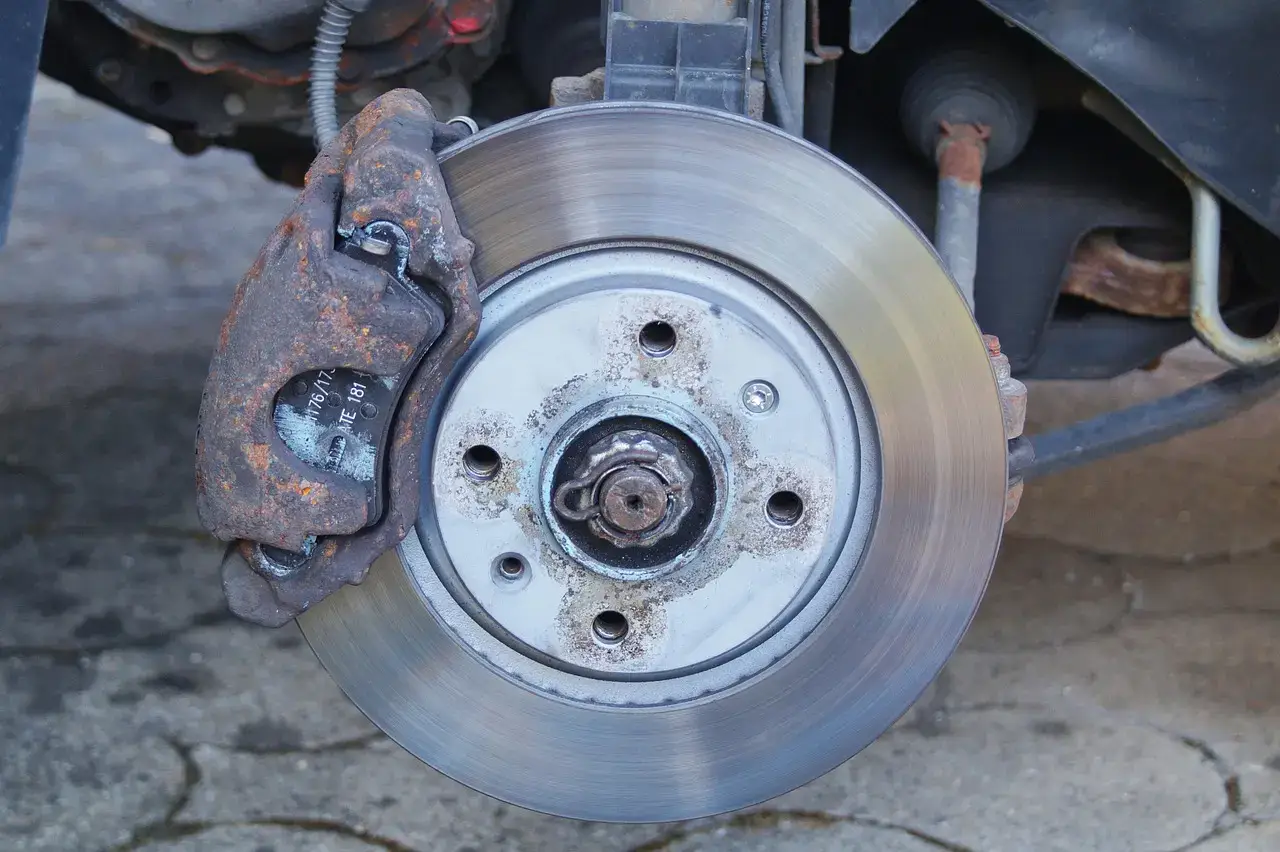
Squealing usually means worn or glazed pads or trail grit between the pad and rotor. A grinding sound means the pad may be down to the backing plate, so replace the pads right away. Never put grease or oil on pads or rotors.
The manual says the parking brake acts on the rear wheels only. To have it hold all four wheels, shift to 4WD before stopping the engine. On a slope, that detail matters.
Tire pressure from the manual is below. Check it cold and keep both sides equal. Slow leaks usually come from a bead that isn't sealing on a dented rim, a valve stem or a puncture, which soapy water will show.
| Item | ODES manual figure |
|---|---|
| Recommended tire pressure, front and rear | 70 kPa (10.2 psi) |
| Allowed range | 63 to 77 kPa (9 to 11 psi) |
| Tire size | 27x9-14 front, 27x11-14 rear |
| Replace tire when tread groove reaches | 6 mm (0.24 in) |
| Wheel nut torque, front and rear | 64 N·m (47 ft-lb) |
The manual says to check chassis fittings for tightness before every ride and to use the service manual or a dealer for other torque values. Only the wheel nut torque is published in the copy opened for this guide.
Dominator 800 specs: what the manual actually says
Many spec lists online mix up the 800 with the 1000 and mix units. The table uses the manual for dimensions and capacities and UTVGuide's archived ODES material for power, and it labels which is which.
| Spec | Value | Source |
|---|---|---|
| Engine | 800-class EFI four-stroke V-twin, liquid-cooled | UTVGuide |
| Claimed power and torque | 60 hp; 73 N·m (about 54 lb-ft) at 4,000 rpm | UTVGuide |
| Claimed top speed | 63 mph (manufacturer claim, not measured) | UTVGuide |
| Drive | 2WD/4WD switch and a diff-lock switch, shaft drive | Manual |
| Fuel tank | 24.5 L (6.5 gal), unleaded '93# or higher' | Manual |
| Spark plug | NGK DCPR8E | Manual |
| Engine oil | 5W-30 mineral all-season; 10W-40 mineral on the hottest days; 5W-40 synthetic optional; API SM, SL or SJ | Manual |
| Final gear case oil | 2.2 L (about 2.3 qt) of XP-S chain case oil or equivalent | Manual |
| Width / ground clearance | 1,730 mm (68.1 in) / 285 mm (11.2 in) | Manual |
| Wheelbase | 1,900 mm (74.8 in) 2-door; 2,700 mm (106.3 in) 4-door | Manual |
| Weight with fluids and full tank | 658 kg (1,451 lb) 2-door; 765 kg (1,687 lb) 4-door | Manual |
Three figures that older guides get wrong: ODES lists torque as 73 N·m, not 73 lb-ft. The fuel tank is 24.5 L (6.5 gallons), not 9. The body is 68 inches wide, not 64.
Coolant should be replaced every 24 months per the manual's chart, with coolant strength checked every 100 hours. Check oil level every ride. Dealers do valve checks and the cooling-system pressure test.
Is a used Dominator 800 worth buying?
The power-for-the-price appeal is real, but dealer and parts support varies by area, so confirm a local dealer before you buy. ODES UTVS LLC lists a warranty department at 888-572-8428 in the manual, and its emissions warranty on engines of 975 cc and under runs 2.5 years or 5,000 km for emissions-related parts such as electronic controls and fuel injection.
| Check before buying | What you want to see |
|---|---|
| Cold start, then run until the fan cycles | Fan comes on, no coolant light, level stable afterward |
| Check-engine light at key-on | Lights up, then goes out after starting |
| Coolant condition and reservoir level | Between MIN and MAX, no oily or rusty look |
| CVT cover drain screw | No water or belt dust pouring out |
| Steering feel with the engine running | Not stiff (an owner thread flagged stiff power steering on a 2016 X4) |
| Rock each wheel | No play or hum; bearings not worn |
| Service records | Coolant changes at least every 24 months |
If a machine fails the fan or coolant check, walk away or price in a dealer pressure test.
FAQ
What engine does the Odes Dominator 800 have?
An 800-class fuel-injected, liquid-cooled four-stroke V-twin. ODES's archived figures are 60 hp and 73 N·m (about 54 lb-ft) at 4,000 rpm. Those are manufacturer claims, not measured numbers.
Why does my Odes Dominator 800 overheat?
Low coolant, a radiator packed with mud, a fan circuit problem or trapped air after a coolant change are the checks to run, in that order. If the coolant light keeps coming on with a full system, a dealer should pressure-test it.
Can I read Dominator 800 fault codes myself?
The manual describes reading codes with ODES's fault diagnosis tester and special data cable at the connector beside the ECU. It doesn't say whether a generic OBD-II reader works, so ask a dealer first.
Why won't my Dominator 800 go faster than about 25 mph?
A reply on UTV Board for a 2021 machine pointed to a low-speed vehicle connector under the hood and said to keep it unplugged for full speed (owner thread). That is not in the manual. Ask a dealer before changing wiring.
What oil does the Odes Dominator 800 take?
The manual lists 5W-30 mineral oil for all seasons, 10W-40 mineral on the hottest days and 5W-40 synthetic as an upgrade, meeting API SM, SL or SJ. It doesn't give an engine oil capacity in the copy opened here, so use the dipstick.
Related guides
- ATV and UTV troubleshooting for bogging, no-start, heat and belts
- Tracker 800 SX problems and fixes
- Kawasaki Mule 4010 problems and fixes
- free off-road calculators

I'm Suryashankar Dasgupta, the founder of Off-Road Handbook. I've been off-roading for years in the USA, including California and Texas, and have ridden mountain and desert terrain abroad. I've also driven a Jeep Compass for more than seven years, so I know the day-to-day side of Jeep ownership first-hand, from the Uconnect screen to the warning lights. Every guide here is researched from manufacturer owner's manuals, NHTSA recall and service-bulletin records and other trusted sources, checked against them before it is published, and corrected when we find a mistake. You can read how we work in our editorial policy: https://offroadhandbook.com/editorial-policy/
Like our off-road guides? Add Off-Road Handbook as a Google Preferred Source so our latest Jeep, ATV, UTV, trail, recovery, and off-road troubleshooting articles can appear more often in your Google Search experience.
Add us as a Preferred Source