Horsepower Loss at Altitude: Turbo vs Non-Turbo on High Trails
This post contains Amazon affiliate links. As an Amazon Associate I earn from qualifying purchases, at no extra cost to you.
A non-turbo gas engine loses roughly a quarter of its power at 10,000 feet and about a third on a 13,000-foot Colorado pass, because each breath of thinner air holds less oxygen. By air density, that's about 11% gone in Moab, 15% in Denver and 32% at Engineer Pass on a standard day, and more when it's hot. Turbocharged engines hold most of their rated power, because the computer raises boost to make up for the thin air until the turbo runs out of headroom.
Plug your own engine and destination into the calculator below. It also shows how much Ford says to cut your towing weight and how far your tire gauge will drift on the climb.
Altitude Horsepower Loss Calculator (Non-Turbo vs Turbo)
Pick a trail from the list or type an elevation. Add the air temperature if you know it, since a hot afternoon thins the air as much as a few thousand extra feet.
The factory figure (SAE net), treated as sea-level power.
Hot air is thinner. Blank uses the standard-day temperature for that elevation.
How it works: the tool finds outside air pressure from the NASA Glenn standard-atmosphere equations, turns that into air density (pressure divided by absolute temperature) and scales your rated horsepower by it. That's a fair estimate of full-throttle power for a non-turbo engine. Real engines vary with tuning and fuel, so treat the result as an estimate, not a dyno number.
It ignores humidity and weather swings in barometric pressure, and it doesn't try to model your exact turbo. Factory horsepower is measured in reference air of 77°F and 29.23 inHg of dry air under SAE J1349, which is close to sea-level air, so the tool treats your rated figure as sea-level power.
How Much Power You Lose on Popular High Trails
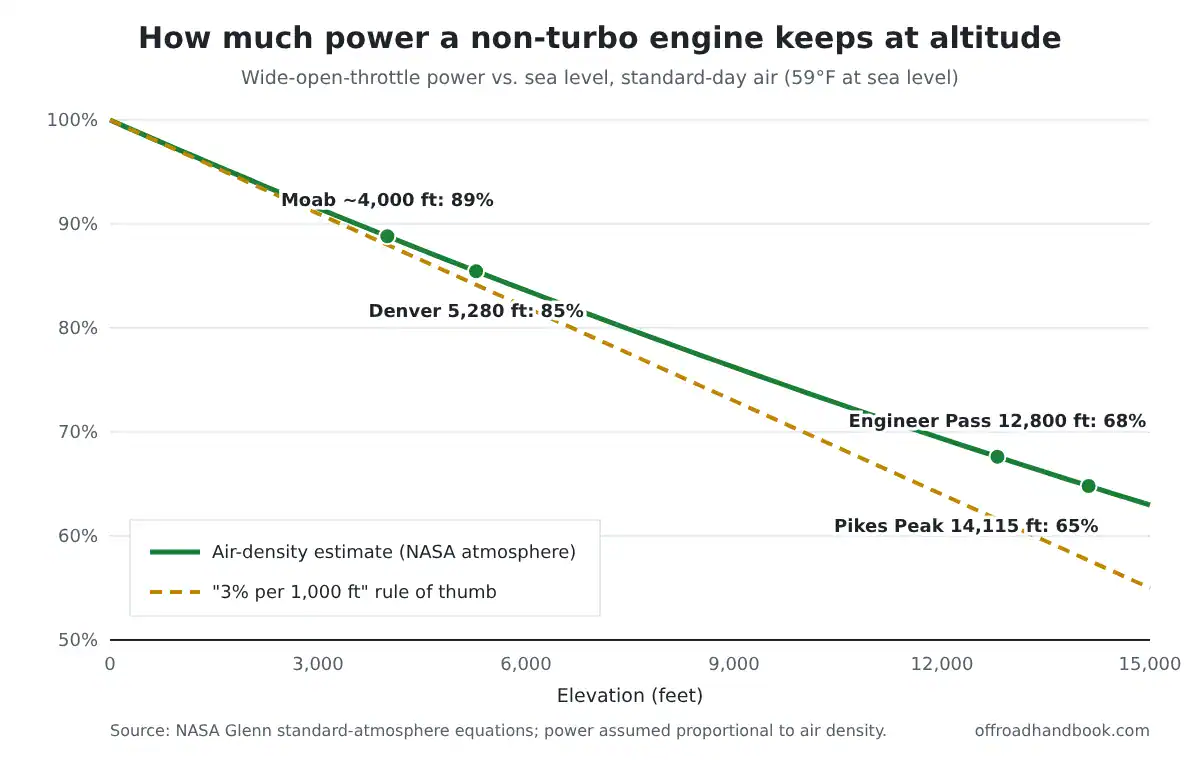
The table runs the same math for a 300 hp non-turbo engine on a standard day. Swap in your own rated horsepower with the calculator. The percentage column works for any non-turbo engine.
| Place | Elevation | Air pressure | Power kept | 300 hp becomes | "3% rule" says |
|---|---|---|---|---|---|
| Sea level | 0 ft | 14.7 psi | 100% | 300 hp | 300 hp |
| Moab, UT (town) | about 4,000 ft | 12.7 psi | 89% | 266 hp | 264 hp |
| Denver, CO | 5,280 ft | 12.1 psi | 85% | 256 hp | 252 hp |
| Generic high trail | 8,000 ft | 10.9 psi | 79% | 236 hp | 228 hp |
| Generic high trail | 10,000 ft | 10.1 psi | 74% | 222 hp | 210 hp |
| Engineer Pass, CO (Alpine Loop) | 12,800 ft | 9.1 psi | 68% | 203 hp | 185 hp |
| Imogene Pass, CO | 13,114 ft | 9.0 psi | 67% | 201 hp | 182 hp |
| Pikes Peak summit, CO | 14,115 ft | 8.6 psi | 65% | 194 hp | 173 hp |
Temperature matters more than most people expect. At Denver on a 90°F afternoon, the same engine keeps about 78% of its power instead of 85%. A 60°F summer day at 12,800 ft drops it to about 62%, compared with the 68% standard-day figure in the table, because standard-day air at that height is only about 13°F.
Pilots call that combined effect "density altitude": hot air at a given height behaves like colder air higher up. That's why your rig can feel noticeably weaker on a July climb than it did on the same pass in September.
Why the "3% per 1,000 Feet" Rule Overshoots Up High
The classic shortcut is that a non-turbo engine loses about 3% per 1,000 ft. Garrett repeats that number in THE SHOP's piece on turbocharging at elevation. Nissan's owner's manual uses about 4% per 1,000 ft, according to Cars.com.
A straight line can't match the atmosphere, though. Air pressure drops fastest near sea level and more slowly as you climb, and the air also gets colder, which partly offsets the pressure drop. On a standard day the density math gives about 2.8% loss for the first 1,000 ft and about 2.5% per 1,000 ft on average from sea level to Pikes Peak.
The result: the 3% rule is close enough below about 6,000 ft, but at 14,115 ft it predicts a 42% loss where the density estimate says about 35%. On a hot day the real number moves back toward the rule, which is why a single percentage never fits every trip.
Some online calculators use the SAE dyno correction formula instead. That formula was written for small weather corrections: SAE J1349 lists its intended range as 900 to 1,050 mb of dry air pressure and 59 to 95°F (source). On a standard day you pass 900 mb at roughly 3,300 ft, so it was never meant for a 12,000-foot pass.
Turbo vs Non-Turbo Engines at Altitude
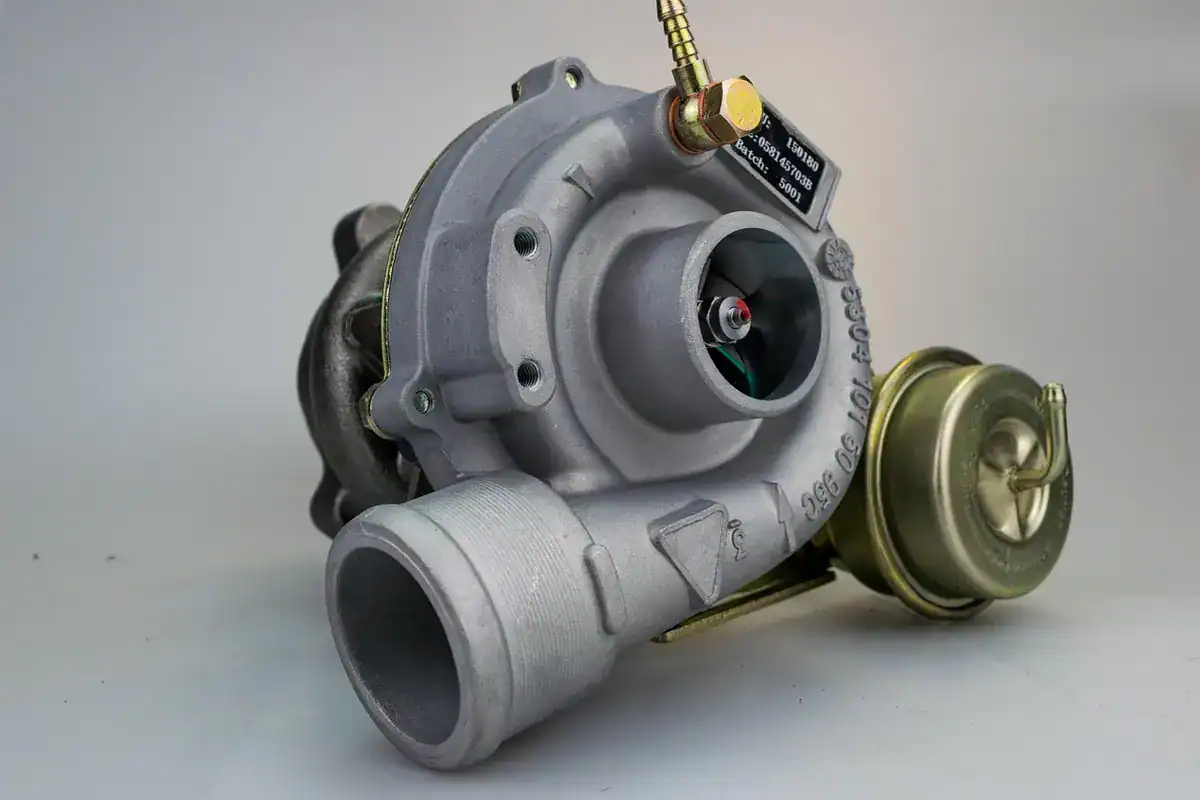
A turbocharger compresses intake air before it reaches the cylinders. At altitude, the engine computer raises boost to make up for the lower air density, so the engine can make close to its sea-level power. That holds "as long as the turbocharger can support the additional air volume and shaft speed," as THE SHOP's Garrett-based article puts it.
Every turbo has a ceiling, though. As the air thins, the compressor has to work at a higher pressure ratio, and the turbo spins faster. Push it far enough and the turbo can't safely spin any faster, so boost stops keeping up with the thinning air. Past that point the engine loses power like a non-turbo engine, just starting from a higher baseline.
For a factory turbo 4x4, that usually means most of the rated power is still there on a Colorado pass, though the turbo is working harder to deliver it. Where the ceiling sits depends on the turbo and the engine tune, so the calculator gives a turbo floor, not a precise number.
Towing at Altitude: What Ford, Jeep, Ram and Toyota Say
Automakers don't agree on whether thin air should lower your towing limits. Ford tells owners to cut weight. Others say their ratings already have enough reserve. Here's what each one actually publishes.
| Brand | What the manual or company says about altitude | Source |
|---|---|---|
| Ford | Reduce gross vehicle weight (GVW) and gross combination weight (GCW) by 2% per 1,000 ft of elevation "to match driving performance as perceived at sea level." Older F-150 manuals start counting at 1,000 ft. | Ford 2024 Towing Basics guide; Cars.com (F-150 manual quote) |
| Jeep (Wrangler JL) | No altitude reduction for GCWR in the towing section. The only altitude note: Stop/Start won't shut the engine off at high altitude. | 2026 Wrangler owner's manual |
| Ram (1500) | No altitude reduction in the 2026 manual. Ram told Cars.com it does "not reduce the towing or payload capabilities" as elevation increases. | 2026 Ram 1500 owner's manual; Cars.com |
| Toyota (Tacoma, Tundra) | No altitude note in the 3.5L V6 Tacoma manual. Toyota told Cars.com the Tundra's towing capacity is not affected by altitude. | Tacoma owner's manual OM04037U; Cars.com |
| Chevrolet | No altitude rule quoted. GM told Cars.com its trucks have "sufficient reserve" for their rated loads. | Cars.com |
| Nissan | The manual says an engine loses about 4% of its performance per 1,000 ft, but Nissan places no altitude limit on GCWR. | Cars.com |
I put this table together by searching the full text of the 2026 Wrangler and 2026 Ram 1500 owner's manuals and a Tacoma manual for "altitude" and "elevation". Only Ford's towing guide gives an actual percentage. GM, Ram, Toyota and Nissan's positions come from their statements to Cars.com, which date from 2016.
Even where your manual doesn't lower the rating, the engine still has less power up high. With a non-turbo V6 at 85% power in Denver, a trailer at your max Wrangler towing capacity will climb grades slower, and the engine and transmission will run hotter.
Practical moves: drop a gear early on long climbs rather than letting the transmission hunt, watch the temperature gauge, and pull over to cool down before it climbs past normal. If it does, the causes in our guide to why a Jeep overheats are the place to start. Loaded down with gear? Check what's left with the 4x4 payload calculator before the trip.
Why Your Tire Gauge Reads Higher Up High
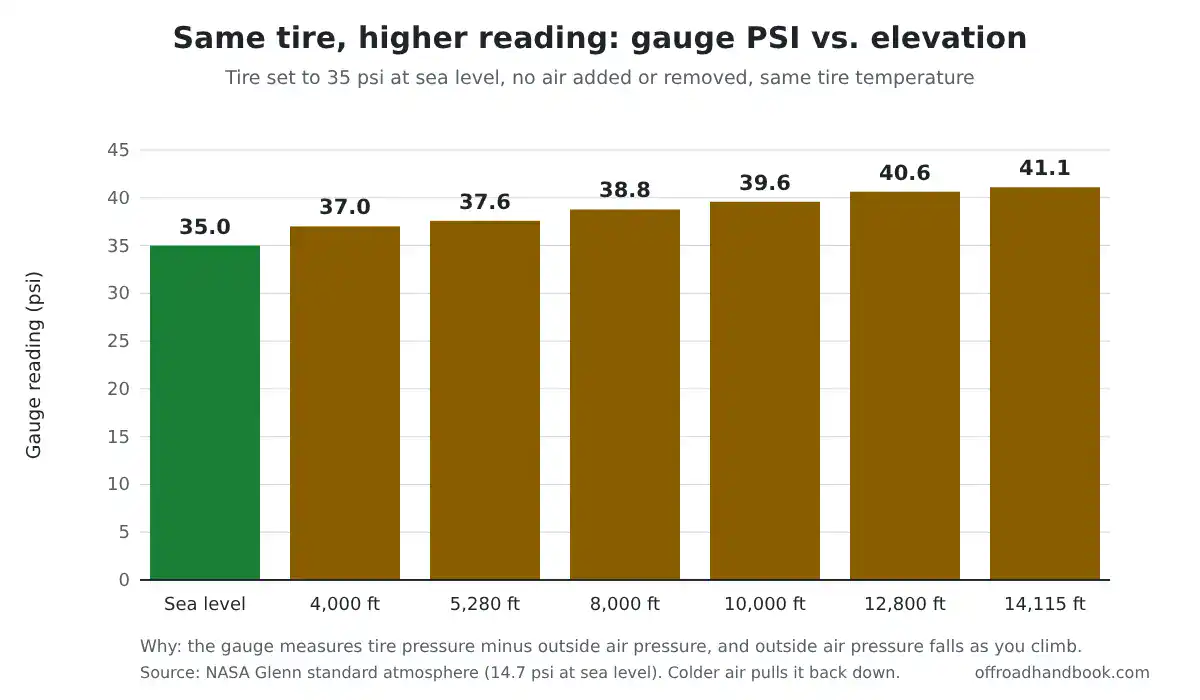
A tire gauge reads the difference between the air inside the tire and the air outside it. Outside air pressure falls from 14.7 psi at sea level to about 10.1 psi at 10,000 ft. So a tire you set to 35 psi at the coast reads about 39.6 psi up there, if the tire stays the same temperature.
In practice the mountain air is colder too, which lowers tire pressure and cancels part of the gain. Our cold weather tire pressure guide covers that effect. Either way, check your pressures with a digital tire pressure gauge at the trailhead rather than trusting the numbers you set at home.
Then air down for the trail with the off-road tire pressure calculator. Before you hit pavement again, air back up to the door-placard pressure, measured cold where you are.
What You Can Do About Power Loss at Altitude
You can't add oxygen to the air, but you can make better use of the power that's left.
- Use the gearing. On steep, slow climbs, 4-Low multiplies torque at the wheels and keeps the engine in its power band. Our guide on how to shift into 4-Low walks through it.
- Fix lost gearing from bigger tires. Oversized tires on stock axle gears already cost you acceleration at sea level, and that's worse at altitude. The regear calculator shows which ratio brings it back.
- Keep the engine breathing. A clogged air filter takes away power you can't spare in thin air. Check it after dusty trail days.
- Know your fuel system. Fuel-injected engines measure the incoming air and adjust fueling on their own. Many vehicles report outside air pressure over OBD-II as the "absolute barometric pressure" value (PID 0x33), which you can watch with a Bluetooth OBD2 scanner. Carbureted engines can't adjust, so they run rich up high. Check your owner's manual for high-altitude jetting before a mountain trip with an older carbureted ATV or dirt bike.
- Plan for heat. Thin air also carries less heat away from the radiator and intercooler. Long, slow climbs on hot afternoons are the hardest case, so take breaks before the gauge climbs.
Altitude and Engine Power FAQ
How much horsepower do you lose per 1,000 feet?
A non-turbo engine loses about 2.5% to 3% per 1,000 ft at low and middle elevations on a standard day, going by air density. The common 3% rule is close below about 6,000 ft and overestimates the loss higher up. Hot weather raises the loss at any elevation.
Do turbo engines lose power at altitude?
Much less than non-turbo engines. The engine computer raises boost to make up for thin air, so a healthy turbo engine stays close to its rated power until the turbo reaches its speed limit. Past that point it starts losing power too.
Should I lower my tire pressure when I drive into the mountains?
Your gauge will read roughly 0.4 to 0.5 psi higher for every 1,000 ft you climb, because outside air pressure drops. Colder mountain air pulls it back down. Check pressures cold at your destination and set them to the door placard for pavement, or to your trail pressure for off-road driving.
Do I need to lower my towing weight at high altitude?
It depends on the brand. Ford says to cut gross vehicle and gross combination weight by 2% per 1,000 ft. Jeep's and Ram's current manuals have no altitude reduction, and Toyota, Ram and GM have said their ratings aren't reduced for elevation. Follow your owner's manual, and expect slower climbs either way.

I'm Suryashankar Dasgupta, the founder of Off-Road Handbook. I've been off-roading for years on mountain and desert terrain. I've also driven a Jeep Compass for more than seven years, so I know the day-to-day side of Jeep ownership first-hand, from the Uconnect screen to the warning lights. Every guide here is researched from manufacturer owner's manuals, NHTSA recall and service-bulletin records and other trusted sources, checked against them before it is published, and corrected when we find a mistake. You can read how we work in our editorial policy: https://offroadhandbook.com/editorial-policy/
Like our off-road guides? Add Off-Road Handbook as a Google Preferred Source so our latest Jeep, ATV, UTV, trail, recovery, and off-road troubleshooting articles can appear more often in your Google Search experience.
Add us as a Preferred Source