What PSI Should LT Tires Run? Match Your Stock Tire's Load
This post contains Amazon affiliate links. As an Amazon Associate I earn from qualifying purchases, at no extra cost to you.
LT tires should run the pressure that carries the same load your original tires carried at the door-placard pressure, not the 80 psi molded on a Load Range E sidewall. Look up the original tire's load at its placard PSI, divide by 1.10 if it was a P-metric tire, then find the lowest pressure where the LT tire carries at least that much.
Two floors apply: never below the placard number, and never below 35 psi for any LT tire. A half-ton that came on P265/70R17 at 35 psi needs 50 psi in LT265/70R17 Load Range E tires, but only 40 psi in LT285/70R17s, because the bigger tire holds more air.
LT Tire Pressure Calculator: Match Your Original Tire's Load
Pick the size on your door placard, the LT tire you're running and its load range. Add axle weights from a scale if the rig is heavier than stock. The calculator gives a street pressure for each axle.
Pick your tires and press the button.
How it works: the original tire's load comes from the Tire and Rim Association (TRA) tables at your placard PSI (standard-load P-metric loads stop rising at 35 psi and are divided by 1.10). The new tire's pressure is the first 5-psi table step that carries that load, with the straight-line interpolated value shown as the absolute minimum. Results are estimates; your tire maker's own table wins.
I compiled the size data from the TRA values that Toyo reproduces in its load and inflation guide, then kept only the sizes whose numbers matched tirepressure.com's LT-metric table and flotation table row for row. That check knocked out 37x12.50R17LT and every hard-metric (no P) size, so for those the calculator asks you to type the load from your tire maker's chart.
Why the 80 PSI on the Sidewall Isn't Your Number
The pressure on the sidewall is the most the tire can safely hold, and for most LT sizes it's also where the tire reaches its top load rating. A Jeep or half-ton rarely puts anywhere near that load on each tire, so filling to the max just makes the ride harsh.
The opposite mistake is worse. Size for size, an LT tire needs more air than a P-metric tire to carry the same weight. Toyo technical bulletin TSD-12-011 shows a P245/75R16 carrying 2,271 lb at 35 psi; the LT245/75R16 needs 50 psi to match it.
That holds for Load Range C, D and E alike. A stiffer load range doesn't carry more at low pressure. It only lets the tire take more air when the load calls for it, which is why an E tire run at 30 psi on the highway heats up like any other under-inflated tire.
How the Load-Matching Method Works, Step by Step
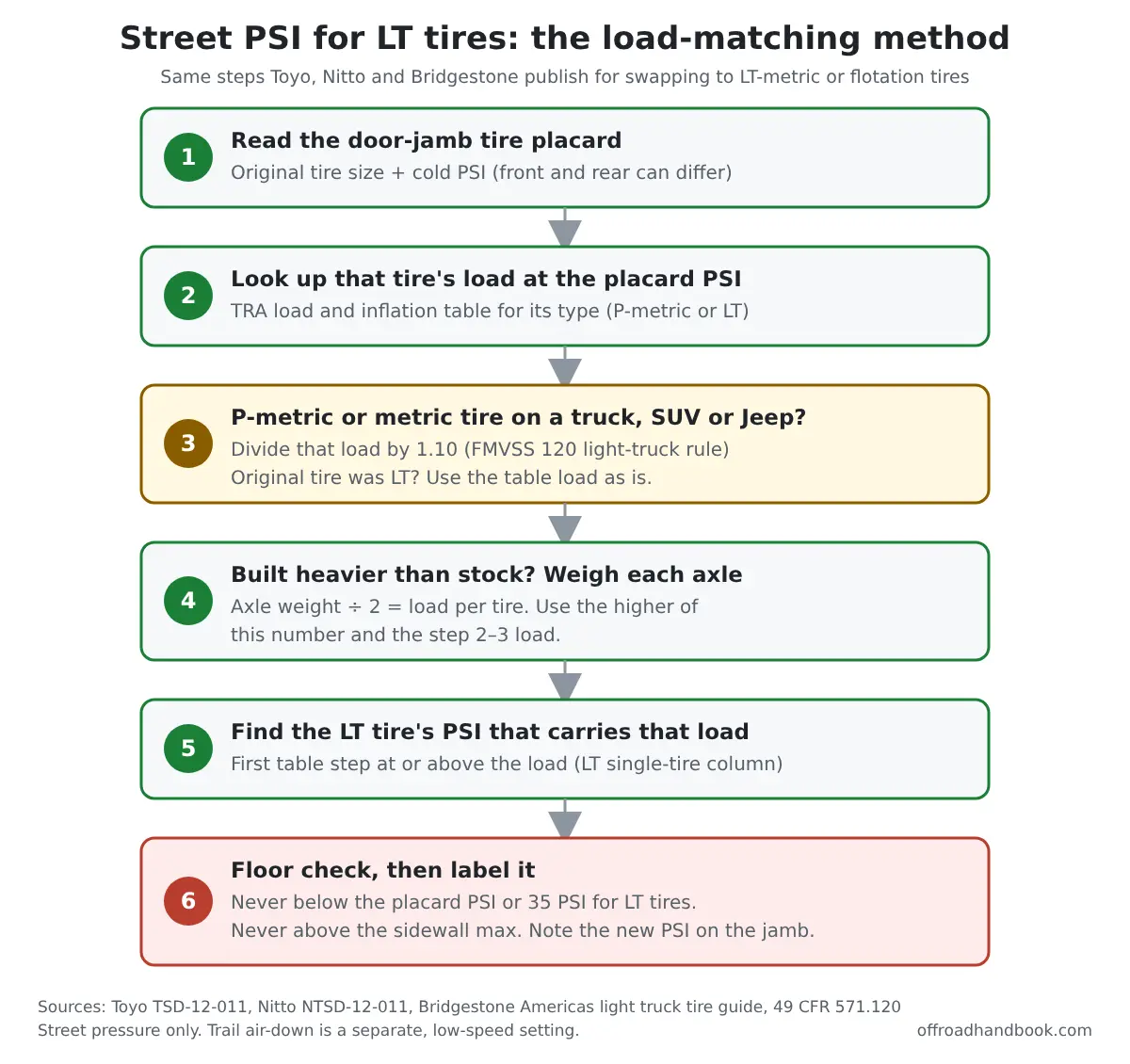
Toyo, Nitto and Bridgestone all publish the same procedure (Toyo technical bulletin TSD-12-011, Nitto bulletin NTSD-12-011, Bridgestone Americas light truck tire guide). Here it is with the details that trip people up.
- Read the placard. It's on the driver's door jamb. Note the original size and the cold pressure for each axle, because some trucks list a higher rear number.
- Find the original tire's load at that pressure. Use the TRA table for its type. If the placard PSI falls between table columns, interpolate in a straight line, as Toyo does in its own worked examples.
- Apply the light-truck factor. A P-metric or metric tire fitted to a truck, SUV or Jeep is rated at its table load divided by 1.10 under FMVSS 120 (49 CFR 571.120). Toyo's F-150 example: P255/70R17 carries 2,337 lb at 35 psi, so the real requirement is 2,125 lb.
- Check the weight you actually carry. Bumpers, a winch, drawers and a rooftop tent add up. If half of a scale-weighed axle is more than the step-3 number, use the bigger number.
- Find the LT pressure. Go along the LT tire's row to the first pressure whose load is equal to or higher than your requirement. In Toyo's example, LT265/70R17 needs 45 psi (2,255 lb), since 40 psi only carries 2,075 lb.
- Apply the floors. Toyo warns never to run less pressure than the vehicle maker recommends, and Bridgestone sets 35 psi as the minimum for LT tires. Write the new pressure on a label next to the placard.
If you're still choosing a load range, the Load Range C vs D vs E comparison covers ride, weight and puncture trade-offs. To check that your tires clear the axle ratings at all, use the tire load index checker.
Same Truck, Four LT Tires, Four Different Pressures
Here's the method run for one setup: a light truck whose placard calls for P265/70R17 at 35 psi. That tire carries 2,535 lb at 35 psi in the TRA table, and 2,535 ÷ 1.10 gives a 2,305 lb requirement per tire.
| LT tire | Interpolated minimum | First table step (set this) |
|---|---|---|
| LT245/75R17 E | 52 psi | 55 psi |
| LT265/70R17 E | 47 psi | 50 psi |
| LT285/70R17 E | 40 psi | 40 psi |
| 35x12.50R17LT E | 35 psi (floor) | 35 psi |
The narrow, tall LT245/75R17 needs 20 psi more than the 35-inch flotation tire to carry the same truck. More air volume carries the load at lower pressure, which is a big part of why bigger tires ride softer on the same rig.
The flip side: a size change also moves your speedometer and gearing. The tire size calculator shows the diameter and speedometer error before you buy.
LT Tire Load and Inflation Table for Popular Off-Road Sizes
These are the single-tire loads the calculator uses. Find your size, read across to the first pressure that meets your requirement, and that's your street PSI (after the floors). Columns at 55, 70 and 75 psi are left out here to fit a phone screen; the calculator uses them.
| Size | 35 psi | 40 psi | 45 psi | 50 psi | 60 psi | 65 psi | 80 psi |
|---|---|---|---|---|---|---|---|
| LT245/75R16 | 1,700 | 1,870 | 2,030 | 2,205 (C) | 2,480 | 2,623 (D) | 3,042 (E) |
| LT265/75R16 | 1,910 | 2,100 | 2,280 | 2,470 (C) | 2,790 | 3,000 (D) | 3,415 (E) |
| LT285/75R16 | 2,130 | 2,340 | 2,540 | 2,755 (C) | 3,110 | 3,305 (D) | 3,750 (E) |
| LT315/75R16 | 2,535 (C) | 2,715 | 2,950 | 3,195 (D) | 3,610 | 3,860 (E) | — |
| LT245/75R17 | 1,770 | 1,945 | 2,110 | 2,270 | 2,580 | 2,755 (D) | 3,195 (E) |
| LT265/70R17 | 1,890 | 2,075 | 2,255 | 2,470 (C) | 2,760 | 2,910 (D) | 3,195 (E) |
| LT285/70R17 | 2,105 | 2,315 | 2,510 | 2,755 (C) | 3,050 | 3,195 (D) | 3,195 (E) |
| LT315/70R17 | 2,535 (C) | 2,685 | 2,915 | 3,195 (D) | 3,195 | 3,195 (E) | — |
| LT275/65R18 | 1,940 | 2,130 | 2,310 | 2,535 (C) | 2,825 | 3,000 (D) | 3,415 (E) |
| LT275/70R18 | 2,070 | 2,270 | 2,470 | 2,680 (C) | 3,020 | 3,195 (D) | 3,640 (E) |
| LT285/65R18 | 2,035 | 2,235 | 2,425 | 2,600 | 2,965 | 3,195 (D) | 3,640 (E) |
| LT275/65R20 | 2,080 | 2,280 | 2,475 | 2,680 | 3,030 | 3,195 | 3,750 (E) |
| LT285/60R20 | 2,020 | 2,220 | 2,410 | 2,600 | 2,950 | 3,085 | 3,640 (E) |
Notice how loads stop climbing once a size hits its load-range maximum. An LT285/70R17 carries 3,195 lb at 65 psi and the same 3,195 lb at 80 psi, so extra air beyond that point adds stiffness, not capacity.
Flotation sizes (the ones written like 35x12.50R17LT) use their own TRA table, which starts at 25 psi. The 35 psi LT floor still applies on the street, even where the table lists a lower number.
| Size | 25 psi | 30 psi | 35 psi | 40 psi | 50 psi | 65 psi | 80 psi |
|---|---|---|---|---|---|---|---|
| 31x10.50R15LT | 1,400 | 1,595 | 1,765 (B) | 1,945 | 2,270 (C) | — | — |
| 33x12.50R15LT | 1,765 (B) | 2,000 | 2,205 (C) | — | — | — | — |
| 35x12.50R15LT | 2,040 | 2,295 | 2,535 (C) | — | — | — | — |
| 33x12.50R17LT | 1,610 | 1,850 | 2,040 (C) | 2,255 | 2,600 (D) | 3,085 (E) | 3,195 (F) |
| 35x12.50R17LT | 1,875 | 2,155 | 2,405 (C) | 2,625 | 3,000 (D) | 3,195 (E) | — |
| 35x12.50R18LT | 1,820 | 2,075 | 2,335 | 2,530 | 2,910 (D) | 3,415 (E) | 3,970 (F) |
| 37x12.50R18LT | 2,095 | 2,395 | 2,680 (C) | 2,915 | 3,415 (D) | 3,970 (E) | — |
| 33x12.50R20LT | 1,390 | 1,580 | 1,765 | 1,920 | 2,205 | 2,600 (E) | 3,000 (F) |
| 35x12.50R20LT | 1,655 | 1,895 | 2,095 | 2,310 | 2,680 (D) | 3,195 (E) | 3,640 (F) |
| 37x12.50R20LT | 1,930 | 2,225 | 2,470 | 2,705 | 3,085 (D) | 3,750 (E) | 3,970 (F) |
Sources disagree on 37x12.50R17LT above 35 psi: Toyo's copy of the TRA table lists 3,525 lb (Load Range D) at 50 psi, while tirepressure.com lists 3,195 lb. Until that's settled, read the load for that size from your tire maker's spec page.
Trucks That Came on LT Tires From the Factory
Most ¾-ton and 1-ton pickups come on LT tires from the factory. Swapping one LT size for another is simpler: no 1.10 factor, just find the original tire's load at its placard pressure and match it.
Toyo's example is an H2 on LT315/70R17 at 37 psi, which carries 2,595 lb. A 35x12.50R17LT needs 40 psi to match it. Bridgestone adds two rules: never replace OE LT tires with passenger tires, and never put flotation sizes on dual rear wheels (Bridgestone Americas light truck tire guide).
When Your Tire Maker's Table Beats the TRA Numbers
Some off-road tires are built to a higher load index than the TRA standard for their size. Toyo's guide lists its Open Country M/T in 35x12.50R17LT 125Q at 3,640 lb at 65 psi, where the TRA table tops out at 3,195 lb.
If the load index on your sidewall is higher than the one in the table, use the tire maker's own chart (Toyo's load and inflation tables are one example). The method stays the same; only the row of numbers changes.
TPMS Lights, Cold Mornings and Airing Down
If your truck has a tire pressure monitoring system, the new pressure may need special handling when the tires go on. Bridgestone tells owners to work that out with the installer (Bridgestone Americas light truck tire guide).
Set pressures cold. LT tires at higher pressure lose more psi per 10°F than passenger tires, so a December morning can drop you under your new number. The cold-weather tire pressure calculator shows how much.
None of this changes trail pressure. Airing down is a separate, low-speed setting; the air-down calculator gives starting numbers by terrain. Air back up to your street PSI before you hit pavement.
An E tire set at 50–80 psi needs a gauge that reads that high and is easy to read; a dial tire pressure gauge with a 0–100 psi range covers every number in these tables (check the current price on Amazon).
LT Tire Pressure FAQ
Can I run Load Range E tires at 35 psi on the street?
Only if the table shows that size carrying your required load at 35 psi and your placard calls for 35 psi or less. In the worked example above, a 35x12.50R17LT E carries the truck at 35 psi, but an LT265/70R17 E needs 50.
Should front and rear pressures be different?
Keep whatever difference your placard shows. Toyo's guide says to maintain the original front-to-rear split, which is why the calculator works out each axle separately.
Is it bad to run more pressure than the calculator says?
Not for load. Anything between the calculated number and the sidewall maximum carries the weight; more air mostly costs ride comfort. Less air than the calculated number overloads the tire.
Does a heavier build change the answer?
It can. Weigh each axle loaded the way you drive and enter the weights in the calculator. If you're near the limit, the 4x4 payload calculator shows how much capacity your build has left.

I'm Suryashankar Dasgupta, the founder of Off-Road Handbook. I've driven a Jeep Compass for more than seven years, so I know the day-to-day side of Jeep ownership first-hand, from the Uconnect screen to the warning lights. Every guide here is researched from manufacturer owner's manuals, NHTSA recall and service-bulletin records and other trusted sources, checked against them before it is published, and corrected when we find a mistake. You can read how we work in our editorial policy: https://offroadhandbook.com/editorial-policy/
Like our off-road guides? Add Off-Road Handbook as a Google Preferred Source so our latest Jeep, ATV, UTV, trail, recovery, and off-road troubleshooting articles can appear more often in your Google Search experience.
Add us as a Preferred Source