Snow Chains on a Jeep or Truck: Which Tire Sizes Are Allowed
This post contains Amazon affiliate links. As an Amazon Associate I earn from qualifying purchases, at no extra cost to you.
Most 4x4s can take snow chains, but usually only on certain factory tire sizes, usually only on the rear axle, and usually only with low-profile chains such as SAE Class S. Jeep's own chart, for example, clears link chains on a Wrangler or Gladiator only with the 245/75R17 tire. The bigger factory sizes, LT285/70R17 included, are approved for a textile sock only.
If you run aftermarket tires, the manual stops covering you. Then the real test is two gaps you can measure in your driveway: tread to fender, and inner sidewall to the nearest suspension part. The table, flowchart and checker below walk through both cases.
Which factory tire sizes allow chains: Jeep, Ram, Ford and Toyota
This table pulls the chain rules out of each maker's own documents. The pattern is clear: rear axle only on every 4x4 here, a 30 mph cap where a manual gives one, and the off-road tire sizes are usually the ones that lose chain approval.
| Vehicle (source) | Axle | Chains allowed on | Sock only or excluded | Max speed |
|---|---|---|---|---|
| Jeep Wrangler JL, gas (2026 owner's manual) | Rear | 245/75R17: Class S or AutoSock | AutoSock only: LT285/75R17C, LT315/70R17C (Sport); 255/70R18 (Sahara); LT285/70R17C, LT315/70R17C (Rubicon) | 30 mph |
| Jeep Wrangler 4xe (2026 owner's manual) | Rear | None | AutoSock only on every listed size: LT285/70R17C, 255/60R20, 275/55R20, 255/70R18 | 30 mph |
| Jeep Gladiator (2022 Mopar tire chain chart) | Rear | 245/75R17: Class S or AutoSock | AutoSock only: LT285/70R17C, 255/70R18, 275/55R20 | Not on chart |
| Jeep Grand Cherokee (2022 Mopar chart) | Rear | Class S: P245/70R17, 265/60R18, 265/50R20. 12 mm cable or chain: 275/45R21XL | Other sizes not listed | Not on chart |
| Ram 1500 (2022 Mopar chart) | Rear | Class S: 275/65R18, 275/55R20 | Ram TRX: no chains | Not on chart |
| Ram 2500 Power Wagon (2022 Mopar chart) | Rear | Class U: LT285/70R17D | Other sizes not listed | Not on chart |
| Ford Bronco (2021 owner's manual) | Rear, in pairs | 255/70R16 and 255/75R17: chains 15 mm or less; no self-tensioning chains | Any size not listed, which includes the 35-inch Sasquatch tires | 30 mph |
| Ford Ranger (2024 owner's manual) | Rear, in pairs | S-class, 15 mm links: 255/70R16, 255/70R17, 255/65R18, LT255/70R17. Raptor: LT285/70R17 only | Any size not listed | 30 mph |
| Ford Ranger 2019–2023 (2021 owner's manual) | Rear, in pairs | S-class, 15 mm links: 255/70R16, 255/65R17, 265/65R17, 265/60R18, LT265/65R17, LT265/70R17 | Any size not listed | 30 mph |
| Toyota Tacoma, 4th gen (current owner's manual) | Rear | No class named; side chain 5 mm (0.2 in), cross chain 6.3 mm (0.25 in) diameter | No size exclusions listed | 30 mph |
| Toyota 4Runner, 5th gen (owner's manual) | Rear | No class named; side and cross chain 5 mm (0.20 in) diameter | No size exclusions listed | 30 mph |
| Toyota Tundra, 3rd gen (current owner's manual) | Rear | No class named; side chain 5 mm, cross chain 6.3 mm diameter | No chains on 285/65R18: "the space between the tire and body is too narrow" | 30 mph |
I compiled this from the manuals and the Mopar chart linked in the caption; the Ford PDFs are owner-forum copies of Ford's own manuals, because Ford's server blocked direct downloads. The F-150, Silverado, Colorado and 2022-and-later Bronco are missing because I couldn't open an official manual for them, so look up "tire chains" or "snow traction devices" in the index of yours.
The Wrangler is the surprise. Jeep's 2026 manual approves Class S chains for exactly one size, the base Sport's 245/75R17. Every Rubicon, every Sahara and every 4xe gets AutoSock only, and the manual adds that "no other tire sizes are recommended for use with the snow traction device."
So if you're running 35s on a stock JL, as in our guide to Wrangler JL tire limits without a lift, you're already outside every factory chain recommendation. That doesn't mean chains can't fit. It means the measuring below is on you.
Toyota takes a different approach: no SAE class, just chain wire diameters and a rear-only rule. Ford names S-class with 15 mm links and lists exact sizes, which matches the 15 mm (0.59 in) sidewall figure in the Class S profile below.
What Class S actually means (and why "Class S" alone isn't enough)
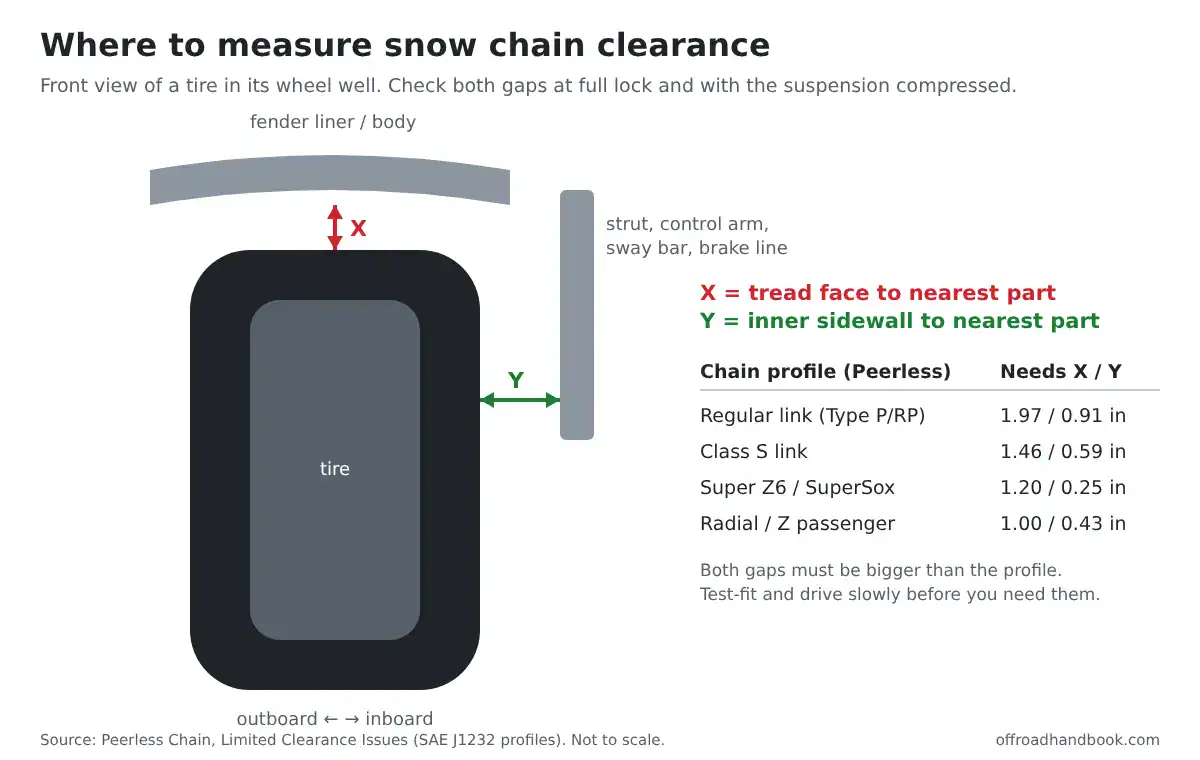
SAE J1232 sorts traction devices by how far they stick out from the tire. Class S is the low-profile class for vehicles with restricted wheel-well room. Class U is regular chain for trucks with plenty of space, which is why heavy-duty Ram 2500 and 3500 pickups get Class U on Mopar's chart.
The clearance numbers come from Peerless Chain's clearance guide. A Class S link chain needs 1.46 in (37 mm) between the tread face and the nearest part, and 0.59 in (15 mm) between the inner sidewall and the nearest part. That gap has to be clear around fenders, braces, suspension parts, strut housings, splash pans and fuel or brake lines.
Here's the catch most chain guides skip. Class S is a clearance standard for the vehicle, not a guarantee for your exact setup. A manufacturer can still rule out a tire size even when a Class S chain would technically fit it, and Jeep does exactly that on the Wrangler.
| Peerless chain profile | Tread gap X needed | Sidewall gap Y needed |
|---|---|---|
| Regular link chain (Type P and RP) | 1.97 in (50 mm) | 0.91 in (23 mm) |
| Class S link chain (Type PL, Z-Chain, Super Z LT, Super Z8) | 1.46 in (37 mm) | 0.59 in (15 mm) |
| Super Z6 cable chain and SuperSox textile | 1.20 in (31 mm) | 0.25 in (6.3 mm) |
| Radial chain and Z passenger chain | 1.00 in (25 mm) | 0.43 in (11 mm) |
Notice the slim Super Z6 and SuperSox profiles need far less sidewall room than a link chain. On a lifted truck, the inner sidewall usually runs closest to a control arm, tie rod or sway bar, so that 0.25 in figure is often what makes a set fit.
Peerless also says that pre-fitting and a short, slow test drive are the only reliable check, and that you shouldn't exceed 30 mph with any traction product.
Snow chain clearance checker
Measure X and Y on the axle you plan to chain, turn the wheel to full lock, and measure again. Use the smallest number you get. Then pick what your manual says about your tire size.
Snow chain clearance checker
The checker compares your two gaps with the four Peerless profiles in the table above. A profile "clears" only if both gaps are larger than its numbers. Anything your owner's manual says overrides the result, and a passing result is still an estimate until you test-fit the chain.
Decision flowchart: can you chain your 4x4?
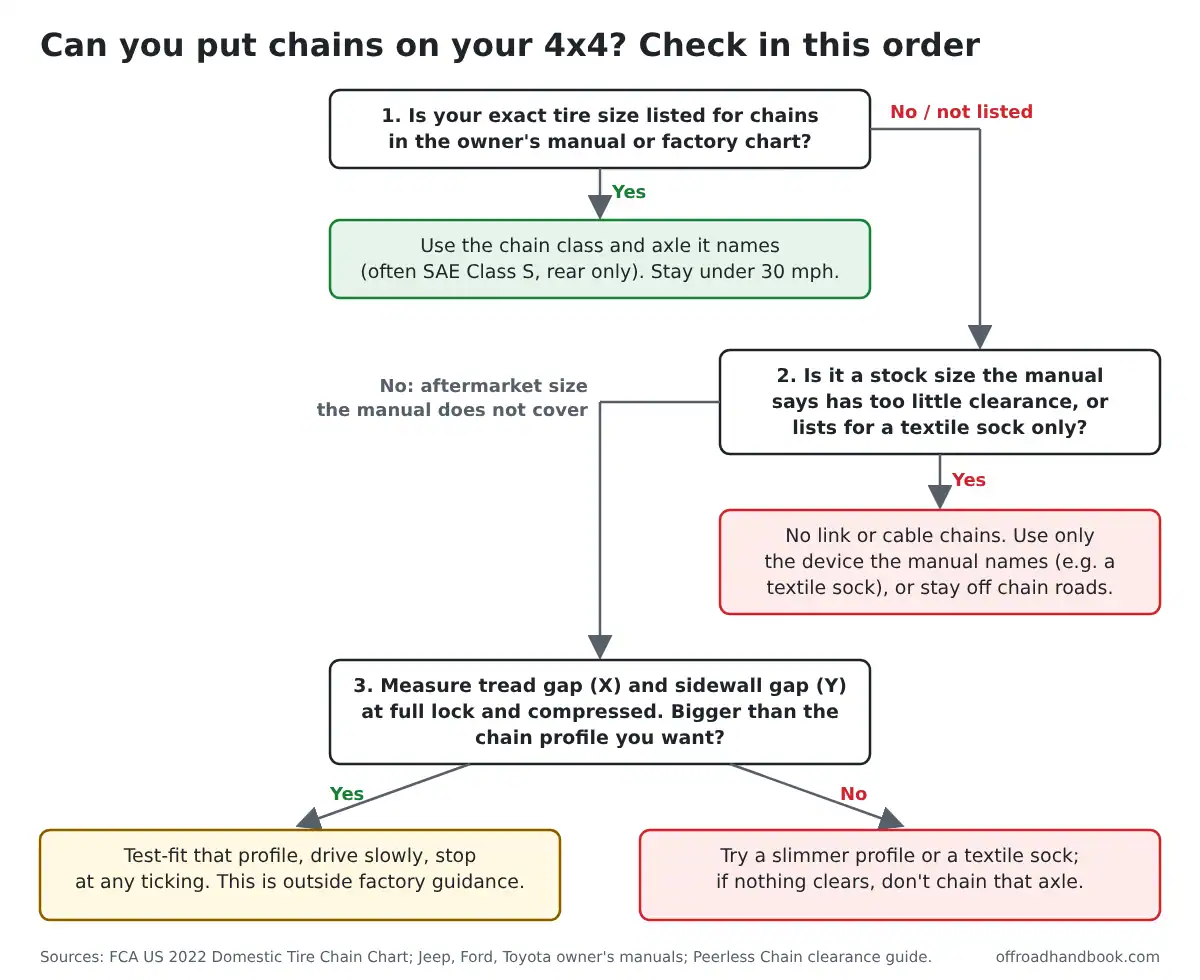
The order matters. Start with the manual, because it's the only source that knows your factory brake lines, fender liners and suspension travel. Measuring only helps once you're outside what the manual covers.
How to measure the gaps on a lifted Jeep or truck
- Park on level ground with the tires at normal street pressure. Aired-down tires bulge and give you a false reading.
- Confirm the exact size on the sidewall. Chains are sold by size, and our tire size calculator converts a flotation size like 35x12.50R17 to its real diameter and width.
- Measure X straight up from the tread to the lowest part above it: fender liner, inner fender, bump stop or body mount.
- Measure Y from the inner sidewall to the closest part: control arm, track bar, tie rod, sway bar link, coil spring, brake hose or ABS wire.
- Turn the steering to full lock both ways and repeat. Front tires swing toward the frame and the inner fender when they turn.
- Think about compression. The suspension moves up over bumps and under load, which shrinks X, so a gap that only just clears with the truck parked doesn't really pass.
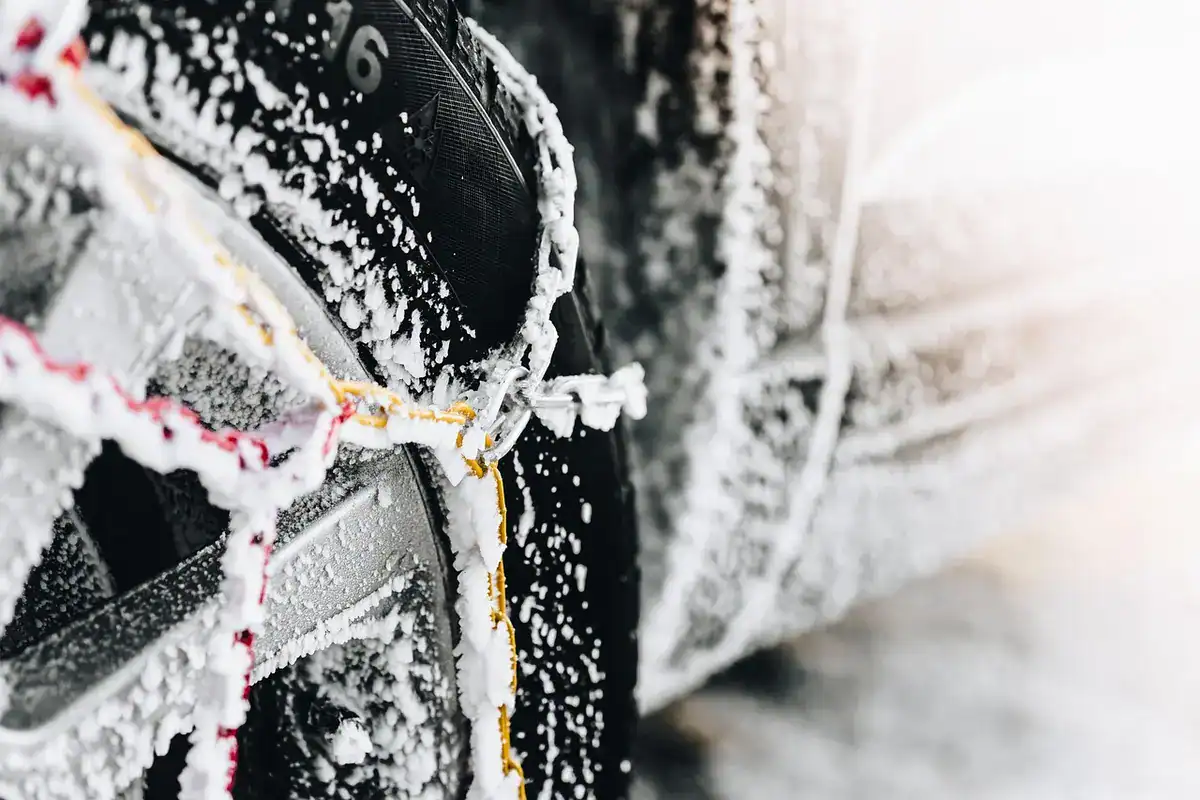
Steering travel is why the front axle is the hard one. A front chain that clears with the wheels straight can still hit the inner fender or a steering link at full lock. Check it both ways before you trust a front fit.
Chains, cable or a textile sock: which to buy
Buy for the tightest gap on the axle you'll chain, then for the road you'll drive. Here's how the three common types sort out on a 4x4.
- Class S link chains are the default when your manual names Class S. Most chain makers sell them by exact tire size, so search by your sidewall size, for example Class S tire chains for SUVs and light trucks, and match the maker's size chart before you order.
- Low-profile cable chains such as the Security Chain Super Z6 need the least sidewall room of the Peerless profiles. They're the usual pick on a lifted rig where the inner sidewall sits close to a control arm. Check the current price on Amazon and the size chart for your exact tire.
- Textile socks like AutoSock are the only device Jeep's chart allows on most Wrangler and Gladiator factory sizes. They go on fast and weigh little, but they're built for snow and ice on pavement, not for rocks or bare road.
Whether a sock counts as a legal chain substitute depends on the state. Colorado lists AutoSock as an approved alternative traction device, but chain-control rules differ in California, Oregon and Washington. Our guide to 4WD chain laws by state covers who has to carry what.
Rules for driving on chains with a 4x4
The Jeep, Ford and Toyota manuals in the table agree on most of the driving rules. Where they differ, follow your own manual.
- 30 mph maximum, or the chain maker's limit if it's lower. Every Jeep, Ford and Toyota manual above says so.
- Never on a compact or temporary spare. Jeep, Ford and Toyota all say this, and Ford adds not to chain the axle the temporary spare is on.
- Retighten after a short distance. Jeep says about ½ mile (0.8 km), Toyota ¼ to ½ mile (0.5 to 1.0 km). Jeep notes AutoSock doesn't need retightening.
- Take them off on bare pavement. Jeep warns against prolonged driving on dry pavement, and Ford says not to use chains on snow-free or dry roads.
- Stop at any new noise. Jeep's manual says to stop immediately if you hear something that could be a broken device and remove the damaged parts before driving on.
- Ford specifics: chains in pairs on the rear, no self-tensioning chains, remove wheel trims first, and Ford recommends steel wheels because chains may chip aluminum ones.
- Tundra specific: Toyota says not to use Lane Tracing Assist while driving on chains.
Put the transfer case in 4H on snow-packed roads if your truck has a part-time system, and check your manual before running 4H on mixed or bare pavement. Our guide on using 4H on the highway covers what each maker allows.
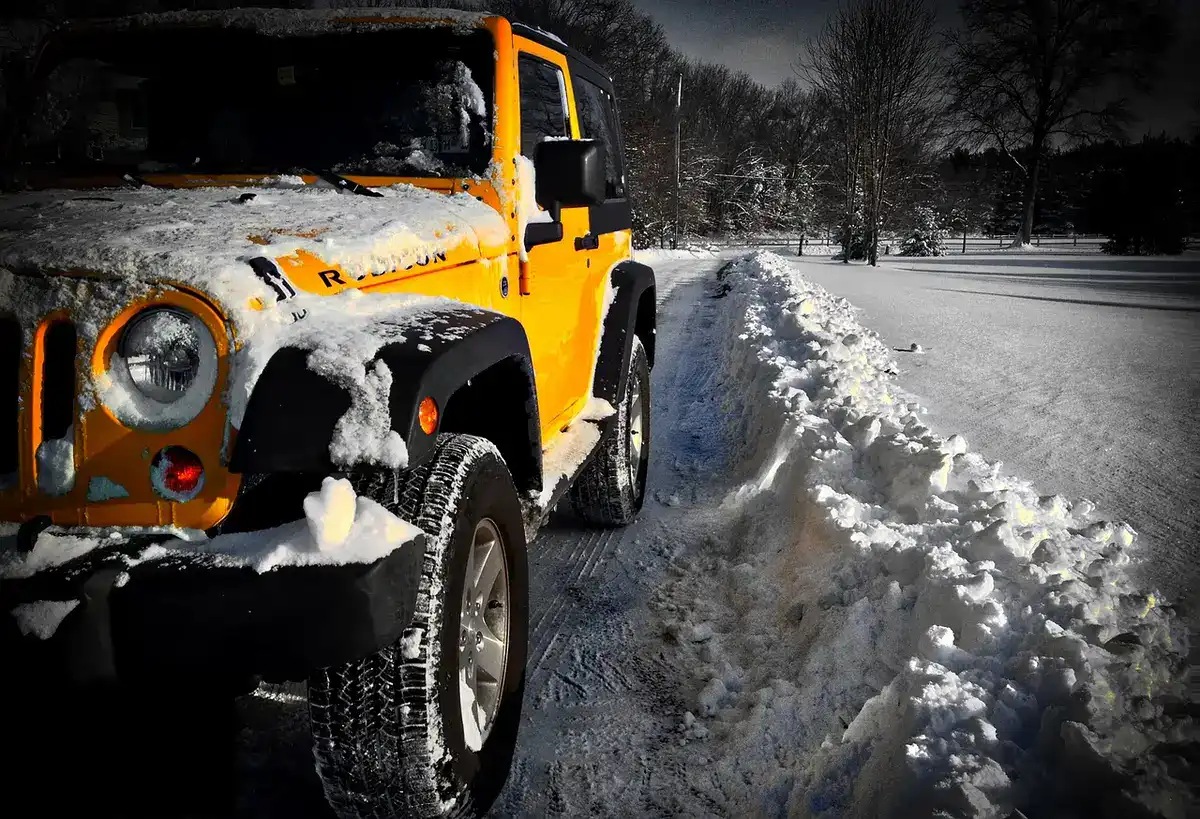
Good snow tires matter as much as chains for most winter driving. If you're choosing tires for the season, our breakdown of M+S vs 3PMSF all-terrain tires shows which ones carry a real severe-snow rating.
FAQ
Can I put chains on all four tires of my 4x4?
Only if your manual or chart says so. Mopar's 2022 chart lists rear only for the Wrangler, Gladiator and Grand Cherokee, front only for the Cherokee, Compass and Renegade, and front and rear only for a few Ram 3500 dually 4x4 models. Some states ask for devices on more tires, so if your manual says rear only, check whether that road's chain law can be met with the rear set.
Will Class S chains fit 35-inch tires?
Sometimes. Chains are sold for common 35-inch sizes, but whether they fit depends on your gaps, not the tire. You need more than 1.46 in at the tread and 0.59 in at the inner sidewall for a Peerless Class S link chain. Your owner's manual won't cover an aftermarket size, so test-fit before you rely on it.
Why does Jeep allow a sock but not chains on the Rubicon's tires?
Jeep's chart doesn't explain its reasoning; it only lists sizes. The practical difference is thickness: a textile sock adds far less to the tread and sidewall than a link chain, so it can fit sizes where a chain wouldn't.
How fast can I drive with snow chains?
Peerless says not to exceed 30 mph with any traction product. If your owner's manual or the chain maker gives a lower number, use the lower one.
Sources
- FCA US LLC, 2022 Domestic Tire Chain Chart
- Jeep, 2026 Wrangler owner's manual, Snow Traction Devices
- Peerless Chain, Limited Clearance Issues (SAE J1232 Class S and U profiles)
- Toyota owner's manuals: Tacoma, 4Runner, Tundra
- Colorado DOT, Traction and Chain Law (approved alternative traction devices)

I'm Suryashankar Dasgupta, the founder of Off-Road Handbook. I've been off-roading for years on mountain and desert terrain. I've also driven a Jeep Compass for more than seven years, so I know the day-to-day side of Jeep ownership first-hand, from the Uconnect screen to the warning lights. Every guide here is researched from manufacturer owner's manuals, NHTSA recall and service-bulletin records and other trusted sources, checked against them before it is published, and corrected when we find a mistake. You can read how we work in our editorial policy: https://offroadhandbook.com/editorial-policy/
Like our off-road guides? Add Off-Road Handbook as a Google Preferred Source so our latest Jeep, ATV, UTV, trail, recovery, and off-road troubleshooting articles can appear more often in your Google Search experience.
Add us as a Preferred Source