What Size Recovery Strap Do I Need? Kinetic Rope & Shackle Calculator
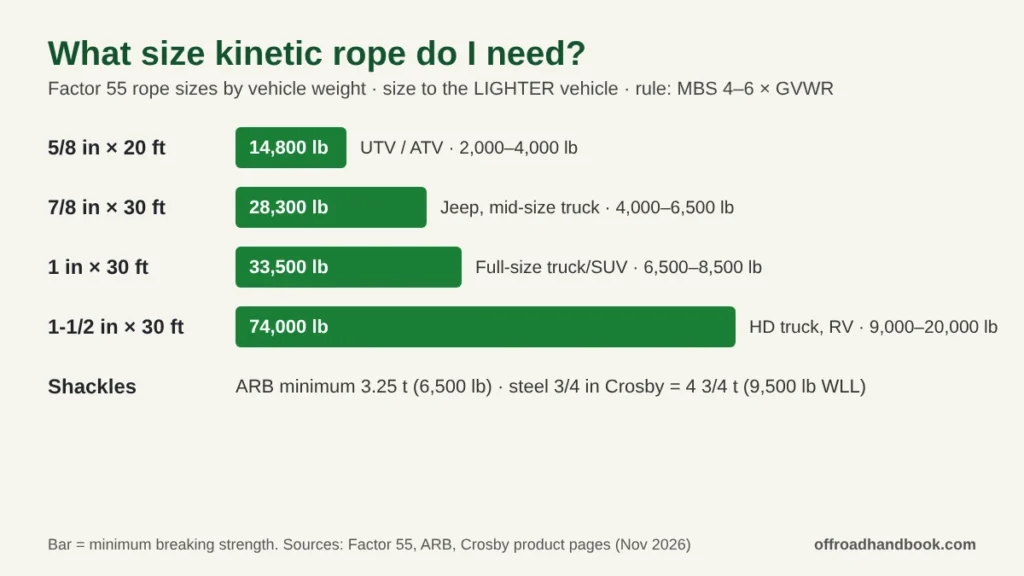
Size a recovery strap or kinetic rope to the lighter of the two vehicles, using the maker's multiplier on its weight. Example: a 5,000-lb Jeep pulled out by a heavier truck needs a snatch strap of 10,000–15,000 lb minimum breaking strength under ARB's 2–3× rule, or a kinetic rope of 20,000–30,000 lb under Factor 55's 4–6× rule (its ⅞-inch, 28,300-lb rope is listed for 4,000–6,500-lb vehicles). Connect it with shackles rated at least 3.25 tons (6,500 lb), ARB's minimum.
Makers don't agree on one formula, so the calculator below shows ARB's, Factor 55's and Bubba Rope's rules side by side, picks the Factor 55 rope size for your weight, and checks a rope, strap or shackle you already own.
Recovery Strap, Kinetic Rope and Shackle Size Calculator
Use the GVWR from each vehicle's door-jamb label, or a loaded scale weight if the rig is built up and heavier. If you've saved a rig in My Rig, its GVWR fills in automatically.
Enter the stuck vehicle's weight, then press Size my recovery gear.
How it works
- Sizing weight: the lighter of the two vehicles. ARB says a snatch strap's MBS "should be suited to the GVW of the lighter of the two vehicles", and Factor 55 says a kinetic rope "must be suited to the GVWR of the lighter of the two vehicles".
- ARB, snatch straps: minimum breaking strength (MBS) = 2 to 3 × the lighter vehicle's gross vehicle weight.
- Factor 55, kinetic ropes: MBS = 4 to 6 × the lighter vehicle's GVWR for typical SUVs and trucks; 2 to 4 × for large vehicles such as Unimogs and EarthRoamers (tick the box in the tool).
- Bubba Rope, kinetic ropes: MBS ≥ 3 to 4 × the weight of the vehicle being recovered (the stuck one), per its Rope Facts page.
- Your line: its MBS ÷ the sizing weight, compared with each rule's range for that line type. Below the range means it is more likely to break; Factor 55 says a kinetic rope that is too large "won't stretch enough, reducing the maximum kinetic energy assist".
- Shackles: the working load limit (WLL) you enter is compared with ARB's minimum of 3.25 tons. Shackle tons are US tons of 2,000 lb: Crosby rates its ¾-inch shackle 4 ¾ t = 9,500 lb.
Limits. These are the makers' own selection rules, not an industry standard; Bubba Rope notes "there is no official working load limit" for kinetic ropes. The tool doesn't know the strength of your recovery points, the line's age or condition, or how deep the vehicle is stuck. Always follow the rating and instructions printed on the gear you actually use.
Kinetic rope size chart (Factor 55)
| Rope | Minimum breaking strength | Working load limit | Listed vehicle weight (GVW) |
|---|---|---|---|
| ⅝ in × 20 ft | 14,800 lb | not listed | 2,000–4,000 lb (UTV/ATV) |
| ⅞ in × 30 ft | 28,300 lb | 5,660 lb | 4,000–6,500 lb (Jeeps, mid-size trucks, SUVs) |
| 1 in × 30 ft | 33,500 lb | 6,700 lb | 6,500–8,500 lb (full-size trucks and SUVs) |
| 1-½ in × 30 ft | 74,000 lb | 14,800 lb | 9,000–20,000 lb (HD trucks, vans, RVs) |
| 2 in × 30 ft | 131,500 lb | 26,300 lb | 20,000–40,000 lb |
| 2-½ in × 30 ft | 201,000 lb | 40,200 lb | 40,000–70,000 lb |
What size shackle do I need?
ARB's Recovery Basics says shackles rated at least 3.25 tons are the minimum for attaching a strap, and the working load limit should be visible on the shackle. The ratings below come from the makers' product pages. Compare WLL with WLL and breaking strength with breaking strength; a soft shackle's big breaking number isn't comparable to a steel shackle's WLL.
| Shackle | Working load limit | Minimum breaking strength | Maker's vehicle guidance |
|---|---|---|---|
| Crosby ¾ in steel (sold by Factor 55) | 9,500 lb (4 ¾ t) | 57,000 lb | Most common for Jeeps, trucks, SUVs |
| Crosby ⅝ in steel (sold by Factor 55) | 6,500 lb (3 ¼ t) | 39,000 lb | Most common for UTVs/ATVs |
| Factor 55 Standard Duty soft, 7/16 × 10 in | 7,800 lb | 39,000 lb | GVW up to 7,500 lb |
| Factor 55 Extreme Duty soft, ⅜ × 10 in | 8,700 lb | 43,500 lb | GVW up to 8,500 lb |
| Factor 55 Standard Duty soft, ½ × 10 in | 12,000 lb | 60,000 lb | GVW 7,500–12,000 lb |
Safety before any strap or rope recovery
- Hook only to rated recovery points. BFGoodrich: "DO NOT attach a strap to a tow ball or bumper hitch." Factor 55 warns a ball on a receiver can become a projectile.
- Don't use a tow strap for a snatch or kinetic pull. Factor 55: "Do not use a tow strap as a recovery strap/kinetic rope."
- Never join two straps or ropes with a shackle; if it breaks it can fly "like a bullet" (BFGoodrich).
- Fit a recovery damper at the middle of the line, and clear spectators well away until the recovery is over (ARB). Never step over a connected strap (BFGoodrich).
- Pull in line with the vehicle, not sideways on a recovery point (BFGoodrich). Don't use a line that is frayed, cut or worn.
- Tighten a screw-pin shackle until it seats, then back the pin off about ½ to a full turn so it doesn't seize (ARB).
Frequently asked questions
Size it to the lighter of the two vehicles. ARB recommends a snatch strap with a minimum breaking strength of two to three times that vehicle's gross vehicle weight, so a 5,000-lb Jeep needs about 10,000–15,000 lb. Kinetic ropes use higher multipliers: 4 to 6 times GVWR for Factor 55.
Factor 55 lists its ⅞-inch × 30-ft rope (28,300 lb MBS) for vehicles of 4,000–6,500 lb such as Jeeps and mid-size trucks, the 1-inch (33,500 lb) for 6,500–8,500 lb full-size trucks, and the ⅝-inch (14,800 lb) for 2,000–4,000 lb UTVs. Bubba Rope's rule is 3 to 4 times the weight of the vehicle being recovered.
Match the maker's vehicle guidance and check the working load limit. Factor 55 lists its 7/16-inch Standard Duty soft shackle (7,800 lb WLL) for vehicles up to 7,500 lb, the ⅜-inch Extreme Duty (8,700 lb WLL) up to 8,500 lb, and the ½-inch (12,000 lb WLL) for 7,500–12,000 lb. ARB treats a 3.25-ton (6,500 lb) rating as the minimum.
Kinetic ropes are sold by minimum breaking strength (MBS), the load at which they break in testing. Some makers also print a working load limit; Factor 55 lists 28,300 lb MBS and 5,660 lb WLL for its ⅞-inch rope. Bubba Rope says there is no official working load limit for kinetic ropes, which is why makers size them with multipliers of vehicle weight.
Sources
- ARB USA, Recovery Basics: Part I (November 17, 2020; opened November 20, 2026): snatch strap MBS two to three times GVW, lighter-vehicle rule, ARB strap sizes 17,600 / 24,000 / 33,000 lb, 3.25-ton shackle minimum, damper and pin advice.
- Factor 55 kinetic recovery ropes and product pages for the ⅞ in, 1 in, ⅝ in, 1-½ in, 2 in and 2-½ in ropes (opened November 20, 2026): 4:1 to 6:1 MBS-to-GVWR rule, 2:1 to 4:1 for large vehicles, MBS, WLL and GVW ranges.
- Bubba Rope, Rope Facts (opened November 20, 2026): multiply the weight of the vehicle you are recovering by 3 or 4; no official working load limit.
- Factor 55 shackle pages: ¾ in Crosby, ⅝ in Crosby, Extreme Duty ⅜ in soft, Standard Duty 7/16 in soft, Standard Duty ½ in soft (opened November 20, 2026).
- Factor 55, Tow Strap vs Recovery Strap vs Kinetic Rope (opened November 20, 2026): tow straps are not recovery lines; never attach to a receiver ball.
- BFGoodrich, 4x4 recovery techniques (opened November 20, 2026): rated recovery points only, no shackle between two straps, never step over a connected strap, in-line pulls.
Related tools and guides: kinetic rope vs snatch strap vs tow strap, soft shackle vs D-ring, the snatch block load calculator, the winch size calculator, the 4x4 payload calculator and all our free off-road calculators.
Last updated: November 20, 2026. Sizing guidance from the makers named above; the rating and instructions on your own gear take priority. Nothing you enter leaves your browser.

I'm Suryashankar Dasgupta, the founder of Off-Road Handbook. I've been off-roading for years on mountain and desert terrain. I've also driven a Jeep Compass for more than seven years, so I know the day-to-day side of Jeep ownership first-hand, from the Uconnect screen to the warning lights. Every guide here is researched from manufacturer owner's manuals, NHTSA recall and service-bulletin records and other trusted sources, checked against them before it is published, and corrected when we find a mistake. You can read how we work in our editorial policy: https://offroadhandbook.com/editorial-policy/
Like our off-road guides? Add Off-Road Handbook as a Google Preferred Source so our latest Jeep, ATV, UTV, trail, recovery, and off-road troubleshooting articles can appear more often in your Google Search experience.
Add us as a Preferred Source