Do Jeep Wranglers Have Two Batteries? Which Ones and Why
Last updated on October 20th, 2026 at 06:37 pm
This post contains Amazon affiliate links. As an Amazon Associate I earn from qualifying purchases, at no extra cost to you.
Some do. A gas Wrangler JL or Gladiator JT with engine Stop/Start usually has a small second 12-volt battery behind the front passenger wheel well. Jeep’s owner’s manual says that secondary battery powers the Stop/Start system and the 12-volt electrical system.
It is not on every Jeep. eTorque, 4xe, V8 and older JK Wranglers are set up differently, and the manual itself only says the vehicle “may be equipped” with one. The sections and the checker below sort out which setup yours has.
Which Wranglers have two batteries?
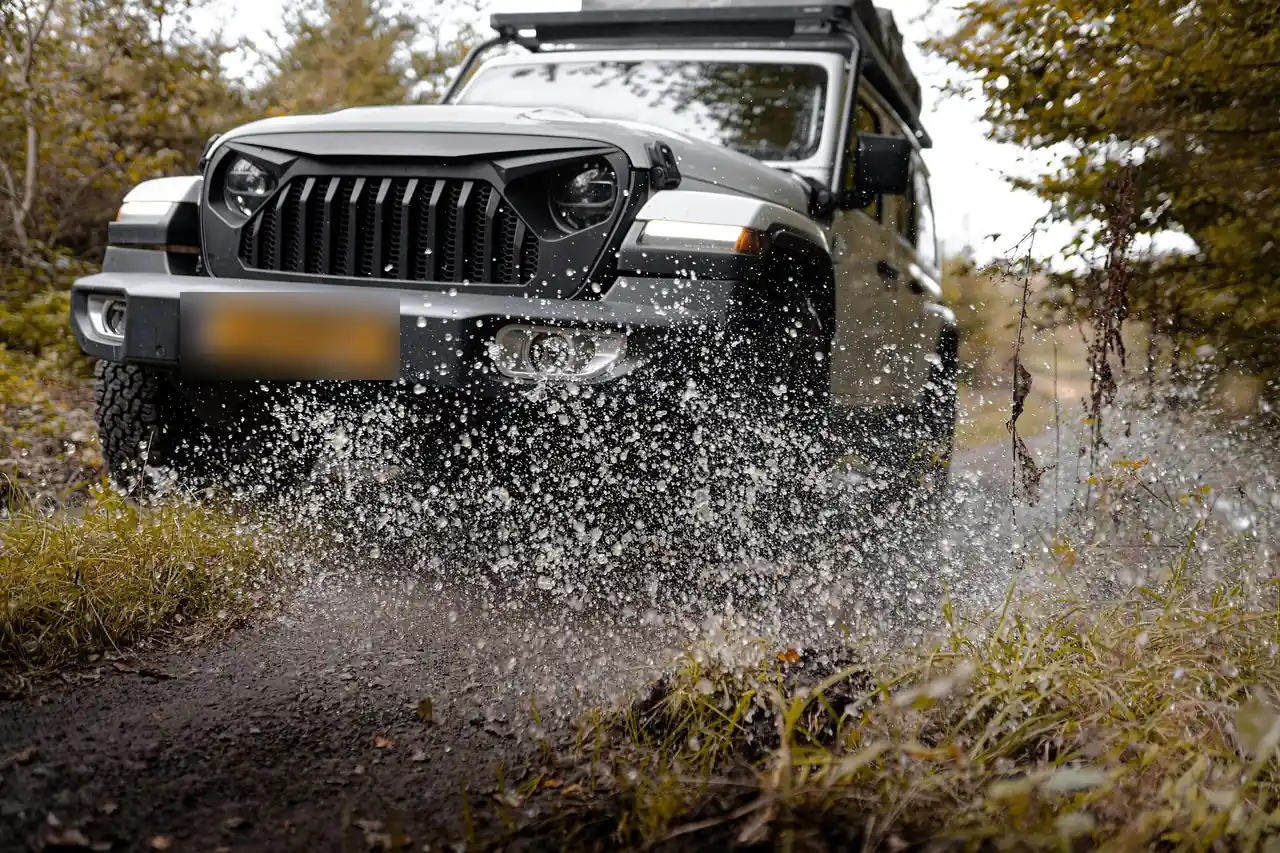
The second battery follows the engine and Stop/Start, not the trim level. Jeep’s 2020, 2021 and 2023 manuals say the vehicle “may be equipped” with a secondary battery. The 2026 manual says the vehicle “is equipped” with one.
That wording is why forum threads disagree. The table sets each setup against what Jeep’s own documents say, and marks what Jeep does not state.
| Your Jeep | Batteries and where | What Jeep’s documents say |
|---|---|---|
| JL, 3.6L or 2.0L turbo, Stop/Start, no eTorque | Main 12 V at the right rear of the engine compartment, plus a small secondary 12 V behind the front passenger wheel well | Secondary battery powers Stop/Start and the 12 V system. Manual warns Stop/Start vehicles have two batteries |
| JL with eTorque | Main 12 V plus an eTorque hybrid pack. Second 12 V not confirmed | Manual: eTorque adds an “additional hybrid electric battery.” It does not say if the 12 V secondary is also fitted |
| JL 3.0L EcoDiesel | Two 12 V expected, same places | Jeep fact sheets list Stop/Start (ESS) on the EcoDiesel |
| JL 6.4L V8 (392) | Not established. Look behind the front passenger wheel well | Manuals do not say whether the V8 has Stop/Start |
| Wrangler 4xe | 12 V in the engine compartment, 400-volt pack under the rear seat | 2026 manual hybrid sections; Jeep press kit for the 400-volt figure |
| Gladiator JT with Stop/Start | Main 12 V plus small secondary 12 V, same places as the Wrangler | 2023 Gladiator manual, same “may be equipped” text |
| JK (2007 to 2018) | One battery, right rear of the engine compartment | 2014 JK manual lists one battery and has no Stop/Start section |
Read “expected” as “follows from Jeep’s Stop/Start wording,” not “confirmed for your VIN.” The manuals checked do not list which engines get the secondary battery.
The two rows to double-check are eTorque and the V8, where the sources are thin. The checker further down covers both.
What the secondary battery does
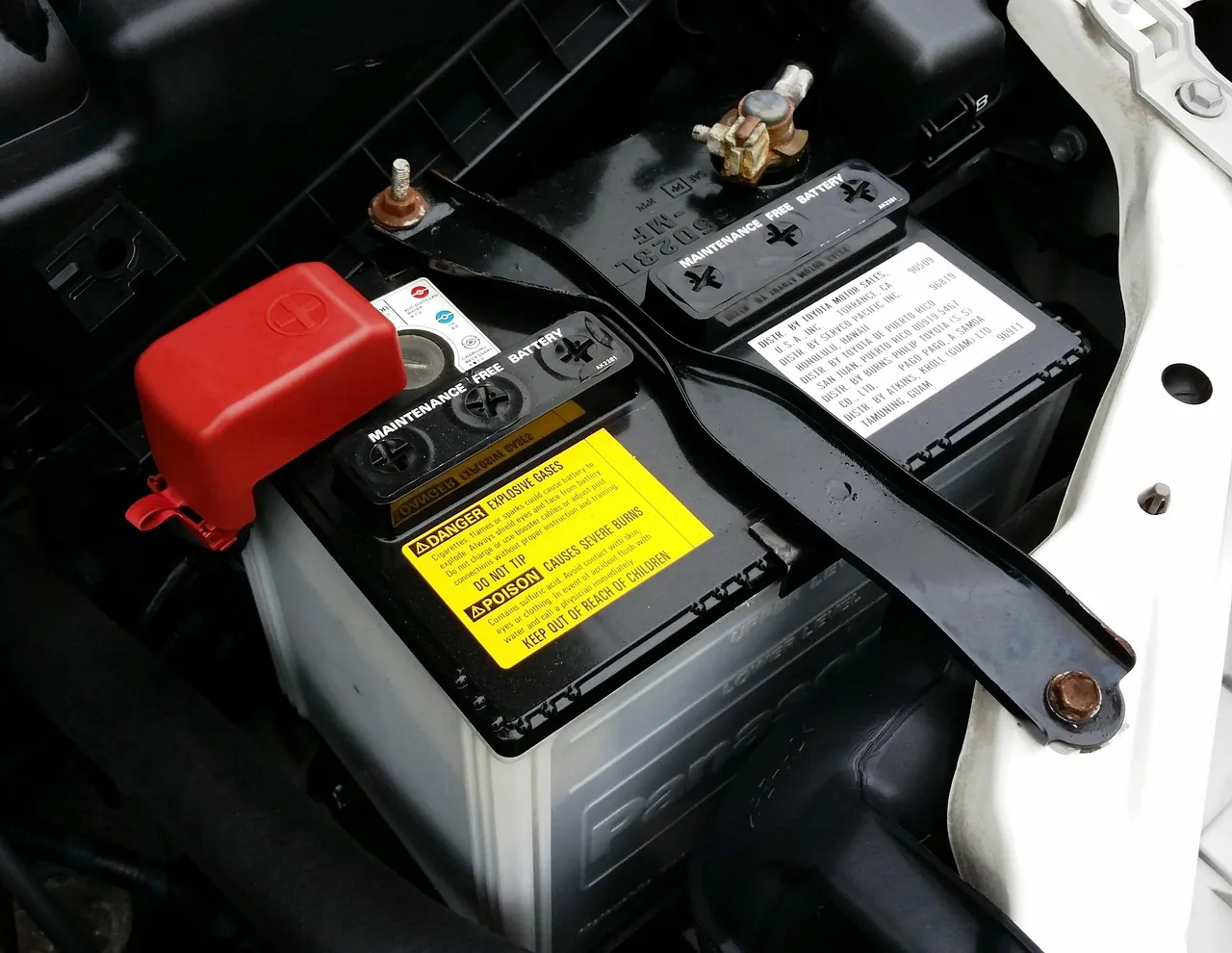
Stop/Start shuts the engine off at a stop and restarts it when you release the brake or press the accelerator. Jeep says these vehicles got a heavy-duty starter, an enhanced battery and other parts to handle the extra starts. The secondary battery is part of that setup.
Jeep describes its job as powering the Stop/Start system and the 12-volt electrical system. The manual never calls it an accessory battery. A Group 400 AUX14 battery is rated about 14 Ah and 200 CCA in retail listings, which is another reason winches and fridges do not belong on it.
Why Stop/Start does not run
The manual lists the conditions that stop the engine from shutting off. Any one of them can keep the system in a not-ready state:
- Driver’s seat belt unbuckled, driver’s door open, or hood open.
- Battery temperature too warm or too cold, or battery charge low.
- Engine not yet at normal operating temperature, or cabin heating or cooling not yet at the set temperature.
- HVAC on full defrost at high blower, or on MAX A/C.
- Steep grade, or brake pedal not pressed firmly enough.
- Transfer case in 4L or Neutral.
Off-road, that last line matters. The manual recommends disabling Stop/Start for off-road use, and the system sits out in 4L anyway. The OFF switch resets to ON every time the ignition cycles, according to the 2026 manual.
Where the two batteries are
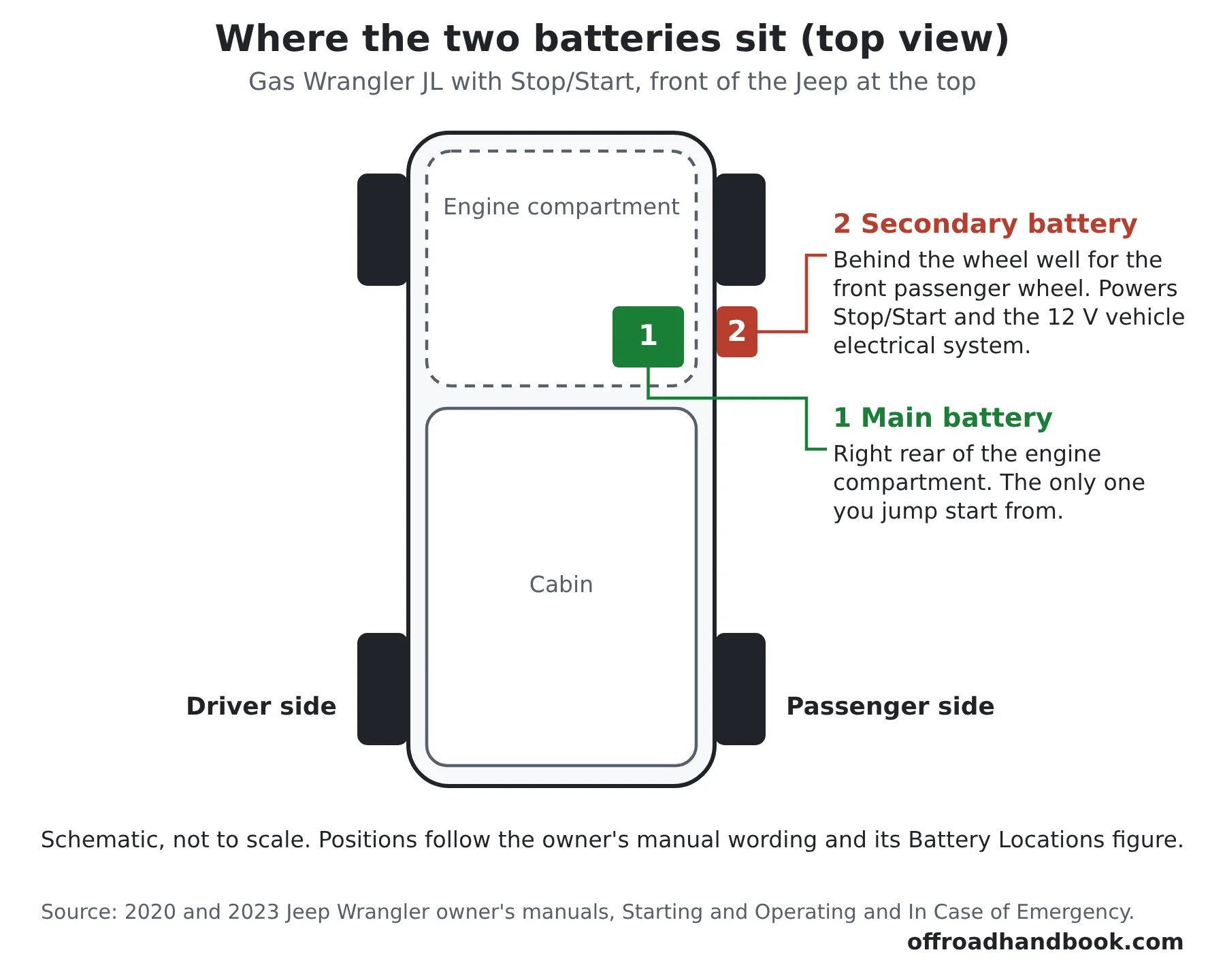
Jeep’s manual puts the main battery at the right rear of the engine compartment. It puts the secondary battery behind the wheel well for the front passenger wheel. On a US Jeep, passenger side means the right side.
The secondary battery is not under the hood, so a hood check alone will not find it. The manual’s Battery Locations figure labels them 1 (primary) and 2 (secondary).
How to check which setup your Jeep has
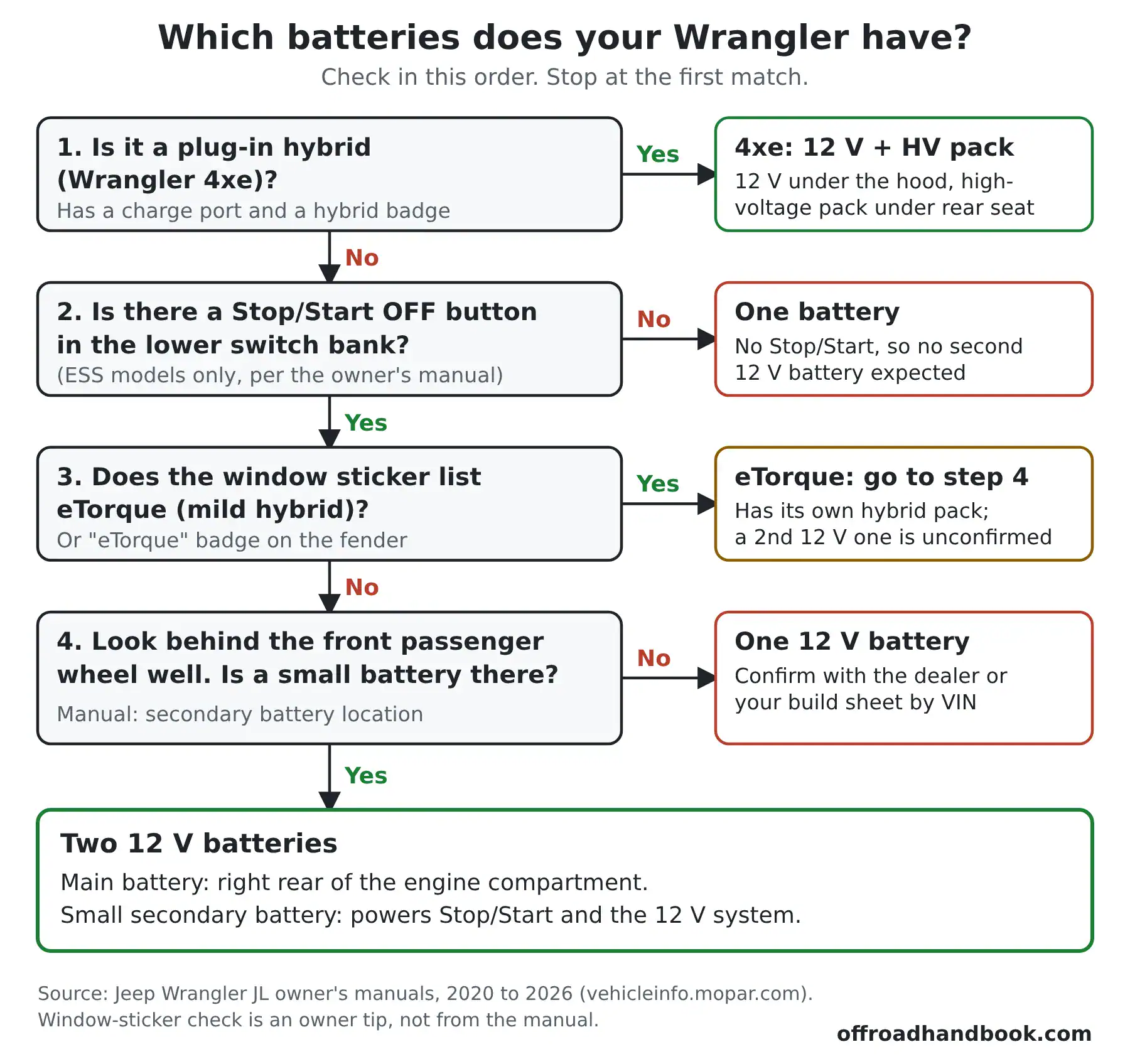
Work down the flowchart and stop at the first match. The steps are the same in plain text:
- Check for a plug-in charge port and hybrid badge. If you have them, it is a 4xe.
- Look for the Stop/Start OFF button in the lower switch bank. The manual puts it there on Stop/Start models. No button means no Stop/Start and no second battery expected.
- Read the window sticker or build sheet for “eTorque.” This is an owner tip, not a manual step.
- Look behind the front passenger wheel well for the small secondary battery. If you can’t find it, ask a dealer to confirm by VIN.
A dealer can read the build sheet from your VIN, which settles any disagreement between the sticker and what you see.
Which battery setup does my Jeep have?
Pick your model, year, engine and transmission. The checker returns what the sources support and says when they do not.
Based on Jeep’s 2014 JK, 2020 to 2026 JL and 2023 Gladiator owner’s manuals and Jeep press material. It cannot see your Jeep, so confirm by looking.
eTorque, 4xe, diesel and V8: what is different
eTorque Wranglers
eTorque is Jeep’s mild hybrid. The manual says eTorque vehicles have a heavy-duty motor generator and an additional hybrid electric battery that stores energy from deceleration for restarts and launch assist. MOTOR magazine calls the eTorque system 48-volt (Nov 2020).
That hybrid pack is not the small 12-volt secondary battery. The manual does not say whether an eTorque Jeep also has the 12-volt one, and JL owners report none. Look in the wheel well before you buy a battery.
Jeep’s press kits show eTorque on the 3.6L, and on the 2.0L turbo from 2018 to 2020. The 2022 and 2023 kits list it only for the 3.6L, and the 2026 kit lists no eTorque. If you drive the 2.0L turbo, our 2.0 turbo problems guide covers the rest of the engine.
Wrangler 4xe
The 4xe has a 400-volt battery pack, per Jeep’s 2022 fact sheet. The 2026 manual puts the high-voltage battery under the rear seat and shows one 12-volt battery in the engine compartment.
The manual says the Jeep needs the 12-volt battery to turn on the high-voltage battery. A discharged 12-volt battery can be jump started. Disconnecting the 12-volt battery also stops the high-voltage pack from charging from a charger.
EcoDiesel and Rubicon 392
Jeep’s 2020 and 2022 fact sheets list Stop/Start on the 3.0L EcoDiesel, so expect the secondary battery there. The manuals say nothing about Stop/Start on the 6.4L V8, so check the wheel well rather than assume.
Older Wranglers: JK and earlier
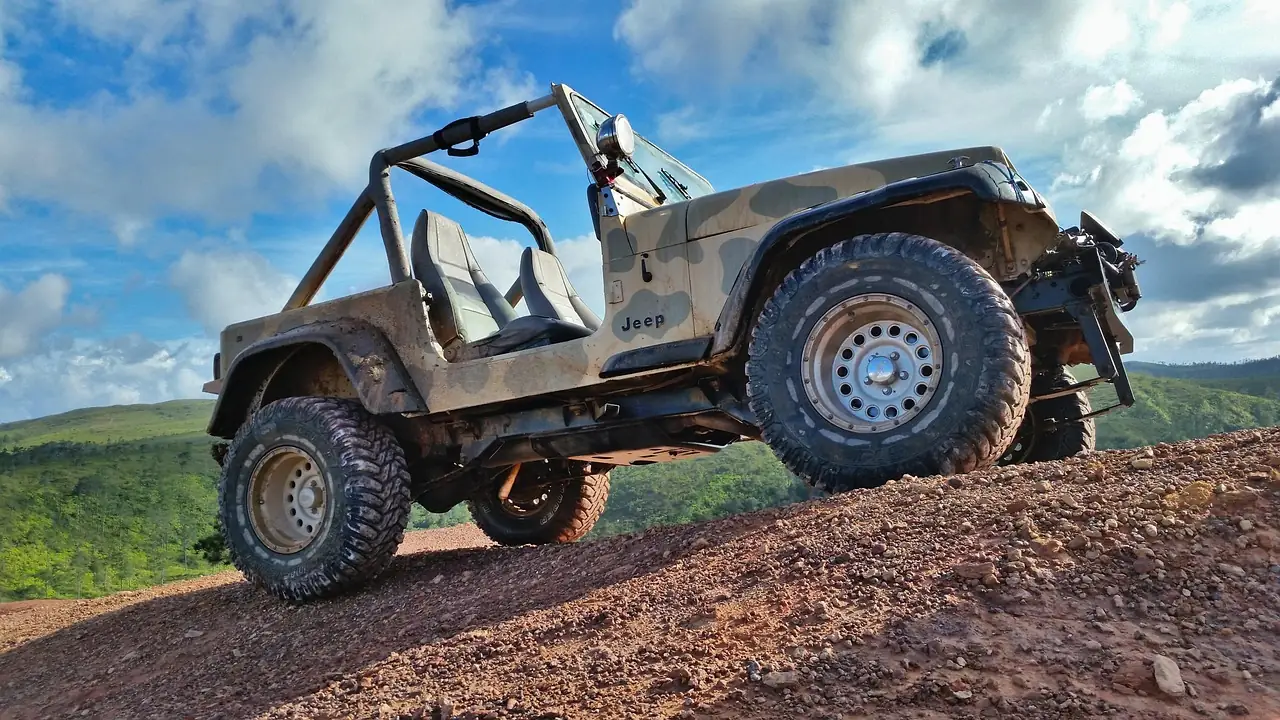
Jeep’s 2014 JK manual lists one battery in the right rear of the engine compartment, behind the power distribution center. It has no Stop/Start section and no secondary battery. That is the one manual checked for the JK.
This guide did not open manuals for the TJ, YJ or CJ, so it does not state their setups. Look under the hood and in your own owner’s manual.
Signs the secondary battery is failing
Jeep’s manual lists these messages as Stop/Start or battery faults without naming the secondary battery as the cause. JL owners commonly trace the Stop/Start ones to it, so test it early, but run the free checks first.
| What you see | What Jeep’s manual says | Check first |
|---|---|---|
| “SERVICE STOP/START SYSTEM” message or yellow Stop/Start light | Stop/Start malfunction. The engine will not shut off at stops. See a dealer | Note if it is constant. Check both batteries’ cable clamps are tight and corrosion-free, then have both tested |
| STOP/START READY never appears, no warning | Many normal blockers, listed above | Run the list: belt, door, hood, MAX A/C, engine warm, 4L or Neutral |
| Stop/Start stays off after battery work | Disconnecting the Intelligent Battery Sensor can leave it off for up to 24 hours | Drive normally for a day and leave the sensor connected |
| “Battery Saver On” or “Battery Saver Mode” | Battery state of charge is low and still dropping faster than charging can sustain; non-essential loads are cut | Switch off extra loads. If the battery charge warning light is on, suspect charging and get it tested |
| Slow crank or no start | Jump start from the main battery only | Charge or jump the main battery, then see if it repeats |
A stalled Jeep that will not restart has more possible causes than a battery; our Jeep shuts off while driving guide covers them. Electrical gremlins after mud or water are in our electrical issues after off-roading guide.
Failing-battery symptom checker
Pick what the Jeep is doing. The checker lists free checks first and shop checks last.
Based on the manual lines in the table above. It cannot test a battery, so use it as a checklist.
Before you go in, open the Stop/Start screen in the instrument cluster display. The manual says it shows detailed information about why the system is or is not running.
Replacing the secondary battery and disconnecting safely
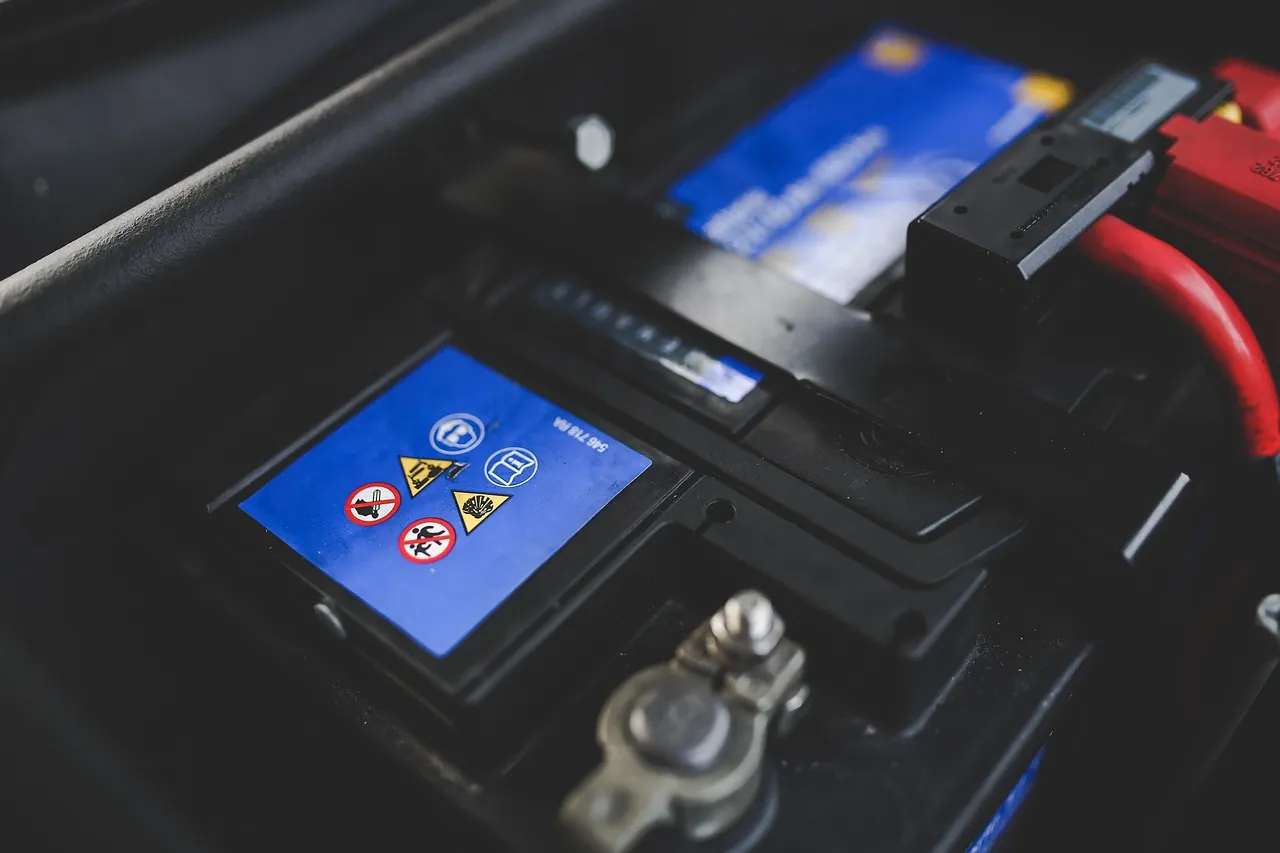
The owner’s manual has no step-by-step for replacing the secondary battery. It says to see an authorized dealer to learn how to disconnect properly. Its warning says serious injury or death could result if you do not disconnect both batteries when you need the 12-volt system fully de-energized.
What the manual does say
- Remove metal jewelry, and keep flames and sparks away. Battery gas is flammable and explosive.
- On Stop/Start vehicles, disconnect both the main and the supplemental negative battery cables to fully de-energize the system for storage.
- Isolate each negative cable from its post so it cannot touch. The manual warns that cables not isolated properly can cause a power spike or surge that damages electrical components.
- Do not disconnect the Intelligent Battery Sensor (IBS), or Stop/Start may not work for up to 24 hours.
- For storage past about three weeks, the manual calls for disconnecting the negative cables.
The manual gives no order for which battery to disconnect first, so do not invent one. Follow your dealer’s service information.
Jump starting
Only use the positive post on the main battery. The manual warns that serious injury or death could result if you try to jump start from the supplemental battery.
If you use a fast charger with the battery in the Jeep, disconnect both vehicle battery cables first. The manual says not to use a fast charger to provide starting.
Which battery to buy
Retail fitment lookups list a Group 400 AGM auxiliary battery, 200 CCA, for a 2020 Rubicon 3.6L (Batteries Plus, Duracell SLI400AGM-AUX). Mopar parts sites list Mopar part 56029759AB as the “Auxiliary” battery for 2018 to 2024 Wranglers. Match the label on yours and confirm by VIN before you buy.
On Oct 17, 2026, Batteries Plus listed the Duracell at $109.99 plus a $10 refundable core deposit; check the current price on Amazon with this Group 400 AUX14 search on Amazon, and the Batteries Plus fitment page for the same battery.
Can it run a winch, or can you delete it?
Accessories are a separate job. A winch, fridge or light bar belongs on an aftermarket dual-battery setup, not on the Stop/Start battery. Size the winch first with our winch size calculator, then plan the battery around it.
Removing the secondary battery is an aftermarket change that Jeep’s manual does not cover. Its warnings assume Stop/Start Jeeps have two batteries. Ask your dealer how it would affect your warranty before touching it.
FAQs
No. Jeep’s manuals say the vehicle “may be equipped” with a secondary battery. JK Wranglers have one, and eTorque and 4xe models use a separate hybrid battery pack.
The 2023 Gladiator manual uses the same wording as the Wrangler. Stop/Start models may have a main battery plus a small secondary one behind the front passenger wheel well.
Jeep’s manual puts it behind the wheel well for the front passenger wheel. The main battery is at the right rear of the engine compartment.
Jeep’s manual does not confirm one. eTorque Jeeps have a hybrid battery pack, and JL owners report no small 12-volt secondary. Look behind the front passenger wheel well to be sure.
No. The manual says to use only the positive post on the main battery. It warns of serious injury or death if you try it from the supplemental battery.

I'm Suryashankar Dasgupta, the founder of Off-Road Handbook. I've been off-roading for years in the USA, including California and Texas, and have ridden mountain and desert terrain abroad. I've also driven a Jeep Compass for more than seven years, so I know the day-to-day side of Jeep ownership first-hand, from the Uconnect screen to the warning lights. Every guide here is researched from manufacturer owner's manuals, NHTSA recall and service-bulletin records and other trusted sources, checked against them before it is published, and corrected when we find a mistake. You can read how we work in our editorial policy: https://offroadhandbook.com/editorial-policy/
Like our off-road guides? Add Off-Road Handbook as a Google Preferred Source so our latest Jeep, ATV, UTV, trail, recovery, and off-road troubleshooting articles can appear more often in your Google Search experience.
Add us as a Preferred Source