Why Does My Truck Shake in 4-Wheel Drive? Common Causes and Fixes
Last updated on October 26th, 2026 at 07:53 pm
A truck that shakes only in 4H or 4L, and stops the moment you shift back to 2H, is almost always in driveline bind. A part-time 4WD system locks the front and rear axles together, and on dry pavement the tires cannot slip enough to let them turn at different speeds. Ford, Toyota, GM and Jeep all say to stay in 2WD on dry roads.
If the shake continues in 2H, or comes with a clunk or a wobbling steering wheel, it is a worn or out-of-balance part, not bind. Full-time 4WD, 4A, AUTO and AWD are built for pavement, so a shake in those modes is never ordinary bind (see 4WD vs AWD vs 4A).
Is it just driveline bind?
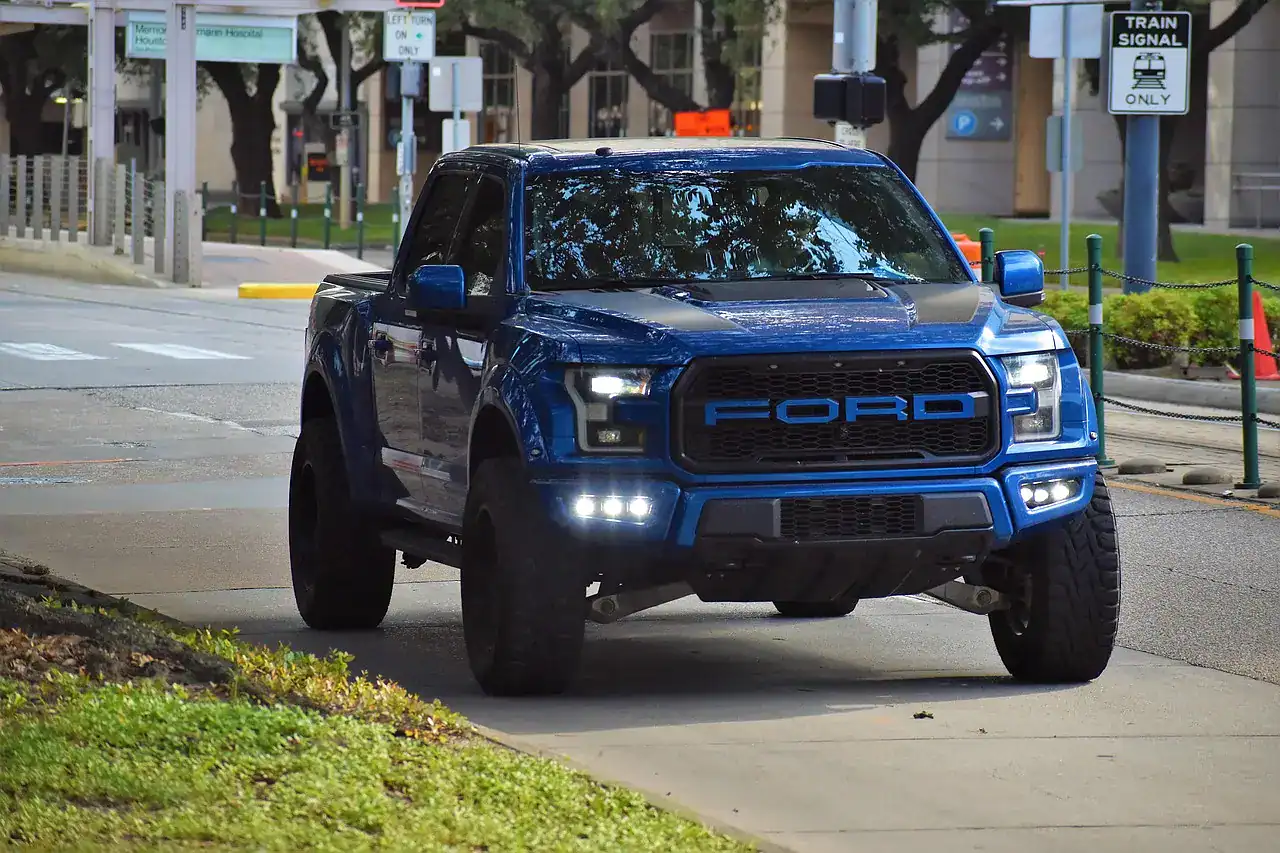
A part-time transfer case has no center differential, so it forces the front and rear driveshafts to turn together. In a turn the front wheels travel farther than the rears. On loose ground the tires slip a little to make up the difference. On dry pavement they cannot, so the driveline winds up and then lets go.
Jeep calls the result crow hop: a bang, a shudder and tire scuffing. GM's service newsletter says 4HI on dry pavement may cause poor handling and a vibration in the steering system, and that choosing the wrong mode for the road can lead to "concern not duplicated" warranty visits.
Each maker words the rule a little differently, but the answer is the same.
| Maker | Manual or source | On dry pavement | Shift limit |
|---|---|---|---|
| Ford | 2017 Expedition owner's manual | Do not use 4H or 4L on dry, hard-surfaced roads. It produces excessive noise, increases tire wear and may damage drive components. | 4L only at 3 mph or less |
| Toyota | 2026 Tacoma owner's manual | 2H is for normal driving on dry, hard-surfaced roads. 4H is for tracks that let the tires slide, such as off-road, icy or snow-covered roads. | 2H to 4H below 62 mph |
| GM | GM TechLink, March 2023 | 4HI is not designed for dry pavement or roads with good traction. AUTO is for variable surfaces. | 4LO stopped or under 3 mph in Neutral |
| Jeep | Jeep 4x4 FAQ | With part-time 4WD, switch to two-wheel drive on dry pavement. Overuse causes driveline noise or binding that can damage parts. | Up to 55 mph in 4x4 high |
Bind is a driving error, not a defect, so the fix is free. Shift to 2H on dry pavement and use 4H only where the tires can slide: snow, ice, loose gravel, sand or mud. The same rule applies on the highway; can you use 4H on the highway covers when it is safe.
If the truck is stuck in 4WD after a bad bind, Toyota's manual says that when the 4HI indicator flashes, the shift has not finished, and you should drive straight ahead while accelerating or decelerating, or drive in reverse. Keep the wheels pointed straight.
How to find the cause, in order
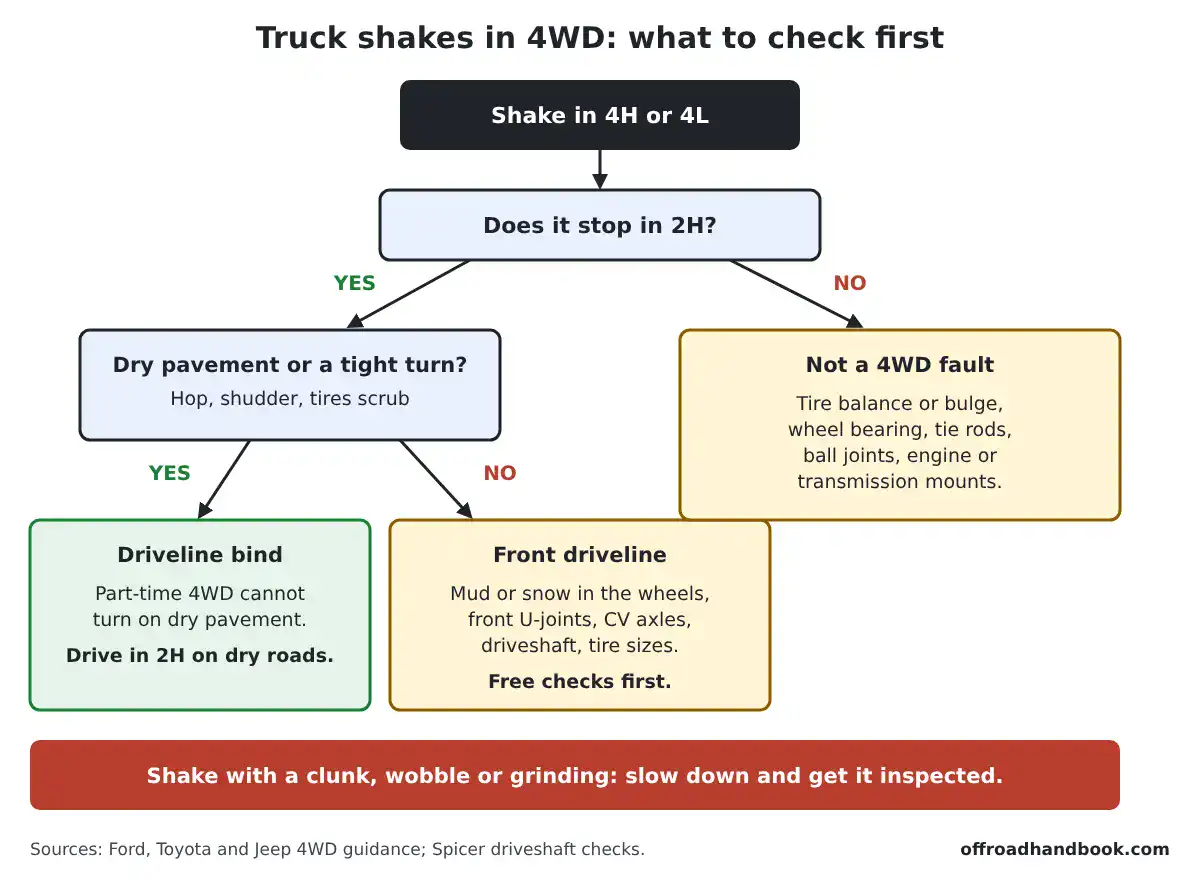
Run the checks in this order. The first four cost nothing and cover most shakes that show up only in 4WD.
- Surface. Is the road dry and are you turning? If so, shift to 2H and drive on. Bind ends right away.
- Mode test. Drive the same road at the same speed in 2H. A shake that disappears points to bind or the front driveline. A shake that stays points to tires, wheels, bearings or steering.
- Wheels. Look behind each wheel and along the driveshafts for packed mud, snow or ice.
- Tires. Confirm that all four are the same size, have similar wear and show no bulges.
- Driveshaft. With the truck on jack stands and chocked, check the yokes, U-joint ends, slip spline and balance weights, as listed in Spicer's driveshaft failure guide.
- Shop. CV axles, front differential, transfer case, wheel bearings, steering parts and mounts need a lift or special tools.
Replace parts only after a test points at them. A front axle shaft will not fix a shake that also happens in 2H, because the front driveline is not what is shaking.
If the shake began after a lift kit, Jeep problems after a lift kit covers driveline angle, wander and death wobble. For clunks after trail runs, see Jeep noises after off-roading.
Symptom, likely cause and fix
| Symptom | Likely cause | Check first | DIY or shop |
|---|---|---|---|
| Hop or shudder in tight turns on dry pavement, only in 4H or 4L | Driveline bind | Shift to 2H | DIY |
| Shake at speed in 4H or 4L on a loose road, gone in 2H | Packed mud or snow, front driveshaft out of balance or worn, mismatched tires | Clear the wheels, compare tire sizes, check the driveshaft | DIY checks, shop for repairs |
| Shake in every mode that rises with speed | Tire or wheel imbalance, bulge, bent wheel | Inspect tires and wheels, then balance | DIY inspect, shop to balance |
| Clunk or bang when engaging 4WD or pulling away | Crow hop, or play in U-joints, yokes or slip spline | Driveshaft checks with the truck supported | Shop |
| Steering wheel wobble, hum that changes in turns | Wheel bearing, tie rod ends or ball joints | Rock and spin each wheel with the axle supported | Shop |
| Vibration at idle or under load in any mode | Engine or transmission mount, or a misfire | Look for a flashing check-engine light | Shop |
| Shake after a lift, bigger tires or new axles | Tire circumference mismatch, driveline angle | Measure each tire around the tread | Shop |
| Shake only in 4A, AUTO or AWD | Not ordinary bind, since those modes are made for pavement | Tire sizes and pressure, then a dealer scan | Dealer |
The key split is 2H. If the shake survives a shift to 2H, a 4WD part is not the cause, and the front driveline can be left alone until the tires, wheels and steering have been cleared.
A mild shudder in a tight turn on dry pavement is not dangerous, but it tells you to stop using 4WD there. Anything stronger needs the checks above before the next highway trip.
Mud and snow packed in the wheels
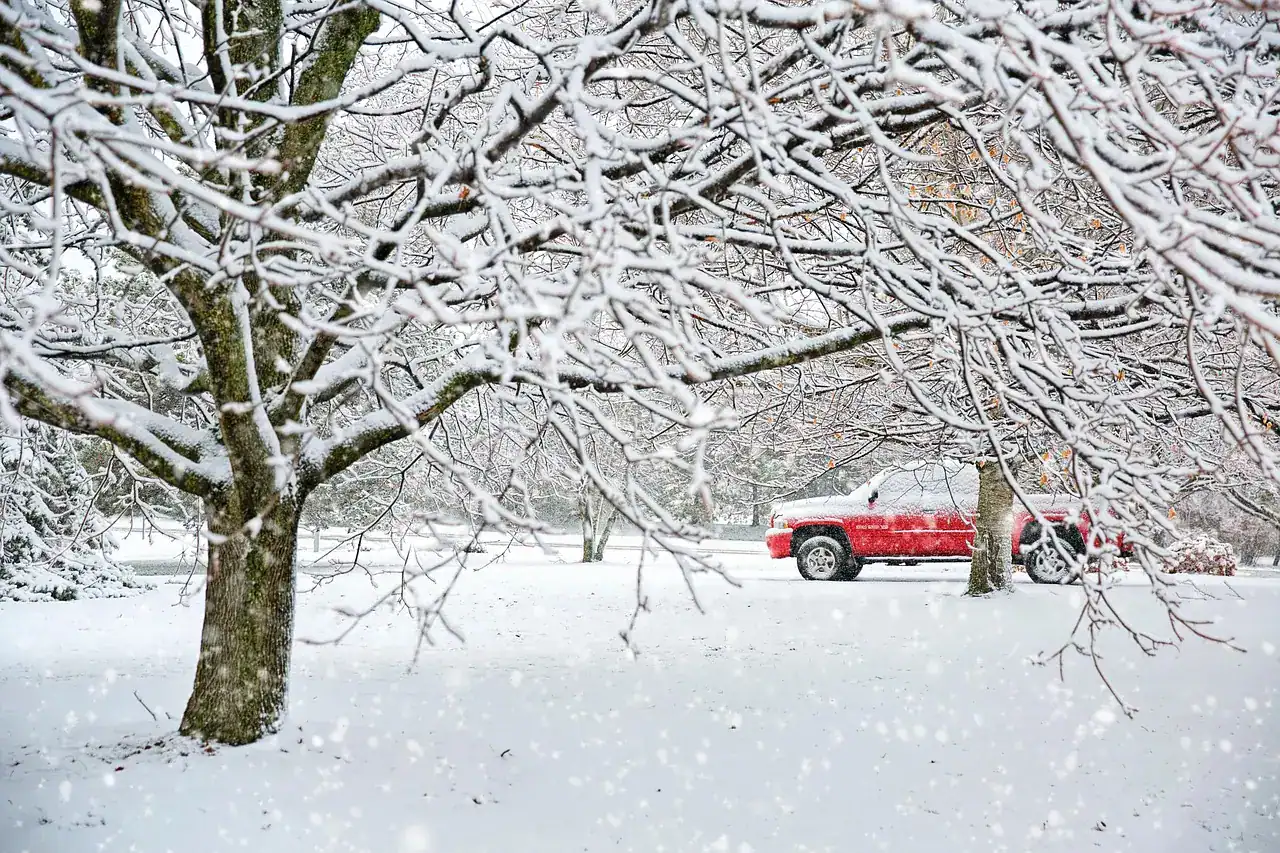
A shake that starts right after a trail run is often not a failed part. Ford's manual warns that excess mud stuck on the tires and rotating driveshafts causes an imbalance that could damage drive components.
Ice or snow packed behind the wheel spokes can unbalance a wheel the same way, though Ford only names mud. Knock the material out with a stick or rinse the wheels at the next stop, then drive the same road again.
Check the inside of each wheel, not just the face, and look along the driveshafts. After muddy trails, rinse the wheels and driveline before highway speeds.
Mismatched or unevenly worn tires
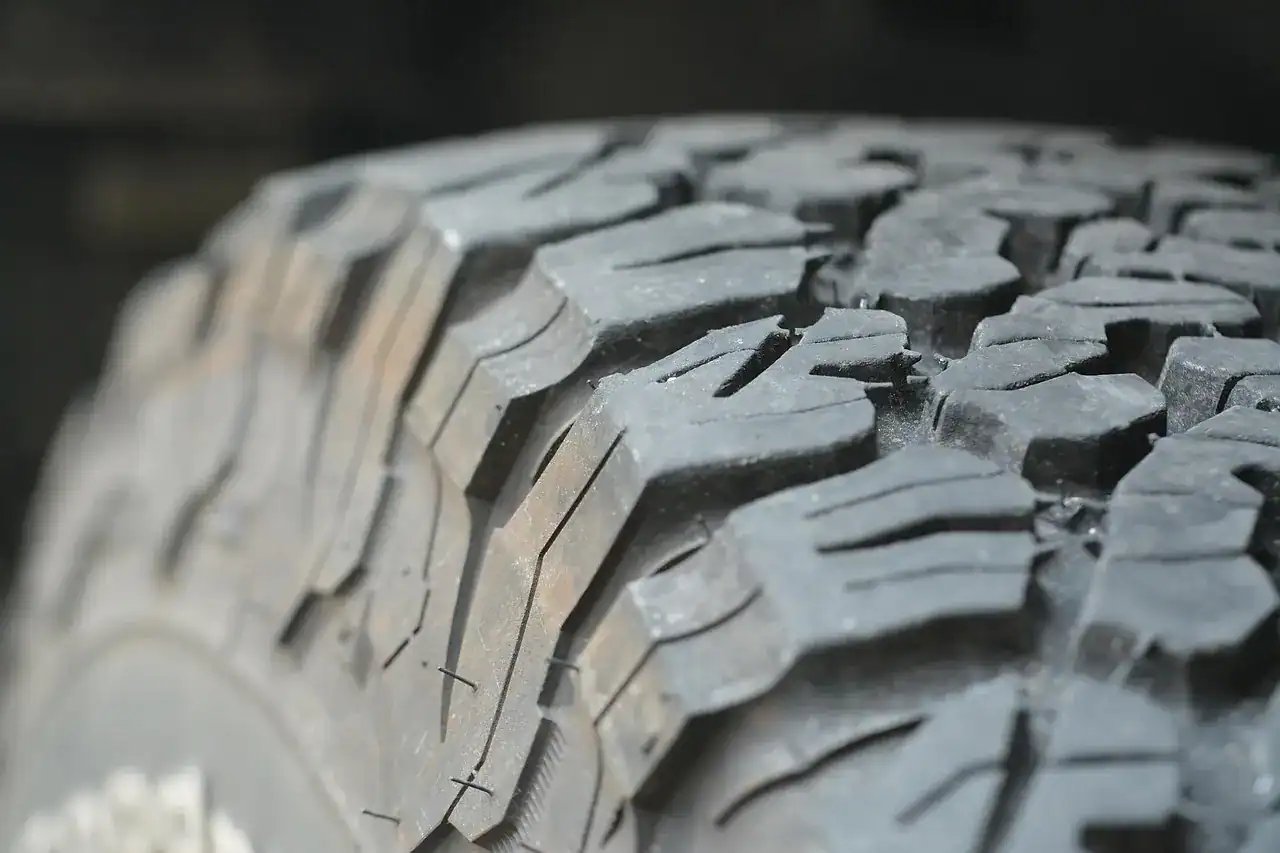
In 4WD the front and rear axles are tied together, so a tire that is smaller or more worn than the others forces its axle to turn faster. A trade guide says tires should be within about ⅛ to ¼ inch of each other in circumference, not diameter.
Our arithmetic shows how little wear that is. Each 1/32 inch of tread lost shortens the circumference by about 0.2 inch (2 × π × 1/32). So roughly 1/32 inch more wear on one axle than the other already sits in that range. This is a geometry estimate, not a manufacturer limit.
Measure with a tape around the tread rather than trusting the sidewall size, and rotate front to rear as your manual says. The tire size calculator converts sizes to real diameters.
Shake checker
Pick your 4WD type and what the truck is doing. The checker lists the checks in order, free ones first and shop work last.
Every line comes from the sources linked in this post. Where the sources say nothing, the checker says so.
The checker is a starting point. Your owner's manual has the final word on modes, shift limits and tire rules for your truck.
When to stop driving
A strong shake at speed, a steering wheel that wobbles, a clunk, or a grinding noise is not safe to ignore. Slow down, get off the road and have the truck inspected, because a failing wheel bearing, tire or U-joint can lead to loss of control.
A driveshaft that is loose at the joints can also come apart. If you find play at a yoke or U-joint, do not drive at highway speed until it is repaired.
FAQs
Most often because it has part-time 4WD and you are on dry pavement, which causes driveline bind. If it also shakes in 2WD, look at tires, wheels, bearings and steering. If mud or snow is packed in the wheels, clear it first.
Only if the road is slippery. Ford, Toyota, GM and Jeep all say part-time 4H is not for dry pavement. Trucks with 4A, AUTO or AWD can be driven on pavement.
Yes. Ford says using 4H or 4L on dry roads increases tire wear and may damage drive components, and Jeep says overuse can cause binding that leads to early part failure.
The front driveshaft and front axle parts only turn under power in 4WD, so a worn U-joint, an out-of-balance shaft or packed mud shows up there. Check the wheels and driveshaft, then have the front driveline inspected.
They can. Tires of different circumference make the axles try to turn at different speeds. A trade guide puts the limit at about ⅛ to ¼ inch of circumference.
No. GM and Jeep describe those modes as made for varying surfaces and pavement, so bind does not explain a shake there. Check tires, then ask a dealer to scan for 4WD faults.
Related guides
- Can I Drive My F-150 in 4A All the Time? What Ford Recommends
- Why Does My Jeep Shake at 40 MPH? Common Causes and How to Fix
- 4WD vs AWD vs 4A: What Each Setting Does and When to Use It

I'm Suryashankar Dasgupta, the founder of Off-Road Handbook. I've been off-roading for years in the USA, including California and Texas, and have ridden mountain and desert terrain abroad. I've also driven a Jeep Compass for more than seven years, so I know the day-to-day side of Jeep ownership first-hand, from the Uconnect screen to the warning lights. Every guide here is researched from manufacturer owner's manuals, NHTSA recall and service-bulletin records and other trusted sources, checked against them before it is published, and corrected when we find a mistake. You can read how we work in our editorial policy: https://offroadhandbook.com/editorial-policy/
Like our off-road guides? Add Off-Road Handbook as a Google Preferred Source so our latest Jeep, ATV, UTV, trail, recovery, and off-road troubleshooting articles can appear more often in your Google Search experience.
Add us as a Preferred Source