Can You Use 4H on the Highway? When It's Safe and When It's Not
Last updated on October 26th, 2026 at 07:53 pm
You can use 4H on the highway only when the road is slippery or your truck has an automatic mode. On a part-time 4WD system, the plain 2H, 4H and 4L selector on most pickups and Wranglers, 4H is for snow, ice, mud and loose gravel, not dry pavement. Jeep, Ram, Chevrolet and Ford say so in their owner’s manuals.
Speed is not the main limit. The Wrangler, Ram and Silverado manuals set speed caps for low range, not for 4H. What does the damage is grip: on clean pavement the axles cannot slip, so the driveline binds in turns.
Below are the manual rules by vehicle, the shift-speed limits, what to do if you already drove on a dry road in 4H, and a checker for your own truck.
Quick decision: 2H, automatic or 4H
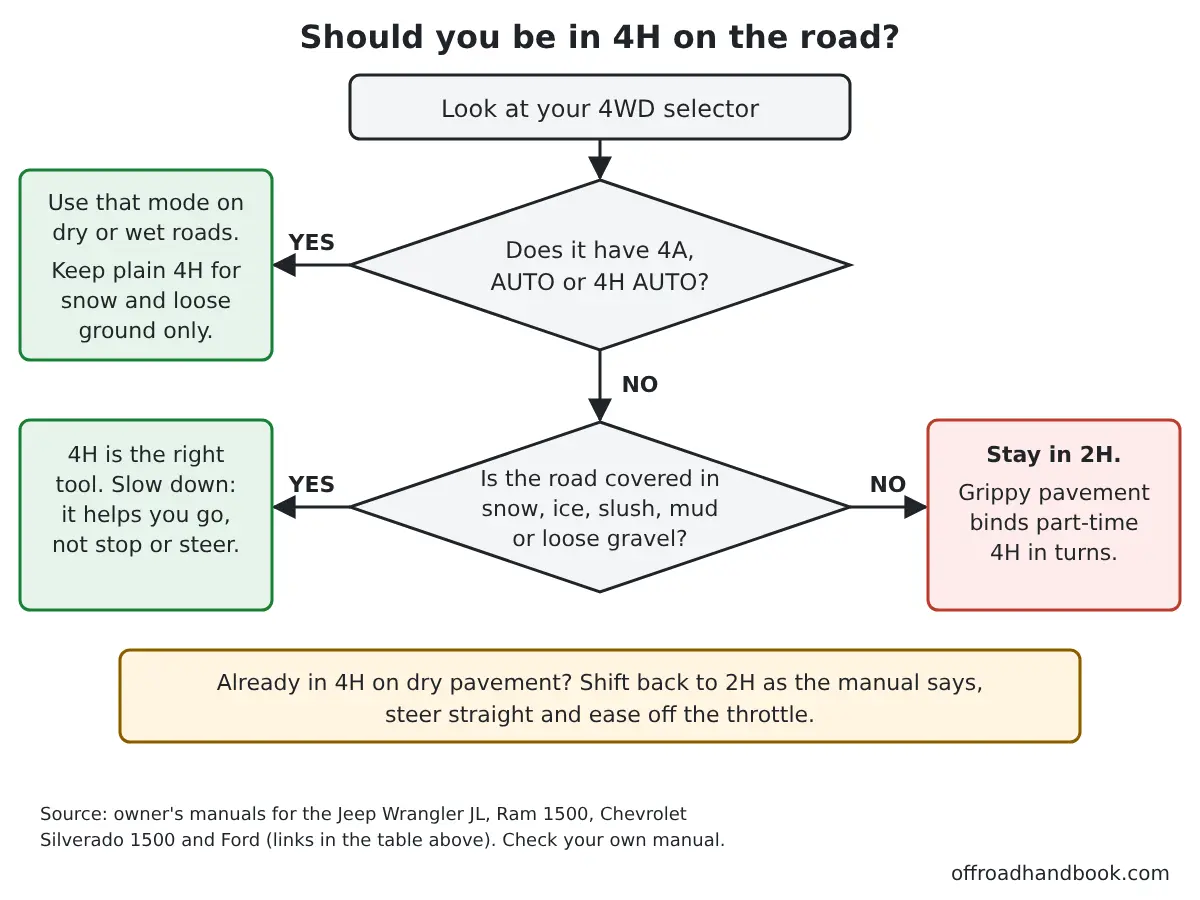
Look at the selector first. If it has 4A, AUTO or 4H AUTO, that is the mode the manuals allow on dry and wet roads. If it only has 2H, 4H and 4L, you have part-time 4WD and 2H is the setting for pavement.
On a slick road, part-time 4H is what the system is for. The checker further down handles your exact vehicle, surface and speed.
What each manual says about 4H on dry pavement
| Vehicle (manual) | What it says about 4H on dry roads | Normal road setting |
|---|---|---|
| Jeep Wrangler JL, 2H / 4H / 4L (2023) | 4H and 4L are “intended for loose, slippery road surfaces only”; on hard-surfaced roads they “will cause increased tire wear and damage to the driveline components” | 2H |
| Jeep Wrangler JL, with 4H AUTO (2023) | Same warning for 4H PART TIME. The case is designed to be driven in 2H or 4H AUTO on dry hard surfaced roads | 2H or 4H AUTO (more fuel than 2H) |
| Ram 1500 (2026) | 4WD HIGH is for loose or slippery surfaces; on dry, hard surfaced roads it “may cause increased tire wear and damage to the driveline components” | 2WD, or 4WD AUTO where fitted |
| Chevrolet Silverado 1500 (2024) | “Do not drive on clean, dry pavement” in 4HI or 4LO “for an extended period”: overheating, oil leakage, front axle damage, premature powertrain wear, steering vibration, tire wear, noise | 2HI, or AUTO when conditions vary |
| Ford (2016 Expedition manual) | “Do not use 4H or 4L mode on dry, hard surfaced roads”; 4H is for consistently slippery or loose surfaces | 4A is appropriate for all on-road conditions |
| Toyota Tacoma (2018 guide) | Keep in 2WD for best fuel economy and performance under normal driving conditions | 2WD |
The risk each maker admits to differs. Jeep says 4H on hard roads “will cause” wear and damage, Ram says it “may”, and Chevrolet is the only one that talks about time, warning against an extended period.
None of these manuals gives a safe distance or time on dry pavement, so any mile figure you read online is a guess. Binding shows up in turns, which is why the advice is to stay out of 4H on dry roads rather than to count miles.
Shift-speed limits by vehicle
Shift speed is the limit people usually mean when they ask how fast you can go in 4H. It applies to engaging the mode, not to driving once it is engaged.
| Vehicle (manual) | Shifting 2H to 4H while moving |
|---|---|
| Jeep Wrangler JL (2023), both transfer cases | Stopped or moving. Preferred shifting speed 0 to 45 mph; do not accelerate while shifting |
| Ram 1500 (2026) | Stopped or in motion. No mph limit stated; the shift will not complete if wheels are spinning |
| Chevrolet Silverado 1500 (2024) | Between 2HI, 4HI and AUTO “at normal driving speed”. No mph limit stated |
| Ford (2016 Expedition manual) | At a stop or while driving. No mph limit stated |
| Toyota Tacoma (2018 guide) | Below 62 mph |
| Toyota 4Runner, part-time (2018 guide) | Below 50 mph (lever type) or 62 mph (push-and-turn selector) |
Two corrections to numbers that float around. Jeep’s wording is a “preferred” 0 to 45 mph, not a flat 50 or 55 mph cap, and the Ram, Silverado and Ford manuals state no mph limit for the 2H to 4H shift at all.
Once you are in 4H, the manuals checked set no top speed. Their caps are for low range: Jeep and Ram’s four-position case say 25 mph in 4L, and Chevrolet says to keep 4LO below 45 mph. For the 4L procedure, see our guide on how to shift into 4-low.
Road conditions set the real limit. Jeep’s manual warns that four-wheel drive creates a tendency to exceed safe turning and stopping speeds, and says not to go faster than conditions permit.
When 4H on the road is the right call
Manuals describe 4H as being for “loose, slippery road surfaces” (Jeep, Ram) or “consistently slippery or loose surfaces” (Ford). That covers three cases.
Snow-packed and icy roads
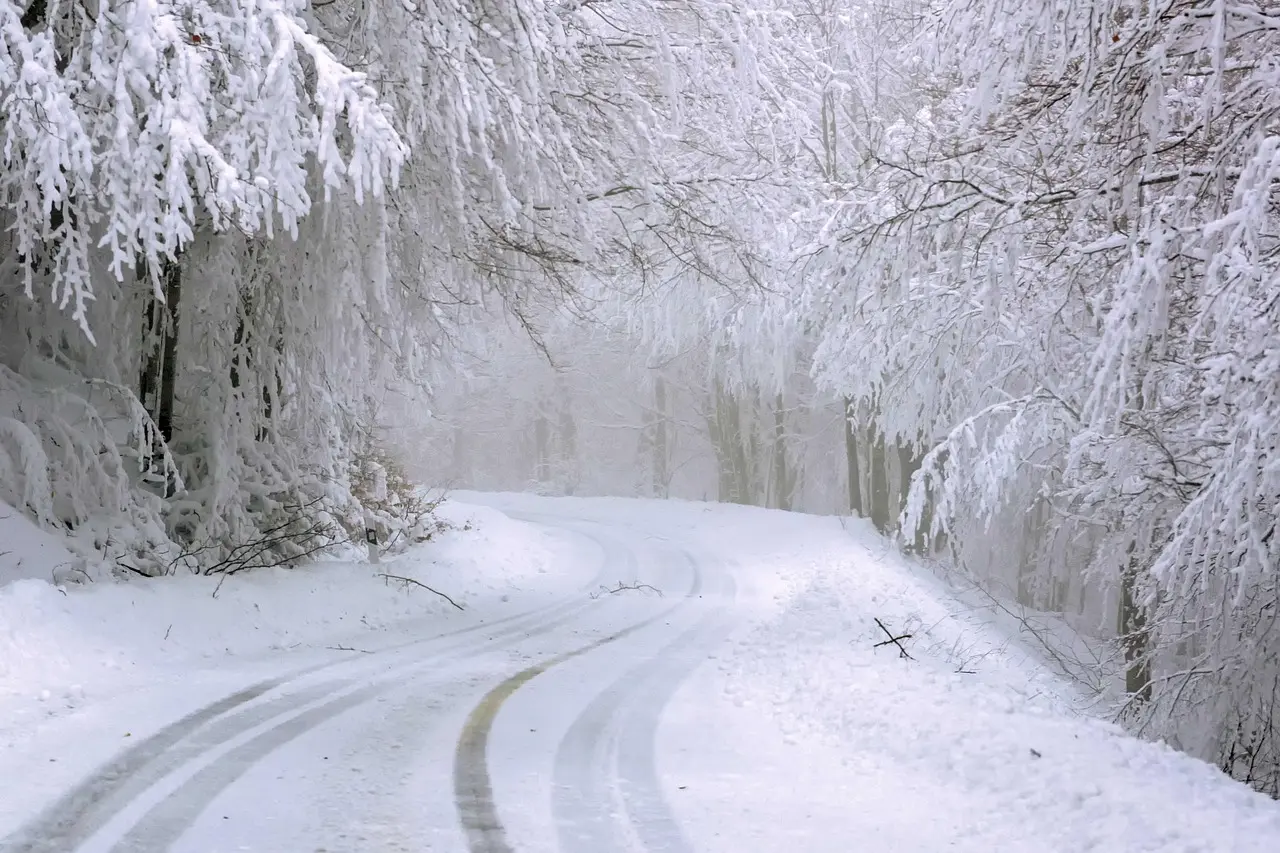
When snow or ice covers the lane, the tires slip enough under power to relieve the stress between the axles, so part-time 4H does what it was built for. Chevrolet’s manual lists snowy or icy roads as a use for 4HI.
Slow down anyway. 4H adds traction for accelerating, not for braking or cornering.
Gravel, dirt and mud
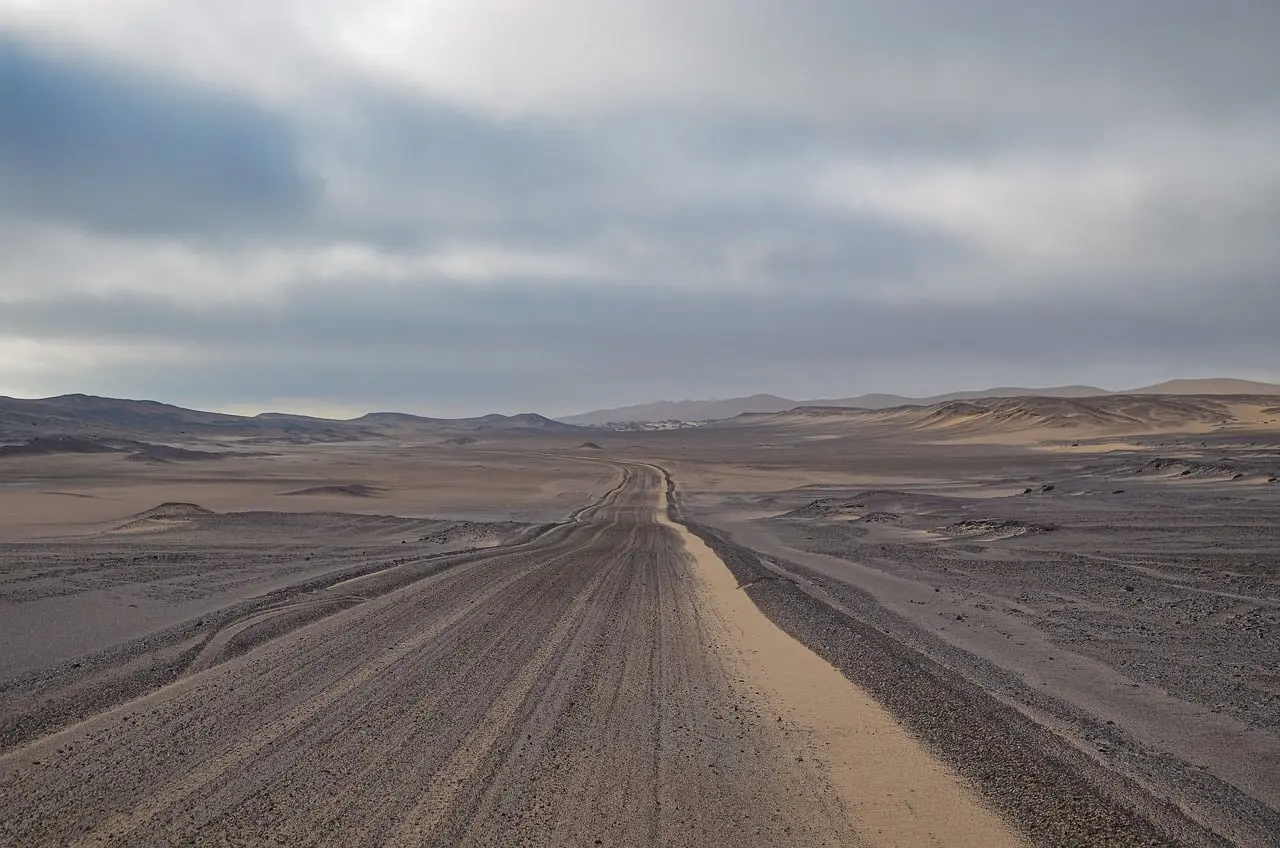
Loose gravel, packed dirt and mud let the tires slip a little, which is the condition 4H is designed for. Keep the speed down on loose ground, because 4H does not shorten stopping distance.
Matching tires matter here. Jeep’s manual says four-wheel drive depends on equal tire size, type and circumference, and that any difference affects shifting and can damage the transfer case. Our tire size calculator shows how far a new size is from stock.
Wet roads and patchy snow
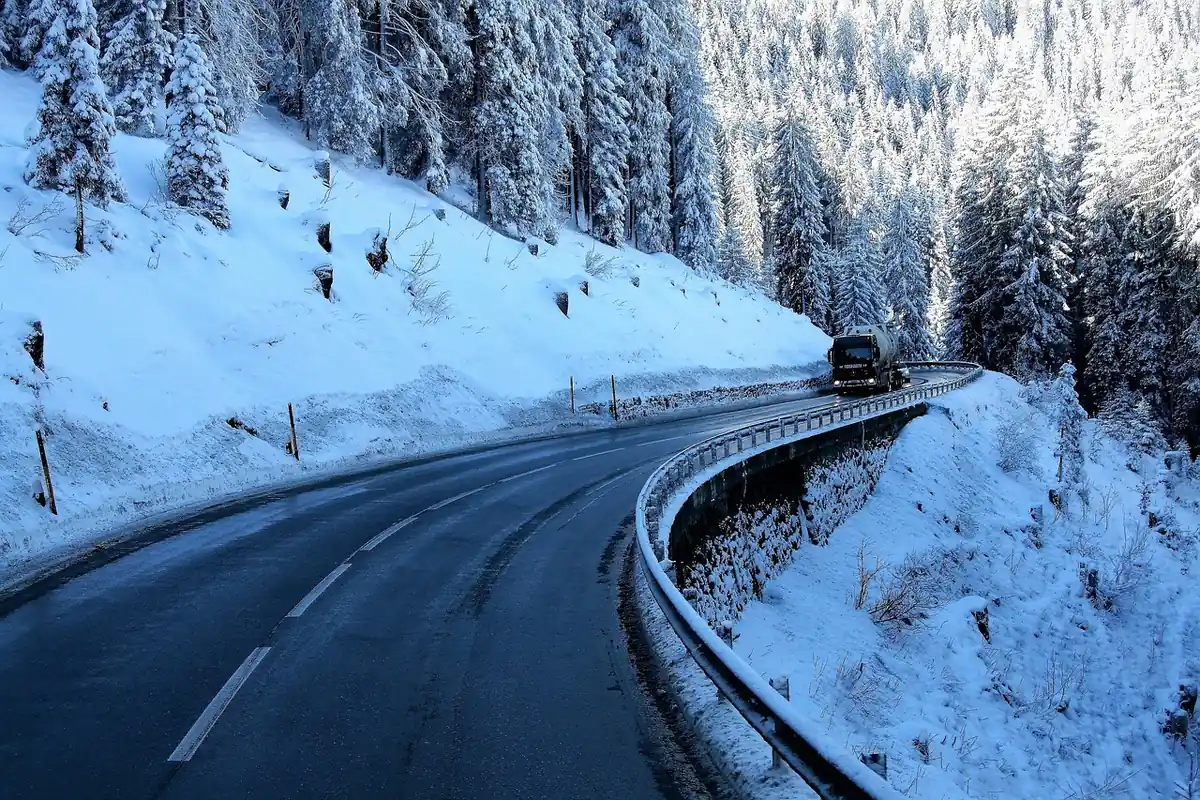
Clean wet asphalt still grips, so the tires cannot slip to relieve binding in a turn. The manuals do not list rain as a 4H condition; this is our reading of their “slippery” wording. Slush, standing water and mud tracked onto the road do count.
If you have 4A, AUTO or 4H AUTO, use it on wet or patchy roads. On a part-time truck, stay in 2H unless the road is truly slick, and shift to 2H if turns start to feel tight.
What happens if you drive in 4H on dry pavement
In part-time 4H, the transfer case locks the front and rear driveshafts together so both axles turn at the same speed, as the Jeep manual describes. In a turn the front wheels travel a longer path than the rear wheels.
On loose ground the tires slip a little and release the tension. On dry pavement they cannot, so the driveline winds up. This is called driveline binding, or windup.
Signs include heavy steering in tight turns, tires that chirp, skip or hop, and a jerk when you straighten out. For other causes of a shudder in four-wheel drive, see why a truck shakes in 4-wheel drive.
The costs the manuals name: increased tire wear and driveline damage (Jeep, Ram, Ford), and overheating, oil leakage and front axle damage (Chevrolet).
How to clear driveline bind
- Slow down and shift back to 2H, or to 4A, AUTO or 4H AUTO if you have it, using your manual’s procedure. Jeep, Ram, Ford and Chevrolet allow the shift while moving.
- If it will not release, check the tires. Jeep lists uneven tire wear, low or uneven tire pressure, heavy loads and cold as causes of delayed shifts out of four-wheel drive.
- Jeep and Ram say the transfer case will not complete a shift while only the front or rear wheels are spinning. Ease off the throttle and steer straight. On a Ram, push the current position, wait five seconds and retry.
- If steering stays heavy, noises persist or a 4WD warning stays on, have a shop inspect it. Ram says a lit SERV 4WD light means service is required.
Check your own situation
Pick your vehicle, the road surface and what you are doing. The checker shows the manual rule that applies and the free checks first.
Every answer comes from the manuals and guides cited in this post. Where they are silent, the checker says so, and lines marked “our reading” are our own judgment, not Toyota, Jeep or Ram wording.
Part-time, automatic, full-time and AWD in one minute
- Part-time 4WD. A 2H, 4H, 4L selector. 4H locks the axles together, so it is for slippery ground only.
- Automatic 4WD. 4A, AUTO, 4H AUTO or 4WD AUTO. The Jeep, Ram, Chevrolet and Ford manuals above allow it on regular roads. Ford owners can read what Ford recommends in our F-150 4A guide.
- Full-time 4WD with a lockable center differential. The 2018 4Runner guide marks H4L and L4L as center differential locked. A locked center differential ties the axles together like 4H (our reading), so check your full manual for which position suits dry roads.
- AWD. No 4H to select. Our 4WD vs AWD vs 4A guide compares all four.
FAQ
Can I drive in 4H on a snowy highway?
Yes, if snow or ice covers the lane, and slowly. Chevrolet lists snowy or icy roads as a use for 4HI. Switch back to 2H when the pavement clears.
How fast can you drive in 4H?
The Wrangler, Ram and Silverado manuals set no top speed for 4H, only for low range. Drive to the road conditions, because 4H does not help you stop.
Can I shift into 4H at highway speed?
It depends on the vehicle. Jeep prefers 0 to 45 mph, the Tacoma guide says below 62 mph, and the 4Runner guide says below 50 or 62 mph by selector type. Ram, Chevrolet and Ford state no mph limit. When in doubt, slow down first.
Does 4H use more gas?
Yes. Ram says 2WD has greater fuel economy because the front axle is not engaged, and Jeep and Chevrolet say their automatic modes use more fuel than 2H or 2HI.
Related guides
- 4WD vs AWD vs 4A: What Each Setting Does and When to Use It
- How to Shift Into 4-Low (and What to Do When It Won’t Go)
- Why Does My Truck Shake in 4-Wheel Drive?
- Tire size calculator

I'm Suryashankar Dasgupta, the founder of Off-Road Handbook. I've been off-roading for years in the USA, including California and Texas, and have ridden mountain and desert terrain abroad. I've also driven a Jeep Compass for more than seven years, so I know the day-to-day side of Jeep ownership first-hand, from the Uconnect screen to the warning lights. Every guide here is researched from manufacturer owner's manuals, NHTSA recall and service-bulletin records and other trusted sources, checked against them before it is published, and corrected when we find a mistake. You can read how we work in our editorial policy: https://offroadhandbook.com/editorial-policy/
Like our off-road guides? Add Off-Road Handbook as a Google Preferred Source so our latest Jeep, ATV, UTV, trail, recovery, and off-road troubleshooting articles can appear more often in your Google Search experience.
Add us as a Preferred Source