How to Prep Your Jeep for Off-Road Trails: Beginner Checklist
Last updated on October 19th, 2026 at 12:36 pm
To get a Jeep trail-ready, inspect tires, wheels, fluids, battery and underbody; set tire pressure for the terrain (often 15 to 20 psi on dirt and rock); pack rated recovery gear, a compressor and a communication plan; and check the route, weather and access rules. The checklists below cover each step.
Start with a pre-trail inspection that catches the failures most people miss
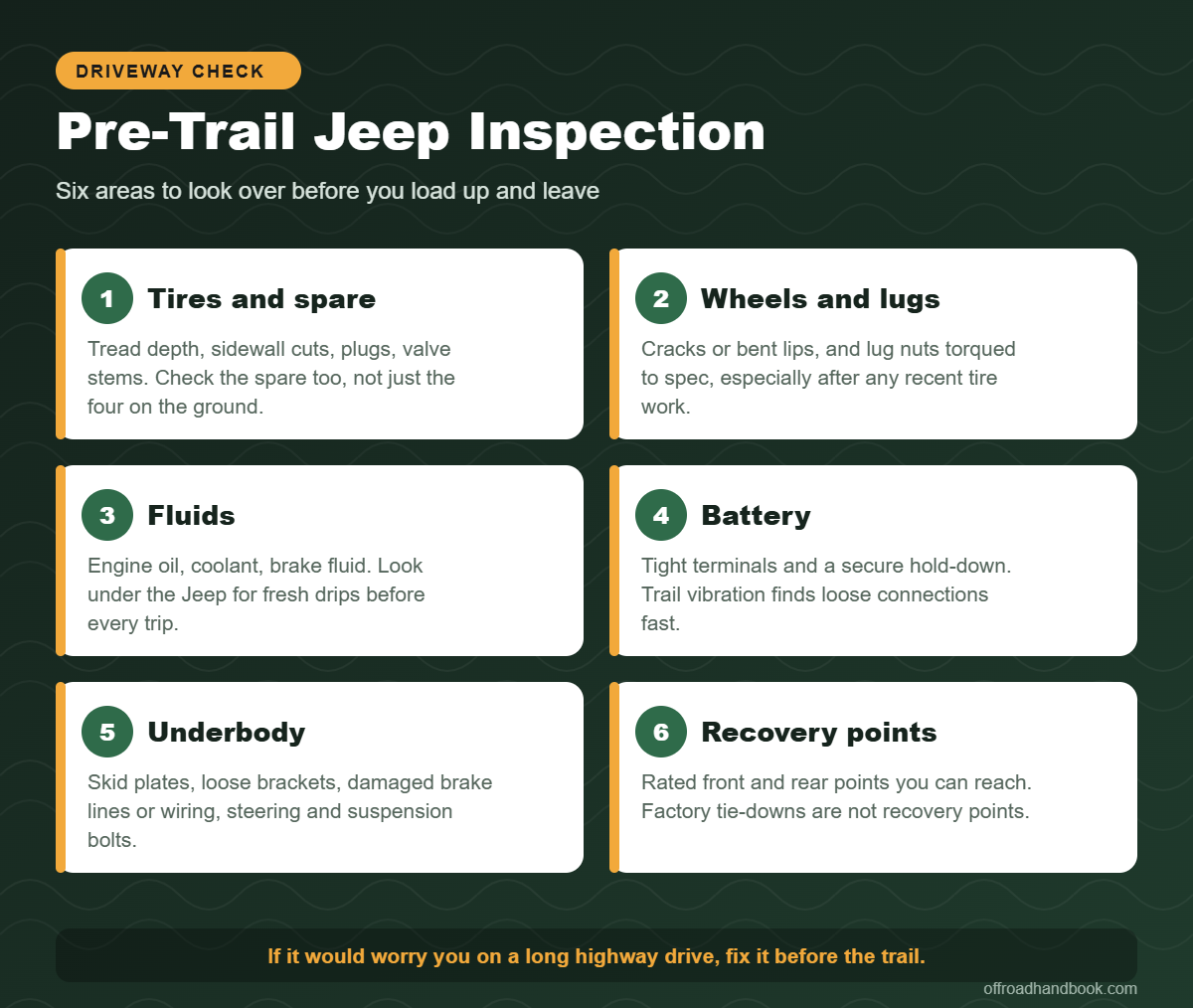
Most trail problems begin in the driveway, not on the mountain. A loose battery terminal, low differential fluid or a cut sidewall can end your day faster than any obstacle, so check the Jeep itself before you think about technique. If your Wrangler has Stop/Start, it may carry a second small battery, so see which Wranglers have two batteries.
Walk around the Jeep and inspect what takes abuse first: tires, wheels, steering parts, skid plates, underbody wiring, and fluid leaks. Then open the hood and confirm engine oil, coolant, brake fluid, and washer fluid are all at proper levels. If your rig has seen recent modifications, re-check torque on suspension and wheel hardware after the break-in miles.
On a Cherokee, Renegade or Compass with the 2.4L engine, check the dipstick before every trip; our Jeep 2.4 engine problems guide explains the oil consumption test and the recalls.
What to inspect before you load up
| Area | What to check | Why it matters on trail |
|---|---|---|
| Tires | Tread, cuts, punctures, valve stems | Traction and puncture resistance |
| Wheels | Cracks, bent lips, lug torque | Prevents vibration and wheel loss |
| Fluids | Engine oil, coolant, brake fluid | Heat and braking loads rise off-road |
| Battery | Tight terminals, secure hold-down | Vibration can cause electrical failure |
| Undercarriage | Leaks, loose skid plates, damaged lines | Protects vital parts from rocks |
A good rule is simple: if a part would worry you on a long highway trip, it deserves extra attention before a trail day.
Older hoses, serpentine belts, and rubber bushings often look fine until heat and flex expose the weakness. If your Jeep is more than a few years into regular trail use, replace suspect rubber before the trip, not after the breakdown.
Set up tires, drivetrain, and clearance for the terrain you'll actually face
Tires change how your Jeep behaves more than most bolt-on parts. Airing down puts more tread on the ground, improves grip and softens the ride. Many drivers start around 15 to 20 psi on dirt and rock, but the right number depends on tire size, load, sidewall construction and terrain. Without beadlock wheels, stay conservative so the tire bead stays seated, and see our off-road tire pressure guide for terrain-by-terrain starting points.
Shift into 4H or 4L before you reach the obstacle, not after the tires start spinning. Engaging early keeps you in control and is easier on the driveline. Your owner's manual explains whether your transfer case shifts on the move or needs the Jeep stopped in neutral. If you're still learning the difference, review these 2WD vs 4WD explanations before your trip.
Tire and traction choices that actually matter
- Match the tire to the trail. Mud-terrain tires aren't always better on mixed rock and dirt.
- Air down carefully. Bring a gauge and know how you'll air back up.
- Inspect the spare. A perfect set of four means little if the spare is flat or dry-rotted.
- Use 4H for faster loose surfaces, 4L for slow technical work. Shift early, not late.
Quick setup priorities by trail type
| Trail type | Best prep focus | Common mistake |
|---|---|---|
| Rocky | Sidewall protection, skid plates, low-range use | Too much speed |
| Sand | Lower tire pressure, momentum, recovery boards | Stopping on soft climbs |
| Mud | Tread cleaning, tow points, steady throttle | Over-spinning tires |
| Forest roads | Tire pressure, visibility, spare fuel planning | Assuming it's an easy drive |
For tire sizing, load ratings and wheel choices, browse our off-road tires and wheels guides.
Ground clearance is useful, but armor is often cheaper insurance
Many beginners focus on lift height first. In practice, decent skid plates, recovery points, and good line choice often protect a lightly modified Jeep better than a tall build with weak underbody protection.
Pack recovery and safety gear for self-reliance
Don't run remote trails alone. Travel with at least one other vehicle and carry a way to call for help where phones don't work, such as a satellite messenger or radios your group has tested. A mild trail can turn complicated when the weather changes or a simple puncture happens far from cell coverage.
Recovery gear you should carry every trip
- Rated recovery points front and rear
- Tow strap or kinetic rope matched to vehicle weight
- Shovel for sand, mud, and trail repairs
- Air compressor for reinflation after airing down
- Tire repair kit with plugs and valve tools
- Gloves, flashlight, and first-aid kit
- Water and weather layers even on short trips
Add gear slowly and buy for real use. Cheap shackles, weak straps, and decorative accessories can create risk.
Communications matter more than one extra light bar
If your group uses radios, test them before leaving. Also share your route, expected return time, and a backup exit. Navigation still matters when screens fail, so keep an offline map or printed route notes in the Jeep.
Plan the route, weather window, and driving strategy before the tires hit dirt
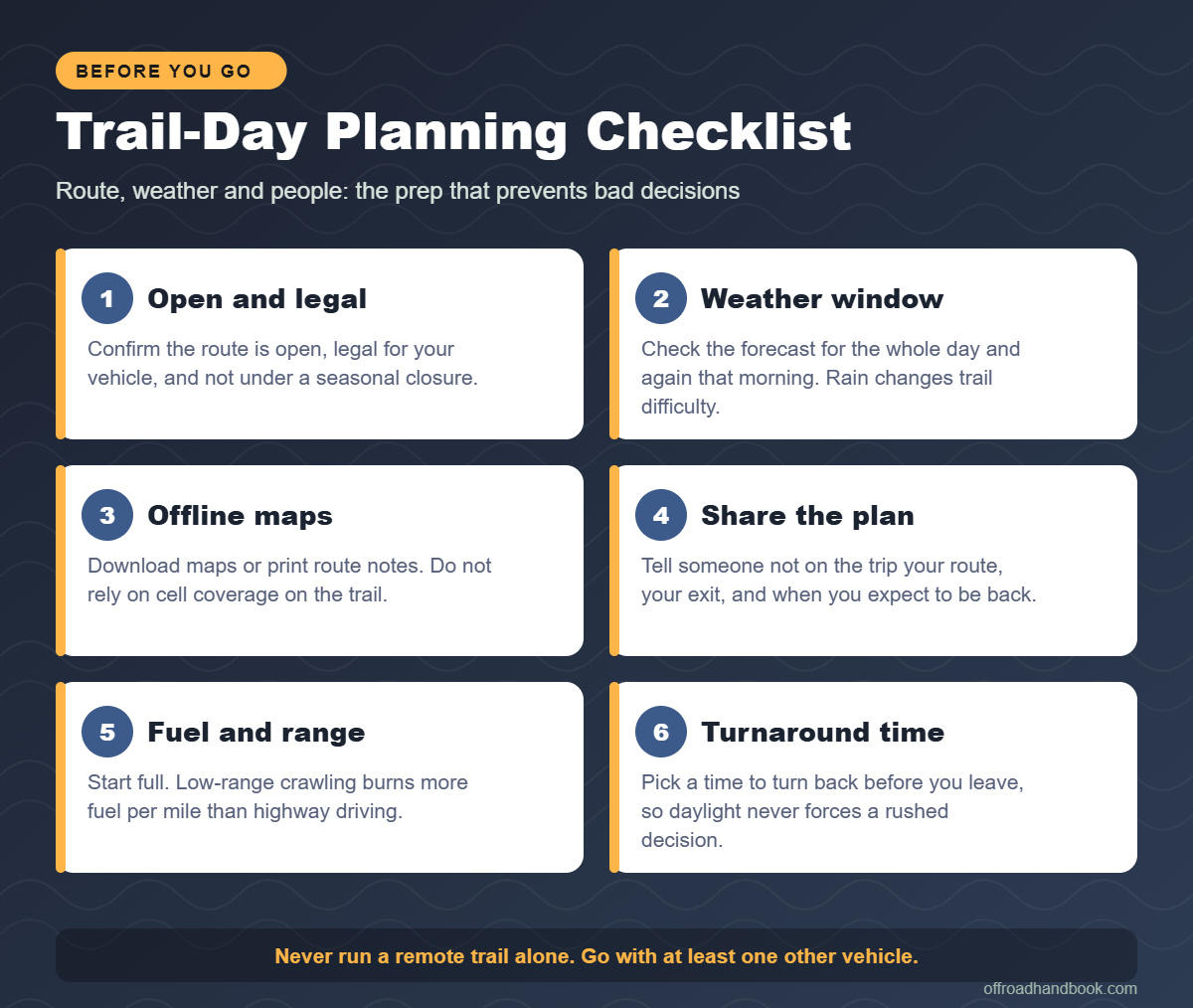
Trail prep is partly mechanical, but route planning is what prevents bad decisions on the day.
Start by checking trail difficulty, seasonal closures, fuel range and legal access. Some routes look easy online and become very different after rain, snowmelt or washouts. Our off-road trail guides can help you compare your Jeep's setup with what a trail actually demands.
A simple pre-trip planning checklist
- Confirm the route is open and legal.
- Check weather for the full window, not just departure time.
- Download maps for offline use.
- Share your route with someone not in the group.
- Set a turnaround time before sunset pressure starts.
Weather can turn a beginner trail into a recovery job
Heavy rain, flooding, or rockfall can change how safe a route is very quickly, so treat the forecast as a core part of your planning, not an afterthought. Check it again the morning you leave.
Use a post-trail routine so your Jeep is ready for the next trip
Preparation doesn't end when you get home. Dirt hides leaks, bent brackets, and torn boots. Cleaning and re-checking the Jeep right after a trail run is the easiest way to catch damage before it grows expensive.
What to do after every trail day
- Wash mud from the undercarriage and brakes
- Reinflate tires to road pressure
- Inspect sidewalls, wheels, and valve stems
- Check for fresh leaks and scraped fluid lines
- Retorque lugs and inspect suspension bolts
- Restock first-aid and recovery gear
Treat every trail day as part of your maintenance cycle. That habit is what separates random trail days from consistent, safe off-roading.
The short version
A trail-ready Jeep doesn't come from one expensive upgrade. It comes from a sound inspection, the right tire setup, useful recovery gear, and a route plan that respects weather and difficulty.
Not sure which recovery line to pack? See our comparison of a kinetic rope, snatch strap and tow strap.
Related guides
- Jeep Oil Change Required Message: What It Means and How to Reset
- Jeep Touchscreen Not Working? Causes and How to Fix Uconnect Fast
- 12 Signs Your Jeep Transmission Is Failing and What to Do Next
Heading for a national forest road? See whether your vehicle suits each Forest Service road maintenance level.
Thinking about a winch for your trail rig? Our winch size calculator covers GVWR, slope and drum layers.
Keep a spare fob and your roadside number handy; our guide to getting back into a locked Jeep Cherokee shows the safe options.

I'm Suryashankar Dasgupta, the founder of Off-Road Handbook. I've been off-roading for years in the USA, including California and Texas, and have ridden mountain and desert terrain abroad. I've also driven a Jeep Compass for more than seven years, so I know the day-to-day side of Jeep ownership first-hand, from the Uconnect screen to the warning lights. Every guide here is researched from manufacturer owner's manuals, NHTSA recall and service-bulletin records and other trusted sources, checked against them before it is published, and corrected when we find a mistake. You can read how we work in our editorial policy: https://offroadhandbook.com/editorial-policy/
Like our off-road guides? Add Off-Road Handbook as a Google Preferred Source so our latest Jeep, ATV, UTV, trail, recovery, and off-road troubleshooting articles can appear more often in your Google Search experience.
Add us as a Preferred Source