ATV Ramp Length by Truck Bed Height (and When You'll High-Center)
This post contains Amazon affiliate links. As an Amazon Associate I earn from qualifying purchases, at no extra cost to you.
To find the right ATV ramp length, divide your tailgate height by the sine of the angle you're willing to climb. Polaris caps its Sportsman ATVs at a 25° incline, and a 25° ramp works out to about 2.4 times the rise. A 36-inch tailgate needs a ramp just over 7 feet long, and a 48-inch tailgate needs about 9.5 feet.
There's a second check most ramp charts skip. Your ATV's belly has to clear the tailgate edge while the front wheels are in the bed and the rear wheels are still on the ramp. The calculator below runs both checks and tells you which one sets the length for your truck and machine.
ATV Ramp Length Calculator
Measure on level ground with the truck loaded the way it will be when you load the ATV. Rise is the distance from the ground to the top of the open tailgate. Wheelbase is axle center to axle center. Ground clearance is the lowest point under the middle of the machine.
ATV ramp length and high-center check (inches unless noted)
How the numbers work: ramp length equals rise ÷ sin(angle). The 25° figure comes straight from the Polaris Sportsman 850/XP 1000 owner's manual, which says never to operate the ATV on hills steeper than 25 degrees. A ramp is a narrow, often slick hill, so that's the ceiling, not a target.
The high-center check uses breakover geometry. It finds the line tangent to both tires that passes through the belly point midway between the axles, which is how the federal definition of breakover angle (49 CFR 523.2) measures it. If your machine's lowest point is not near the middle, treat the result as a best case.
I built the calculator on the 25° limit because it's the only hard incline number I could find in an ATV maker's own manual. The ramp makers whose calculators come up for this search don't publish their formulas.
Minimum Ramp Length by Tailgate Height
If you just want a number for your truck, use this table. Measure your tailgate rather than trusting a spec sheet. Lift kits, bigger tires, a loaded bed and even tire pressure all change it by a few inches.
| Rise (ground to top of tailgate) | Shortest ramp at 30° | Minimum ramp at 25° |
|---|---|---|
| 24 in | 4.0 ft (48 in) | 4.7 ft (57 in) |
| 30 in | 5.0 ft (60 in) | 5.9 ft (71 in) |
| 36 in | 6.0 ft (72 in) | 7.1 ft (85 in) |
| 42 in | 7.0 ft (84 in) | 8.3 ft (99 in) |
| 48 in | 8.0 ft (96 in) | 9.5 ft (114 in) |
| 54 in | 9.0 ft (108 in) | 10.6 ft (128 in) |
| 60 in | 10.0 ft (120 in) | 11.8 ft (142 in) |
The 30° column is there because it's the steepest setup any ramp manual we found allows. The Harbor Freight 80-inch folding ramp manual says not to use that ramp if the tailgate is higher than half the ramp's length. That ramp is rated for 2-wheeled vehicles only, so don't treat 30° as an ATV number.
Black Widow, a ramp maker, says a ramp of 7 to 9 feet hits the sweet spot for most pickups. Run that through the math and a 7-foot ramp stays at or under 25° up to about a 35.5-inch rise. A 9-foot ramp gets you to about 45.6 inches. Over that, you need a longer ramp or a lower tailgate.
Will Your ATV High-Center on the Tailgate?
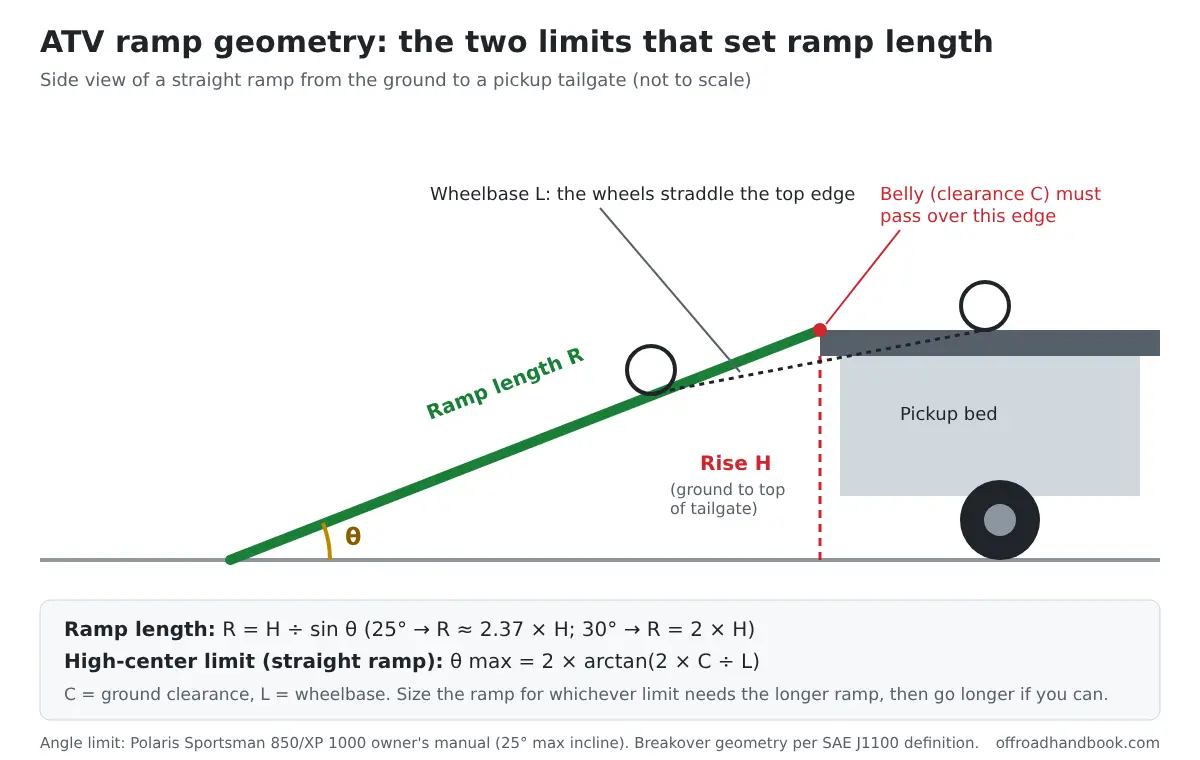
Halfway into the bed, the ATV bridges a crest. The front tires are on the flat bed floor, the rear tires are on the ramp, and the tailgate edge points straight up at the frame. If the angle between ramp and bed is bigger than the machine's breakover angle, the belly lands on the edge and the rear wheels lose traction.
For most utility ATVs, this isn't the limit that bites. The table shows the steepest straight ramp a machine can crest, calculated with 25-inch tires as an example. Put your own tire size in the calculator, because tire size shifts the limit a little.
| Wheelbase | 5 in clearance | 7 in clearance | 9 in clearance | 11 in clearance |
|---|---|---|---|---|
| 45 in | 26.7° | 37.8° | 48.9° | 59.7° |
| 50 in | 23.8° | 33.6° | 43.4° | 53.0° |
| 55 in | 21.5° | 30.3° | 39.1° | 47.7° |
Here's the takeaway. At 7 inches of clearance or more, the 25° incline limit is the stricter rule. At around 5 inches, with a long wheelbase, the high-center angle drops below 25°. That covers lowered sport quads, a skid plate hanging low or a machine squatting under a load. In that case the high-center check sets the length.
Arched ramps exist for exactly this problem. The curve spreads the angle change over the ramp instead of putting it all at the tailgate. Black Widow notes that a longer or arched ramp prevents high-centering. If you're shopping, look at arched folding ATV loading ramps. Check the rated capacity against your ATV's weight (check the current price on Amazon).
This is the same breakover math the site's approach, departure and breakover angle calculator uses for trucks and Jeeps. If you also want to know whether your truck will scrape coming off a curb or a trail ledge, it's worth a look.
Ways to Make a Short Ramp Work
Can't buy a 10-foot ramp, or it won't fit in the bed? Change the rise instead. The University of Wyoming Extension ATV loading guide (B-1336) recommends reducing the ramp angle, especially for taller trucks. Park with the rear wheels in a small ditch, or back the truck up to a small rise or earthen bank.
Every inch you take off the rise saves ramp length. At 25°, dropping the tailgate 6 inches cuts the required ramp by about 14 inches. Enter your ramp length in the calculator and it tells you how much lower the tailgate needs to be.
- Dip or ditch: rear wheels down, ramp foot on higher ground. Make sure the truck is in Park with the parking brake set and can't roll.
- Bank or loading dock: back up to a rise so the ramp is shorter or nearly flat.
- Trailer instead of a pickup: the extension guide calls a trailer the safest option, especially one with an attached ramp. Black Widow says a 6-foot ramp is usually enough for a trailer because the deck sits lower.
- Winch it up: covered in the next section.
One thing not to do is improvise. The same extension guide says never to build a ramp out of 2x4 or 2x6 boards.
Ride It Up or Winch It Up?
The sources disagree, and that's worth knowing before you choose. The Wyoming extension guide describes riding up: wear a helmet, gloves, goggles, boots and long sleeves. Stand up and lean forward, and hold a low, steady speed so you don't stall halfway up. It also offers a winch as the alternative when loading into a truck feels intimidating.
Some ramp makers are stricter. Harbor Freight's ramp manual warns that riding an ATV while loading or unloading is dangerous and should not be attempted. Follow the manual for the ramp you actually own, since it's the one rated for your load.
To winch, you need an anchor point at the front of the bed, next to the cab. Put the ATV in neutral and let the winch pull it up the ramp. The same setup lowers it back down. If you're sizing a winch for that job, the site's winch size calculator with its layer-pull chart explains how line pull drops as rope stacks on the drum.
If you do ride, the gear matters more than people think, because a backward flip on a ramp happens fast. Here's the ATV riding gear checklist covering helmet, goggles, gloves and boots.
Before You Load: Ramp Setup Checklist
These steps come from the ramp makers' manuals and the extension guide linked above. Most loading accidents start with a skipped step here, not with a bad ramp length.
- Level, firm ground. The QuadBoss arch ramp manual warns against soft surfaces and uneven terrain. Don't load in slippery conditions.
- Check the ratings. The ramp's capacity must exceed the ATV's weight. Don't exceed your tailgate's rated capacity either, and check with the truck maker if you don't know it.
- Strap the ramp to the truck. Hook the safety strap to a solid point in the bed so the ramp can't kick out. The extension guide says never to load or unload without securing the ramps first.
- Empty the racks. Both ramp manuals say not to load an ATV with gear on its racks.
- Clear the area. Keep everyone not helping away from the ramp and out of the machine's path. Don't load alone.
- Tie it down. Once it's in the bed, follow your ATV's manual. Polaris says to stop the engine, put the transmission in Park, set the parking brake and remove the key. Strap the frame, not the racks, handlebars or front A-arm bolt pockets.
That tie-down guidance is in the Polaris "Transporting the ATV" section. The extension guide adds that heavy straps should compress the suspension at least several inches so the ATV can't bounce, and recommends frequent stops to check them. For the straps themselves, 2-inch ratchet tie-down straps are what Black Widow recommends over bungees or cam straps (check the current price on Amazon).
What Most Ramp Charts Get Wrong
One retailer's ATV calculator labels its result as a "1:12 slope." That's the wheelchair-ramp ratio. Taken literally, a 36-inch tailgate would need a 36-foot ramp, so that label can't describe what the tool actually calculates. Read calculator labels with that in mind, and work out the angle yourself.
The other common miss is treating length as the only variable. The same 8-foot ramp is about 22° on a 36-inch tailgate and about 30° on a 48-inch lifted truck. The ramp didn't change. The rise did, and that's why measuring your own tailgate beats any "best length" list.
Side-by-sides are a different job. Measure the width between your wheel wells before you assume one fits in the bed. This side-by-side vs ATV comparison covers how much bigger they are.
FAQ
How long should ATV ramps be for a lifted truck?
Measure the lifted tailgate height and divide by sin 25° (0.423), or multiply by about 2.37. A 48-inch tailgate needs about 9.5 feet, and a 54-inch tailgate needs about 10.6 feet. If that's too long to carry, lower the rise with a dip or bank, or use a trailer.
Is a 7-foot ramp long enough for a pickup?
Only for a tailgate up to about 35.5 inches, if you want to stay at or under 25°. Many stock half-tons sit higher than that, so measure first.
What's the maximum safe angle for an ATV ramp?
No standard sets one for ramps. The closest hard number is the 25° maximum incline in Polaris Sportsman owner's manuals. Check your own ATV's manual, and treat any limit as a ceiling, not a target. Gentler is always better.
Should I back an ATV up the ramp?
The QuadBoss arch ramp manual says rear-engine equipment should be loaded in reverse to avoid the front rearing up. For an ATV, follow its owner's manual and the ramp maker's instructions. The extension guide describes riding forward up and backing down.

I'm Suryashankar Dasgupta, the founder of Off-Road Handbook. I've been off-roading for years in the USA, including California and Texas, and have ridden mountain and desert terrain abroad. I've also driven a Jeep Compass for more than seven years, so I know the day-to-day side of Jeep ownership first-hand, from the Uconnect screen to the warning lights. Every guide here is researched from manufacturer owner's manuals, NHTSA recall and service-bulletin records and other trusted sources, checked against them before it is published, and corrected when we find a mistake. You can read how we work in our editorial policy: https://offroadhandbook.com/editorial-policy/
Like our off-road guides? Add Off-Road Handbook as a Google Preferred Source so our latest Jeep, ATV, UTV, trail, recovery, and off-road troubleshooting articles can appear more often in your Google Search experience.
Add us as a Preferred Source