What Is a Side-by-Side (SxS)? How It Differs From an ATV or Quad
Last updated on October 20th, 2026 at 09:33 am
This post contains Amazon affiliate links. As an Amazon Associate I earn from qualifying purchases, at no extra cost to you.
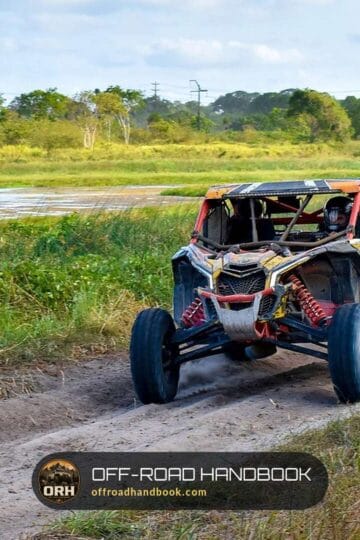
A side-by-side (SxS) is an off-road vehicle where the driver and passengers sit next to each other, steer with a wheel, work foot pedals and sit inside a roll cage with seat belts. An ATV, or quad, is the one you straddle like a motorcycle and steer with handlebars. Most ATVs are built for one rider, while side-by-sides seat two to six.
The names overlap. UTV, ROV and SSV all describe side-by-sides, and the number that matters most when you shop is width: the Honda ATV below is 47.4 inches wide, and the Honda side-by-sides are about 60 to 68, which decides which trails you can legally ride.
Side-by-side vs ATV: the key differences
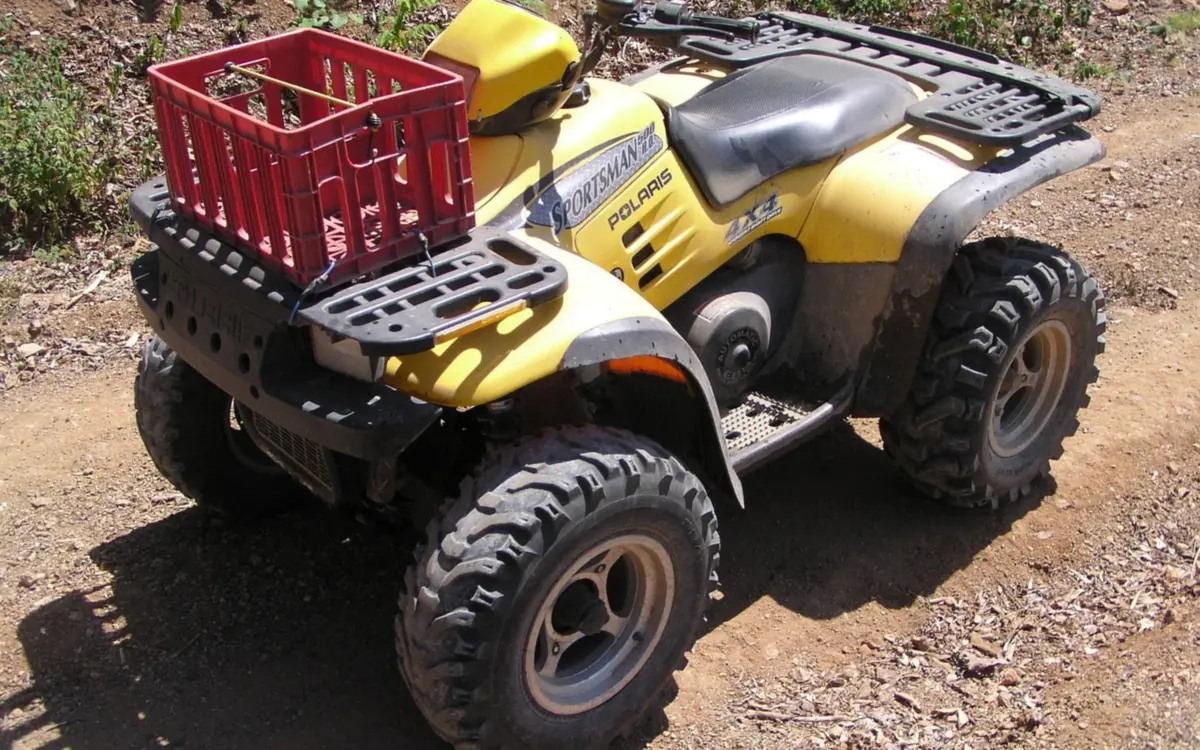
| Feature | Side-by-side (SxS/UTV) | ATV (quad) |
|---|---|---|
| Seating | Seats side by side, up to six seats | One rider on most models; Can-Am lists one or two |
| Controls | Steering wheel, gas and brake pedals | Handlebars, thumb or twist throttle, hand and foot brakes |
| Protection | Roll cage and seat belts; windshield, roof and doors are optional | None; helmet and riding gear are the protection |
| Riding style | Car-like, no body-weight shifting | Active; the rider shifts weight to steer and balance |
| Weight (Can-Am range) | About 1,200 to 2,900 lb | About 290 to 1,500 lb, youth to large adult models |
| Width | Honda examples: 59.9 in (Pioneer 700) to 68.1 in (Talon 1000R-4) | Honda example: 47.4 in (Foreman Rubicon) |
| Cargo | Cargo bed; 1,000 lb on the Honda Pioneer 700 | Racks; 99 lb front and 187 lb rear on the Honda Foreman Rubicon |
Under the skin they share a lot, such as the liquid-cooled gasoline engines in all three Honda models below. Even so, an SxS drives like a car, which most new riders find easier to learn than an ATV.
The trade is size. A side-by-side carries people and cargo, but an ATV goes where a wider machine is not allowed, and it fits in a pickup bed (Can-Am).
How big are they? Three Honda models, side by side
Spec talk gets vague fast, so here are three real machines from one maker, all taken from Honda’s 2024 spec sheets: a mid-size utility ATV, a utility side-by-side and a four-seat sport side-by-side.
| Spec | FourTrax Foreman Rubicon (ATV) | Pioneer 700 (utility SxS) | Talon 1000R-4 (sport SxS) |
|---|---|---|---|
| Engine | 518 cc single | 675 cc single | 999 cc parallel twin |
| Width | 47.4 in | 59.9 in | 68.1 in or 64.0 in (Honda lists two values) |
| Length | 84.5 in | 114.8 to 115.2 in | 152.5 in |
| Curb weight | 700 to 729 lb | 1,292 to 1,499 lb | 1,790 to 1,843 lb |
| Ground clearance | 9.4 in | 10.4 to 10.8 in | 12.4 to 13.2 in |
| Cargo | Racks: 99 lb front, 187 lb rear | Bed: 1,000 lb | Bed: 299 lb |
| Towing | 1,322 lb | 1,500 lb | Not listed on the sheet |
The pattern holds across makers. A utility side-by-side trades speed for a big bed and a high tow rating, and a sport model trades cargo for suspension travel. The Talon’s 299 lb bed is a quarter of the Pioneer’s.
Towing is closer than most people expect: the Foreman’s 1,322 lb rating is not far under the Pioneer’s 1,500 lb. The real cargo advantage is the bed, not the hitch.
Why width decides where you can ride
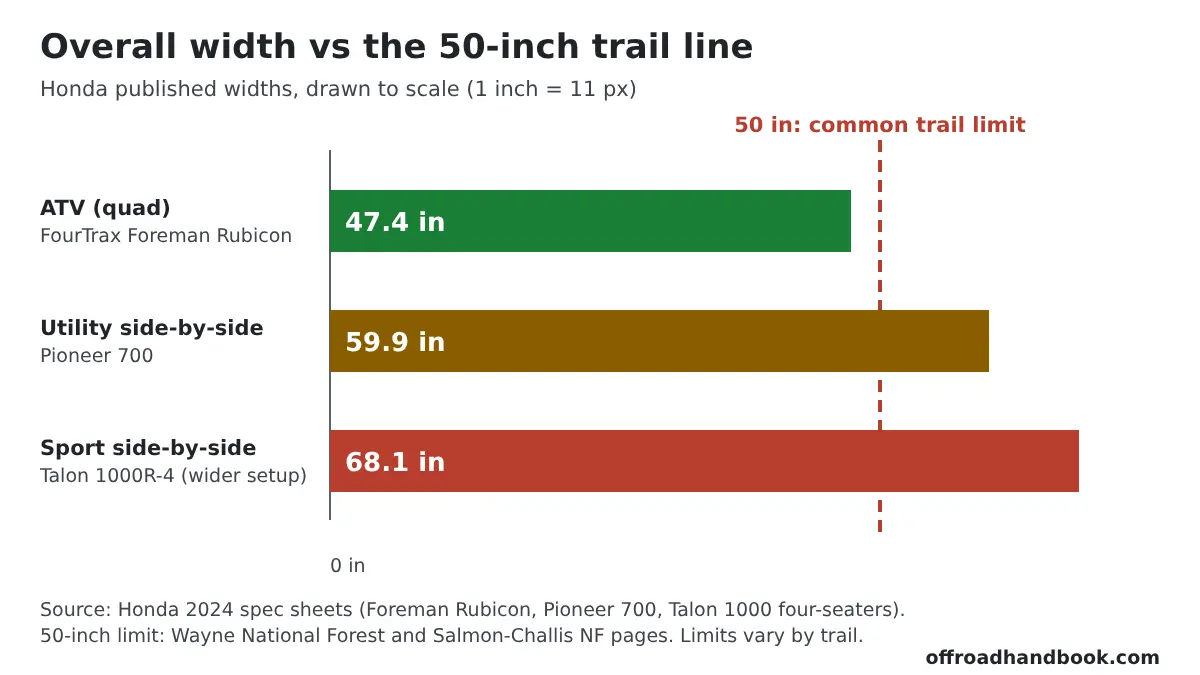
Many trails are cut for ATVs and motorcycles. The Wayne National Forest in Ohio prohibits any OHV wider than 50 inches, measured from its widest point (USDA Forest Service).
Idaho’s Salmon-Challis National Forest marks some trails “Vehicles 50 Inches or Less in Width”, which typically admit ATVs, motorbikes and some ROVs. Wider side-by-sides are limited to designated 4×4 routes, and the motor vehicle use map is the official reference (USDA Forest Service).
Use the checker below with your own width. Add what bolts on: wider tires, wheel spacers or mirrors can all push a machine over a limit that its spec sheet width meets.
Based on the Honda widths in the table above and the 50-inch examples from the Forest Service. Your trail may set a different limit, so use the number posted for it.
Other names for a side-by-side
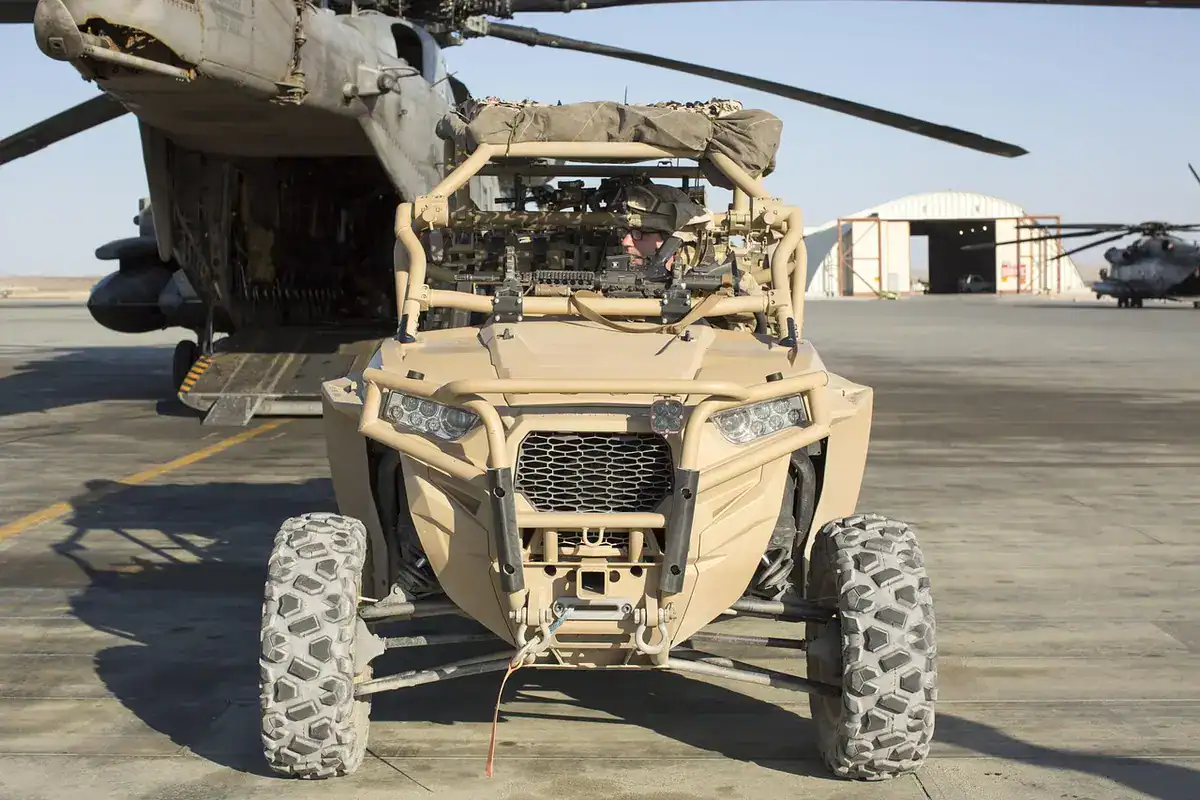
Depending on the use, the same machine is called a utility task vehicle or utility terrain vehicle (UTV), a recreational off-highway vehicle (ROV or ROHV), a multipurpose off-highway utility vehicle (MOHUV) or an SSV. Can-Am uses “SxS” and “SSV”. In daily use the terms are interchangeable.
Industry standards draw the lines with numbers. As summarized by Wikipedia, which cites the standards, the two US standards say this:
| Standard | Vehicle class | Key limits |
|---|---|---|
| ANSI/OPEI B71.9-2016 | MOHUV (utility) | Top speed at least 25 mph; width 80 in or less; GVWR 4,000 lb or less; cargo capacity at least 350 lb |
| ANSI/ROHVA 1-2016 | ROV (recreational) | Speed above 30 mph; GVWR 3,750 lb or less; gasoline engine 1,000 cc or less |
Wikipedia’s definition of a side-by-side requires at least two seats side by side in a roll cage, four or more wheels, a steering wheel and foot controls, and it excludes straddle-seat vehicles with handlebars. That is why a big quad is still an ATV.
Types of side-by-sides
Can-Am sorts side-by-sides into utility, recreational and sport. Its examples are the Defender for utility, the Commander and Maverick Sport for recreational and the Maverick X3 for sport (Can-Am).
| Type | Built for | What to expect |
|---|---|---|
| Utility | Hauling, towing, ranch and farm work | Big bed and tow rating, modest speed. Honda Pioneer 700: 1,000 lb bed, 1,500 lb tow |
| Recreational / crossover | A mix of trail riding and work | Between the two; check the bed and tow ratings for the exact model |
| Sport | Fast trail, dune and desert driving | Long suspension travel, bucket seats, small bed. Honda Talon 1000R-4: 299 lb bed |
Each of these comes in two-seat and longer crew versions. Our model guides cover what goes wrong on them, for example the Can-Am Defender, the Honda Pioneer 700 and the Maverick X3.
Which one should you pick?
Start with where you will ride and who rides with you. Then check the width, because a machine over the limit can’t use the trail. The picker below adds up the factors that came out of the sources above.
Based on the Can-Am and CPSC statements and the Honda specs cited in this post. It compares the machine types, not a specific model, so read the spec sheet for yours.
Safety: rollover, belts and age
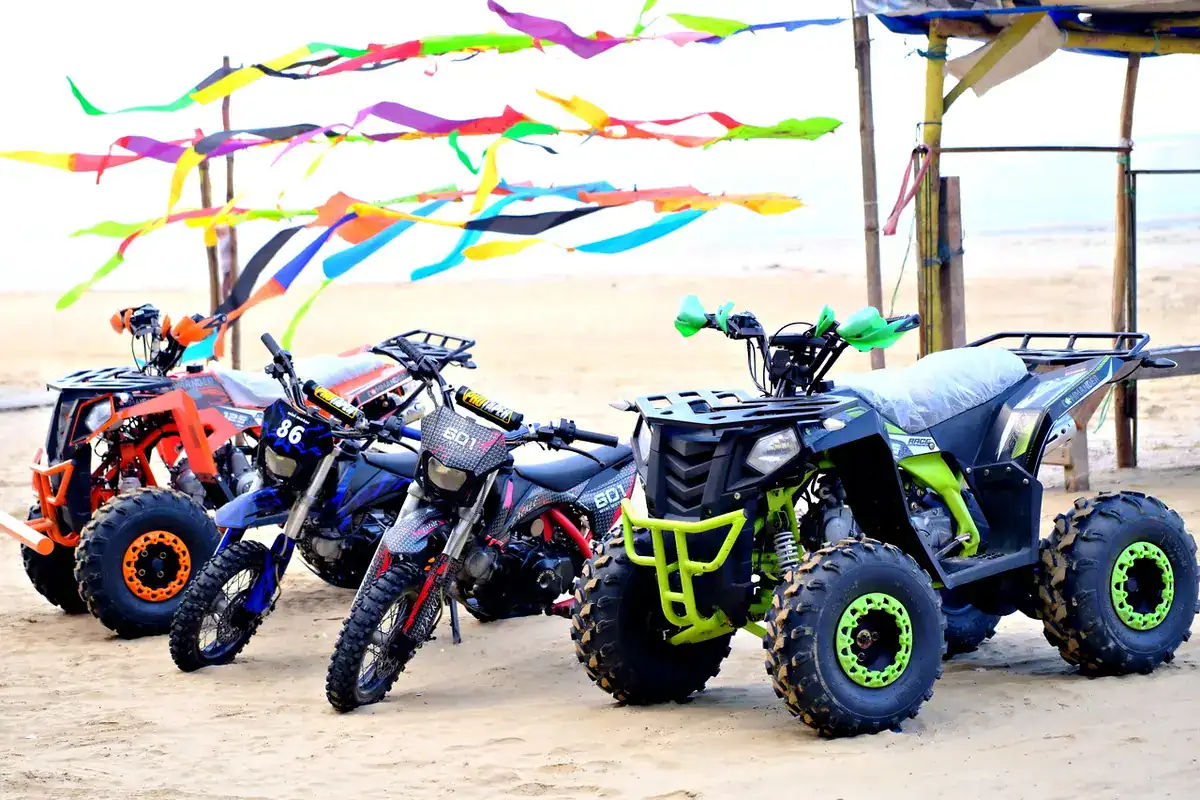
A cage and belts do not make a side-by-side safe on their own. The CPSC’s ROV advice is plain: everyone in an ROV should wear a helmet, fasten the seat belt, keep every part of the body inside, carry no more passengers than there are belts, and never carry passengers in the cargo bed (CPSC).
A passenger should be able to place both feet on the floorboard with their back against the seat. If a child can’t, they shouldn’t ride. A DOT-approved off-road helmet, for example one from this Amazon helmet search, is the first purchase.
The ATV side has numbers behind it. The CPSC counted 81,800 ER-treated ATV injuries in 2018, with children under 16 the largest age group at more than a quarter of them, and 591 deaths in 2016. Its advice: riders under 16 only on youth-model ATVs, no more passengers than seats, and no riding on paved roads (CPSC).
Is a side-by-side street legal?
Not as sold. The CPSC’s ROV advice is not to drive them on paved roads. State and local rules differ: some allow SxS on certain roads once you add lights, mirrors and other equipment, and others ban them.
Registration is a separate question. Ohio, for example, treats a UTV or side-by-side as an “unconventional vehicle” to be registered with the BMV, and only street-legal, licensed vehicles may use public roads (USDA Forest Service, Wayne National Forest). Check your own state before you ride on pavement.
FAQ
You straddle an ATV and steer with handlebars, usually alone. A side-by-side has a steering wheel, pedals, seat belts and a roll cage, with seats for two to six.
In everyday use, yes. UTV often points to work-oriented models and ROV to recreational ones, but dealers and trail rules treat them as the same kind of vehicle.
Not if it is wider than 50 inches. The Honda Pioneer 700 is 59.9 in wide and the Talon 1000R-4 is 64.0 to 68.1 in. Some trail-oriented models are narrower, so read the spec sheet and the trail sign.
The CPSC says everyone riding in an ROV should wear one. Some areas also require it, such as the Wayne National Forest, which requires a DOT-compliant helmet and eye protection for OHV riders.
They add a roll cage and belts, which ATVs lack, but they can still roll over, so belts and helmets still matter. Follow the maker’s age and speed guidance.
Next steps: if you already own one, start with the ATV and UTV troubleshooting guide, read the trail etiquette and rules before your first ride, and see which ATVs hold up in the reliable 4x4 ATV guide. Our free off-road calculators cover tire size, gearing and more.

I'm Suryashankar Dasgupta, the founder of Off-Road Handbook. I've been off-roading for years in the USA, including California and Texas, and have ridden mountain and desert terrain abroad. I've also driven a Jeep Compass for more than seven years, so I know the day-to-day side of Jeep ownership first-hand, from the Uconnect screen to the warning lights. Every guide here is researched from manufacturer owner's manuals, NHTSA recall and service-bulletin records and other trusted sources, checked against them before it is published, and corrected when we find a mistake. You can read how we work in our editorial policy: https://offroadhandbook.com/editorial-policy/
Like our off-road guides? Add Off-Road Handbook as a Google Preferred Source so our latest Jeep, ATV, UTV, trail, recovery, and off-road troubleshooting articles can appear more often in your Google Search experience.
Add us as a Preferred Source