Can You Off-Road With Street Tires? What Works and What Doesn't
Last updated on October 26th, 2026 at 08:14 pm
This post contains Amazon affiliate links. As an Amazon Associate I earn from qualifying purchases, at no extra cost to you.
Yes, on dry, graded gravel and dirt roads, at low speed. Street tires (highway, touring and most all-season tires) have tread built for pavement and sidewalls built for comfort, so they lose grip in mud, sand, snow pack and loose rock, and a rock cut can end the trip.
Continental says on-road tires can handle a well-compacted dirt track, gravel lane or forest path only if the surface is close to paved. Past that, it recommends all-terrain tires, ideally with all-wheel drive.
Which roads and trails street tires can handle
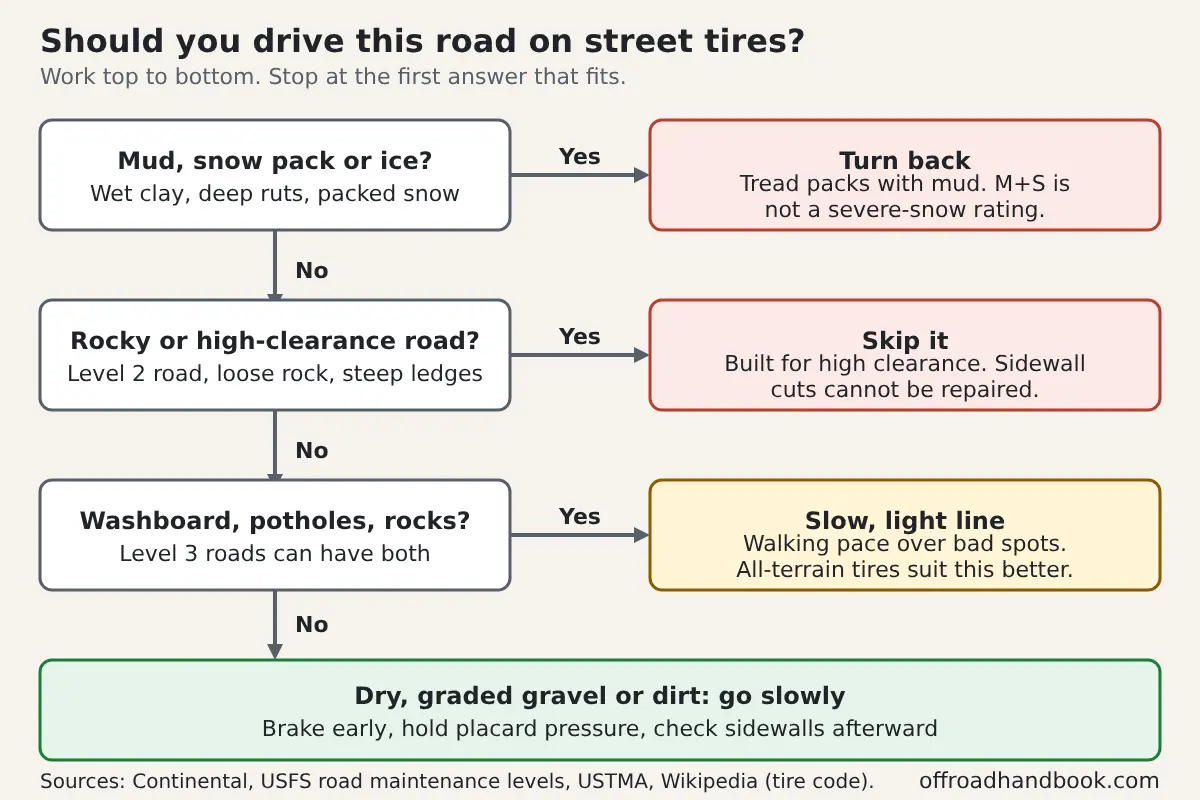
The flowchart and the table below use the same rules. Mud and rock decide the answer before tire brand does.
| Surface | Street or all-season tires | Why |
|---|---|---|
| Smooth, dry gravel or dirt road | Usually fine at low speed | Close to paved quality is the limit Continental gives for on-road tires |
| Washboard or potholes | Marginal | Level 3 Forest Service roads can have potholing and washboarding, and user comfort is a low priority |
| Rocky or high-clearance road | Skip it | Level 2 roads are built for high-clearance vehicles, and passenger car traffic is not a consideration |
| Mud | Poor | Continental says the tread grooves are not self-cleaning, so stones and mud clog them |
| Sand | Marginal | Pressure usually has to come down; stay within the tire maker’s limits and re-inflate afterward |
| Snow pack and ice | Depends on the tire | M+S is an all-season designation with average mud and snow traction; the three-peak mountain snowflake marks severe-snow tires |
Our air-down guide covers pressures by surface. Stay inside the tire maker's limits, and re-inflate before you return to pavement.
What a Forest Service road level means for your tires
Most national forest roads carry a maintenance level from 1 to 5. The level tells you what the road is built and kept for, which is a better guide than how it looks on a map.
| Level | Built for | Street tires |
|---|---|---|
| 1 | Closed to vehicles | Not open |
| 2 | High-clearance vehicles; passenger cars are not a consideration | Skip it |
| 3 | Prudent drivers in standard passenger cars; low speed; potholes and washboard may occur | Usually fine when dry, slowly |
| 4 | Moderate comfort at moderate speeds; mostly double-lane and gravel | Fine |
| 5 | High comfort; normally double-lane and paved | Fine |
If you are driving a front-wheel-drive car on forest roads, read our guide to whether a 2WD vehicle can drive Forest Service roads.
Street tires vs all-terrain and mud-terrain tires
- Tread: all-terrain (A/T) and mud-terrain (M/T) tires have larger blocks and wider grooves to bite into loose surfaces and clear mud. Street tires have tighter, shallower tread.
- Sidewalls: Continental says on-road sidewalls are not reinforced like off-road tires, so a large rock can cause damage and a flat.
- Road manners: A/T and M/T tires are noisier and use more fuel on pavement. Our guide on whether mud tires affect gas mileage covers the cost.
- Middle ground: an all-terrain tire in your factory size, or a light-truck all-season, is the usual mixed-use compromise.
If you drive pavement 95 percent of the time and only use graded dirt roads, street or all-season tires can be the sensible choice. A second set of wheels with all-terrain tires covers the rest.
Trail check for your tires
Pick the tire type and the surface. The tool gives a go, careful or turn-back verdict from the table above, plus what to check before you leave.
Based on Continental’s off-road guide, the Forest Service maintenance levels and the tire markings described on Wikipedia. It cannot see the road, so walk anything you are unsure about.
Risks to know about
Sidewall cuts
This is the common failure. The U.S. Tire Manufacturers Association says a repair is possible only in the tread area, for a puncture no larger than ¼ inch (6 mm), and a plug alone is not acceptable. Damage to the shoulder or sidewall means replacing the tire. Our guide to plugging a flat on the trail covers what is safe as a temporary fix.
Getting stuck
Less traction in mud, sand and snow means you may need recovery gear or help. Do not go where you cannot be reached, and keep a way to air up and a tire plug kit in the vehicle.
A plug kit and 12V compressor and a digital pressure gauge take little space.
Low clearance
Passenger-car-based vehicles also have less ground clearance and no skid plates. That matters as much as the tires on rutted roads.
Warranty and legal questions
Will off-roading on street tires void my warranty?
Not automatically. The FTC says the Magnuson-Moss Warranty Act makes it illegal to void a warranty or deny coverage simply because you used an aftermarket part, but the maker can deny a claim if it shows the part caused the problem. Tire damage from impacts is also usually a road-hazard matter, so read your tire warranty. Source: FTC consumer alert on auto warranties (PDF).
Is it legal to drive on street tires off-road?
No U.S. law requires a particular tire type for public dirt roads or national forest roads. What matters is where you may drive (designated routes, seasonal closures, OHV rules) and, on public roads, tire condition, which varies by state. Check with the Forest Service, BLM and your state before you go.
FAQ
Yes, on maintained dry gravel or dirt roads at low speed. Skip anything with deep ruts, rocks, stream crossings or recent rain.
For graded gravel and dry dirt, generally yes. For mud, sand or rocky terrain, an all-terrain tire is the better match.
No. The U.S. Tire Manufacturers Association limits repairs to the tread area, for punctures up to ¼ inch.
It is a manufacturer-declared designation for average traction in mud or snow. The three-peak mountain snowflake marks tires that passed a severe-snow test.
Sources: Continental, USDA Forest Service, U.S. Tire Manufacturers Association, Wikipedia: Tire code, FTC consumer alert.
Related guides
- Off-road tire pressure calculator
- Load range C vs D vs E
- How much off-road tires cost
- Tire size calculator

I'm Suryashankar Dasgupta, the founder of Off-Road Handbook. I've been off-roading for years in the USA, including California and Texas, and have ridden mountain and desert terrain abroad. I've also driven a Jeep Compass for more than seven years, so I know the day-to-day side of Jeep ownership first-hand, from the Uconnect screen to the warning lights. Every guide here is researched from manufacturer owner's manuals, NHTSA recall and service-bulletin records and other trusted sources, checked against them before it is published, and corrected when we find a mistake. You can read how we work in our editorial policy: https://offroadhandbook.com/editorial-policy/
Like our off-road guides? Add Off-Road Handbook as a Google Preferred Source so our latest Jeep, ATV, UTV, trail, recovery, and off-road troubleshooting articles can appear more often in your Google Search experience.
Add us as a Preferred Source