ATV Weight Chart: Factory Curb, Wet and Dry Weights by Model
This post contains Amazon affiliate links. As an Amazon Associate I earn from qualifying purchases, at no extra cost to you.
A full-size utility ATV weighs about 550 to 860 pounds from the factory, depending on engine size and trim. Youth quads run 250 to 315 lb, and a 450cc sport quad like the Yamaha YFZ450R is about 405 lb fueled. Before you haul one, check whether your number is dry, curb or wet weight, since that alone shifts it 25 to 50 lb.
ATV weight chart: factory figures by model
Every number below comes from the manufacturer's own 2026 US spec page, spec sheet or brochure (Can-Am's current sheets are already labeled model year 2027). The "Figure" column matters: curb and wet weights include fluids and a full tank, dry weights don't.
| Model | Class | Weight (lb) | Figure | Width (in) | Rack front / rear (lb) | Towing (lb) |
|---|---|---|---|---|---|---|
| Kawasaki KFX50 | Youth | 249.2 | Curb | 34.1 | n/a | n/a |
| Kawasaki KFX90 | Youth | 269.0 | Curb | 35.6 | n/a | n/a |
| Yamaha Grizzly 110 | Youth | 315 | Wet | 40.6 | not listed | not listed |
| Yamaha YFZ450R | Sport | 405 | Wet | 48.8 | n/a | n/a |
| Kawasaki Brute Force 300 | Entry utility (2WD) | 551.3 (527.0 dry) | Curb | 42.5 | 44 / 66 | 500 |
| Honda FourTrax Rancher (2WD) | Utility | 580 | Curb | 47.4 | 66 / 133 | 848 |
| Honda FourTrax Rancher 4x4 | Utility | 615 | Curb | 47.4 | 66 / 133 | 848 |
| Honda Rancher 4x4 Automatic DCT EPS | Utility | 642 | Curb | 47.4 | 66 / 133 | 848 |
| Honda Rancher 4x4 Automatic DCT IRS EPS | Utility | 686 | Curb | 47.4 | 66 / 133 | 848 |
| Yamaha Kodiak 450 | Utility | 637 | Wet | 46.5 | not listed | not listed |
| Yamaha Grizzly EPS | Big-bore utility | 701 | Wet | 48.4 | not listed | not listed |
| Kawasaki Brute Force 750 | Big-bore utility | 707.8 (661.5 dry) | Curb | 46.1 | 88 / 176 | 1,250 |
| Kawasaki Brute Force 750 EPS | Big-bore utility | 732.1 (685.8 dry) | Curb | 46.1 | 88 / 176 | 1,250 |
| Suzuki KingQuad 750AXi Power Steering | Big-bore utility | 725 (728 CA model) | Curb | 47.8 | not listed | not listed |
| Can-Am Outlander 500/700 (base model) | Big-bore utility | 740 | Est. dry | 47.6 | 120 / 240 | 1,830 |
| Can-Am Outlander XT 700 | Big-bore utility | 858 | Est. dry | 48.8 | 120 / 240 | 1,830 |
I built this table by opening each maker's spec sheet one at a time and copying the weight exactly as labeled, footnote included. Polaris's spec pages wouldn't load for automated access during research, so the Sportsman is left out rather than filled in from dealer listings. The last section shows where Polaris owners can find their trim's number.
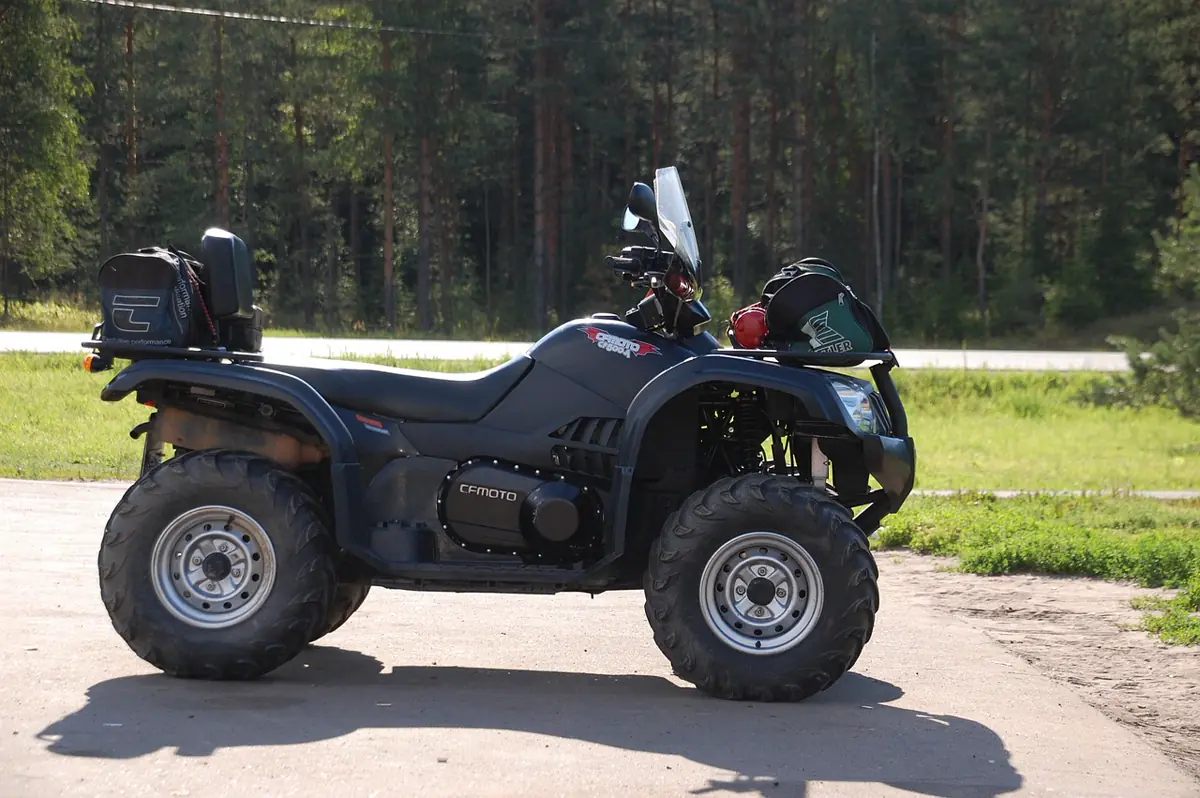
One pattern jumps out: engine size alone doesn't predict weight. The 421cc Kodiak 450 is listed at 637 lb wet. That's within about 65 lb of 700cc-class machines, because the frame, racks and shaft-drive 4WD are much the same.
Dry, curb or wet weight: which number to use
Makers use three labels, and they aren't interchangeable:
- Dry weight leaves out the fluids and fuel. Kawasaki's sheets say their dry figure excludes "all necessary materials and fluids," the full tank and the tool kit. Can-Am lists an "estimated dry weight" and notes the base model's figure is shown.
- Curb weight is the machine ready to ride. Honda's brochure defines it as including all standard equipment, required fluids and a full tank of fuel. Kawasaki and Suzuki also use curb weight.
- Wet weight is Yamaha's term for the same idea: all standard equipment, oil, coolant and a full tank, without options or accessories.
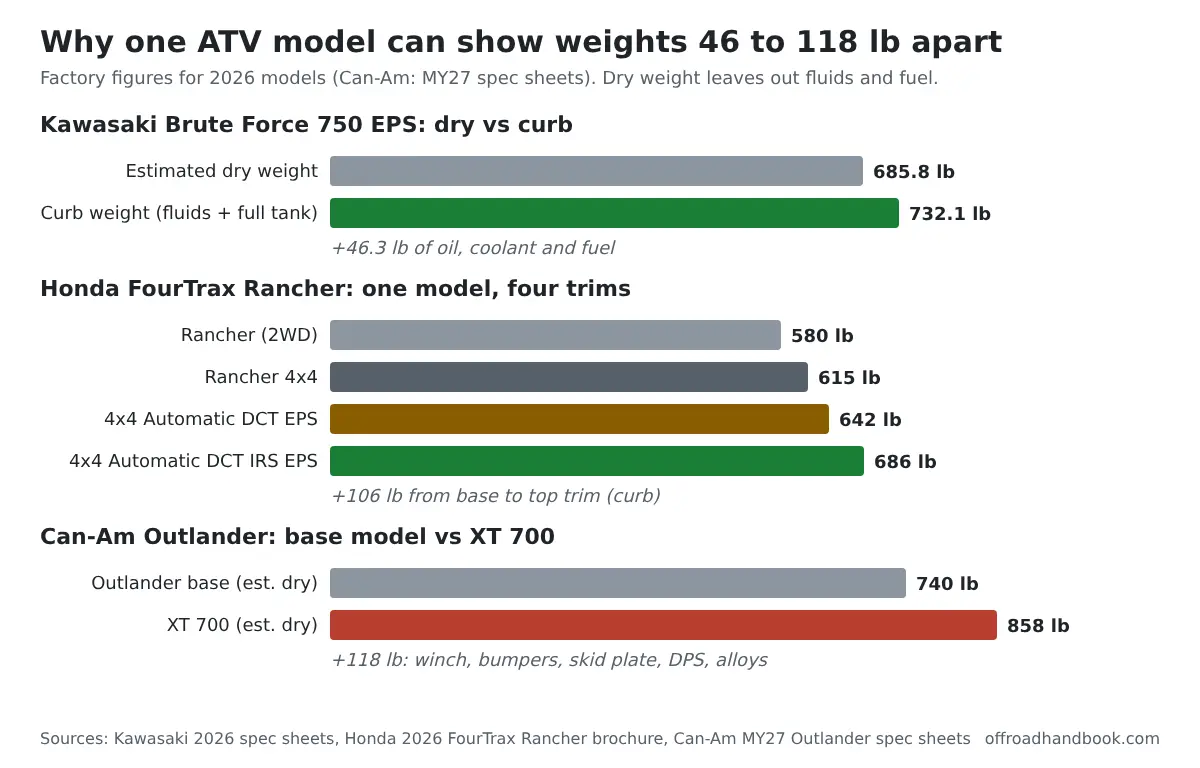
Kawasaki prints both numbers for the same machines, which shows the gap. The Brute Force 750 EPS goes from 685.8 lb dry to 732.1 lb curb, a 46.3 lb difference with a 5.0-gallon tank. The smaller Brute Force 300 gains 24.3 lb with its 3.2-gallon tank.
For hauling, use curb or wet weight. If all you have is a dry figure for a big-bore machine, add roughly 45 to 50 lb, as Kawasaki's sheets show, or weigh the quad itself.
What adds weight after the showroom
Trim level is the first surprise. Honda lists the 2026 FourTrax Rancher at 580 lb in 2WD form and 686 lb as the 4x4 Automatic DCT IRS EPS. That's 106 lb more for 4WD, the DCT automatic, power steering and independent rear suspension.
Factory packages add more. Can-Am's base Outlander sheet shows 740 lb estimated dry, while the Outlander XT 700 is 858 lb. The XT adds a 3,500-lb winch, front and rear bumpers, a full skid plate, Tri-Mode power steering and 14-inch aluminum wheels with 26-inch tires.
Then there's what owners bolt on: a plow, rack boxes, a gun scabbard, a spare fuel can. None of it shows up in the brochure number. If you've added a winch, plow mount or cargo box, weigh those parts or use the maker's listed part weight, and add them in the calculator below.
Rack capacity is a separate number. It's how much the racks can carry, not part of the ATV's weight. For example, Kawasaki rates the Brute Force 750 at 88 lb front and 176 lb rear. Anything you leave strapped to the racks while hauling still counts toward the total.
ATV hauling calculator: truck bed or trailer
Pick a model from the chart or type your own weight, then choose truck bed or trailer. The tool adds everything up and compares it with the limits you enter from your truck's door-jamb sticker and your trailer's VIN plate.
How it works: a dry weight gets the fluids allowance added (46 lb by default, the gap Kawasaki lists for the 5-gallon Brute Force 750 EPS), then add-ons and gear.
In truck-bed mode, the total plus cab occupants and other cargo is compared with your payload. Trailer mode adds the empty trailer and checks it against the trailer's GVWR and your truck's tow rating.
The results are only as good as the numbers you enter. Factory weights are for stock machines, so a scale ticket always beats an estimate.
Hauling an ATV in a pickup bed: payload, width, tailgate
Payload first. The payload on your door-jamb sticker has to cover everyone in the cab, everything in the bed and the ATV. A 700 lb quad, two 175 lb adults and 50 lb of gear already add up to 1,100 lb. Our payload calculator for built 4x4s walks through finding the real number for your truck.
Width next. Full-size utility ATVs in the chart run 46.1 to 48.8 inches wide, and youth models 34 to 41 inches. Measure your bed between the wheel wells with a tape. If the quad is wider, its tires will sit up on the wells instead of the bed floor.
Then the tailgate. Length matters too: compare the ATV's overall length (81.5 inches for the Grizzly EPS, 86.0 inches for the Brute Force 750) with your bed length. If the rear wheels end up on a lowered tailgate, check your truck's owner's manual for the tailgate's load limit before you rely on it.
For loading, the angle depends on your tailgate height and ramp length. The ATV ramp length calculator gives the ramp you need for your bed height. Pick folding aluminum ATV loading ramps rated above your ATV's curb weight (check the current price on Amazon). Secure the machine with four ratchet tie-down straps whose working load limit suits the job.
Towing an ATV on a trailer: the numbers that count
A trailer takes the ATV's weight off your truck's payload, except for the tongue weight pressing on the hitch. Three limits apply: the trailer's GVWR (on its VIN plate), the truck's towing capacity, and the hitch's rating, whichever is lowest.
Remember the trailer itself counts. A 600 lb utility trailer carrying an Outlander XT 700 (858 lb estimated dry, more once fueled) and 50 lb of gear is already at least 1,508 lb behind the truck, before fuel cans or a second quad.
Heading out of state with it? Some states require a nonresident sticker on the ATV itself. Our nonresident OHV permit guide by state lists fees and rules.
Why sport quads weigh about 300 lb less than utility ATVs
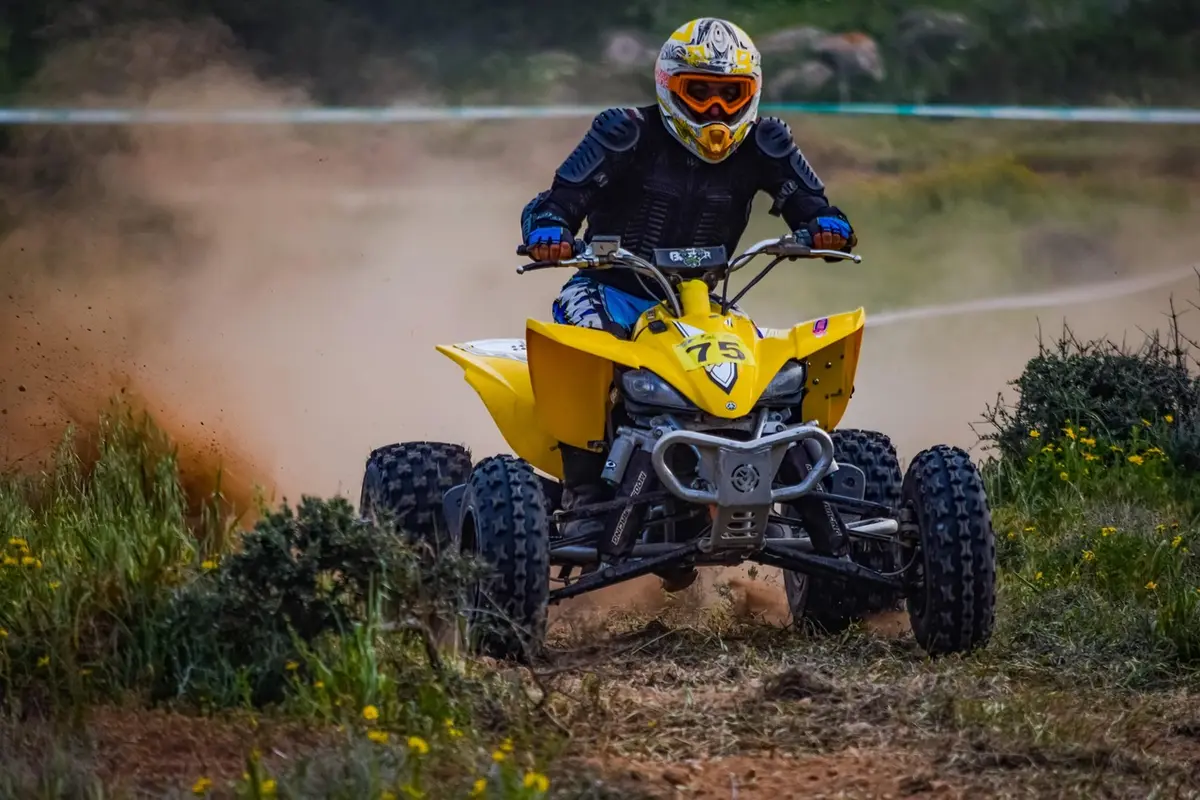
Yamaha's own numbers make the point: the YFZ450R is 405 lb wet and the Grizzly EPS is 701 lb wet, a 296 lb spread from the same maker. The YFZ450R uses a cast aluminum swingarm and a small 2.6-gallon tank. The Grizzly carries a 4.8-gallon tank, shaft-driven 4WD with a locking front differential and independent rear suspension.
Weight isn't only a hauling question. If you're shopping, our look at the most reliable 4x4 ATVs by recall record covers the utility models that make up most of this chart.
How to find your own ATV's exact weight
- Check the maker's spec page for your exact year and trim. Look for the footnote that says whether it's dry, curb or wet. For a Polaris Sportsman, open your trim's spec page at polaris.com and note which weight label it uses.
- Look in the owner's manual. The specifications section usually repeats the weight and lists the tank capacity.
- Weigh it. A public truck scale at a truck stop or a farm co-op scale gives the real number with accessories and fuel aboard. Weigh the truck with and without the quad, or the loaded trailer by itself.
Once you have a number, the full set of free off-road calculators can help with the rest of the trip, from fuel to tire pressure.
ATV weight FAQ
How much does a 4-wheeler weigh in tons?
A full-size utility 4-wheeler at 580 to 858 lb is about 0.29 to 0.43 US tons (2,000 lb per ton). Youth models at 249 to 315 lb are around 0.12 to 0.16 tons.
How much does a youth ATV weigh?
From the chart: Kawasaki KFX50 249.2 lb and KFX90 269.0 lb curb, and Yamaha Grizzly 110 315 lb wet. That's light enough for a small trailer or most pickup beds.
Is an ATV's weight the same as its GVWR?
No. Weight is the machine itself. A gross vehicle weight rating, where a maker lists one, is the most the machine may weigh with rider, cargo and accessories. Rack and towing capacities are separate limits again.
Will a full-size ATV fit in a short-bed pickup?
Often only with the tailgate down. Utility ATVs in the chart are 80 to 90 inches long, so compare that with your bed length and check the tailgate's load limit in your truck's manual. Width matters too: 46 to 49 inches against your wheel-well spacing.
Sources
- Kawasaki 2026 spec sheets: Brute Force 750, Brute Force 750 EPS, Brute Force 300, KFX90, KFX50
- Yamaha 2026 spec pages: Grizzly EPS, Kodiak 450, YFZ450R, Grizzly 110
- Honda 2026 FourTrax Rancher brochure (PDF)
- Suzuki 2026 KingQuad 750AXi Power Steering brochure (PDF)
- Can-Am MY27 spec sheets: Outlander 500/700, Outlander XT 700

I'm Suryashankar Dasgupta, the founder of Off-Road Handbook. I've driven a Jeep Compass for more than seven years, so I know the day-to-day side of Jeep ownership first-hand, from the Uconnect screen to the warning lights. Every guide here is researched from manufacturer owner's manuals, NHTSA recall and service-bulletin records and other trusted sources, checked against them before it is published, and corrected when we find a mistake. You can read how we work in our editorial policy: https://offroadhandbook.com/editorial-policy/
Like our off-road guides? Add Off-Road Handbook as a Google Preferred Source so our latest Jeep, ATV, UTV, trail, recovery, and off-road troubleshooting articles can appear more often in your Google Search experience.
Add us as a Preferred Source