Honda Talon Problems: Recalls, Warning Lights and Fixes
Last updated on October 18th, 2026 at 03:30 am
The Honda Talon 1000’s best-documented problems are three recalls: an intake funnel band screw that can enter the engine (2019–2021), rolling in Park (2019–2020) and an accessory heater that can overheat (2022–2024). In daily use, the warnings owners meet are the flashing clutch temperature indicator and the high coolant temperature light.
Honda’s owner’s manual gives a clear response for both. The Talon has a 999cc parallel-twin and a 6-speed dual-clutch transmission (DCT) with a high/low sub-transmission (Honda’s 2021 Talon specifications), so there is no CVT belt to burn.
Honda Talon problems at a glance
The table lists each problem in the order to check things: free checks first, dealer work last. Recalls are repaired free at a Honda Powersports dealer, so check your VIN before anything else on a 2019–2021 machine.
| Symptom | Likely cause (check order) | What to do | Cost to you | Source |
|---|---|---|---|---|
| Clutch temperature indicator flashing | Slow rock crawling, holding the vehicle on an incline with the throttle, stuck wheels not turning, pulling an immovable object | Release the throttle, brake, shift to N or P, idle until it stops. See a dealer if it keeps flashing | Free (your own checks) | Owner’s manual |
| High coolant temperature light or gauge at H | Mud on the radiator, long idling, a leak, low oil or coolant, a blown fan fuse | Stop safely, check airflow, let it idle, check fan fuse and reserve tank | Free check; a fuse is a small parts cost | Owner’s manual |
| Starter does not turn, or turns weakly | Low battery | Remove the battery and recharge it; Honda says to avoid jump starting | Free; new battery if it will not hold a charge | Owner’s manual |
| Sudden engine failure, 2019–2021 | Intake funnel band screw loosened and entered the engine | Check VIN; stop using the machine if recalled | Free recall repair | CPSC 22-096, 23-090 |
| Rolls or moves in Park, 2019–2020 | Park-position recall | Check VIN; free inspection and repair | Free recall repair | CPSC 20-751 |
| Accessory heater overheating, 2022–2024 | Honda accessory heater recall | Stop using the heater; free repair | Free recall repair | CPSC 25-207 |
Honda does not publish repair prices for non-recall work, so no dollar figures are shown for those rows. Ask your dealer for a written quote before authorizing anything beyond a recall or warranty repair.
Every row comes from Honda’s owner’s manual or a CPSC notice. Problems that only aftermarket sources mention are kept separate further down.
Which Talon warning to check first
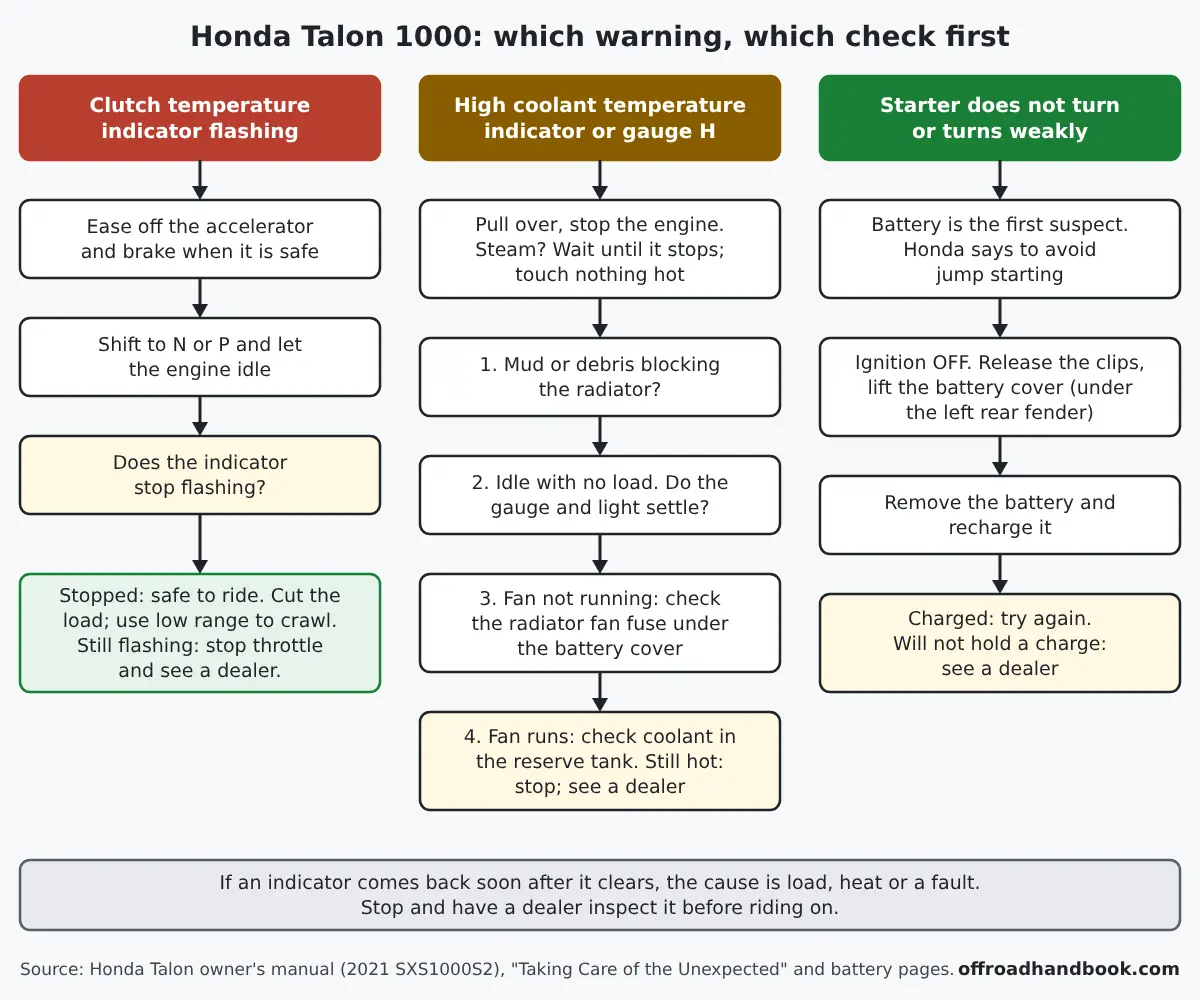
Three situations account for the warnings Honda’s manual walks owners through. Each column starts with the free step and ends with a dealer visit.
Follow one column from top to bottom. If the problem comes back right after you clear it, stop riding and have a dealer look at it.
What is your Honda Talon doing?
Pick the symptom and your model year. The checker lists the checks in order, free ones first, and adds any recall that applies to that year.
Nothing you enter leaves the page, and the answers come only from the sources listed under the tool.
This checker follows the steps in Honda’s 2021 owner’s manual, the rear final drive procedure in Honda’s dealer newsletter, and the CPSC recall notices. It does not replace a dealer inspection.
Honda Talon recalls and VIN ranges
Three CPSC recalls touch the Talon 1000. All three repairs are free at an authorized Honda Powersports dealer, and Honda’s toll-free line is 866-784-1870. You can also enter your VIN at powersports.honda.com/recalls.
The intake funnel recall is the serious one: a loose band screw entering the engine can cause sudden engine failure and loss of control. Honda received 16 reports of loose screws entering engines and one crash with minor injuries when the first recall was announced, and 18 incidents by January 2023.
| Recall | Date | Covers | Problem | Remedy |
|---|---|---|---|---|
| CPSC recall 20-751 | June 18, 2020 | 2019 Talon 1000 (2-seat) and 2020 Talon 1000 (2- and 4-seat), plus 2019–2020 Pioneer 1000; about 25,000 units in total | Can move or roll in Park (3 reports, no injuries) | Free inspection and repair |
| CPSC recall 22-096 | March 9, 2022 | 2019–2021 Talon 1000 S2 (2-seat) and 2020–2021 S4 (4-seat); about 32,000 | Intake funnel band screw can loosen and enter the engine | Free inspection and repair |
| CPSC recall 23-090 | January 12, 2023 | Adds about 2,000 2021 S2 and S4 units, about 34,000 in total | Same intake funnel screw hazard | Free inspection and repair |
| CPSC recall 25-207 | April 3, 2025 | Honda accessory heater for 2022–2024 Talon 1000 (about 2,340 heaters across Talon and Pioneer) | Heater can overheat and catch fire (3 reports, 2 fires, no injuries) | Stop using the heater; free repair |
The January 2023 expansion matters if you bought a 2021 machine, because the first notice did not list every 2021 VIN. The table below shows the ranges from the expansion notice, so you can see where your machine sits before you call.
| Model year | Model | VIN range (first notice) | VIN range added in January 2023 |
|---|---|---|---|
| 2019 | Talon 1000 S2 (2-seat) | 1HFVE05**K4000003 to K4003902 | none |
| 2020 | Talon 1000 S2 (2-seat) | 1HFVE05**L4100001 to L4102280 | none |
| 2020 | Talon 1000 S4 (4-seat) | 1HFVE06**L4000002 to L4003420 | none |
| 2021 | Talon 1000 S2 (2-seat) | 1HFVE05**M4200001 to M4202760 | 1HFVE05**M4200084 to M4203061 |
| 2021 | Talon 1000 S4 (4-seat) | 1HFVE06**M4100001 to M4102218 | 1HFVE06**M4100121 to M4102580 |
The two asterisks in each VIN stand for characters that vary. Compare only the model year letter and the serial digits at the end.
The checker below does that comparison for you. Type the VIN you read off the frame, and it tells you whether the number falls inside any intake funnel range.
The checker only compares your VIN with the table above. Honda’s own recall lookup is the final word.
Clutch temperature indicator flashing
The indicator flashes when clutch temperature becomes unusually high. Honda’s manual lists slow-speed rock crawling, holding the vehicle on an incline with the accelerator, a stuck vehicle with wheels not turning, and pulling an immovable object as typical triggers.
- Release the accelerator pedal as soon as it is safe and apply the brakes.
- Shift to neutral (N) or park (P) and let the engine idle until the indicator stops flashing.
- Once it stops, Honda says the vehicle is safe to operate.
- If it keeps flashing, have your dealer inspect it.
Honda warns that continuing to apply the accelerator with the indicator flashing can damage the clutch (Honda Talon 2021 owner’s manual (ManualsLib copy)).
Honda’s dealer newsletter adds that every Talon left the factory with the updated, better-cooled clutch cover, and tells dealers that a slipping clutch with those parts is likely due to severe usage.
Honda’s advice is to use low range when appropriate and not to hold the vehicle on a hill with the throttle (Honda’s dealer newsletter The Wrench (Jan–Mar 2020, posted by NHTSA)). The same note says oversize wheels or tires can speed up clutch wear. If you are weighing bigger tires, run the numbers in our tire size calculator first.
Honda’s steps say to idle in neutral or park rather than shut the engine off, so follow that order.
Overheating and the high coolant temperature light
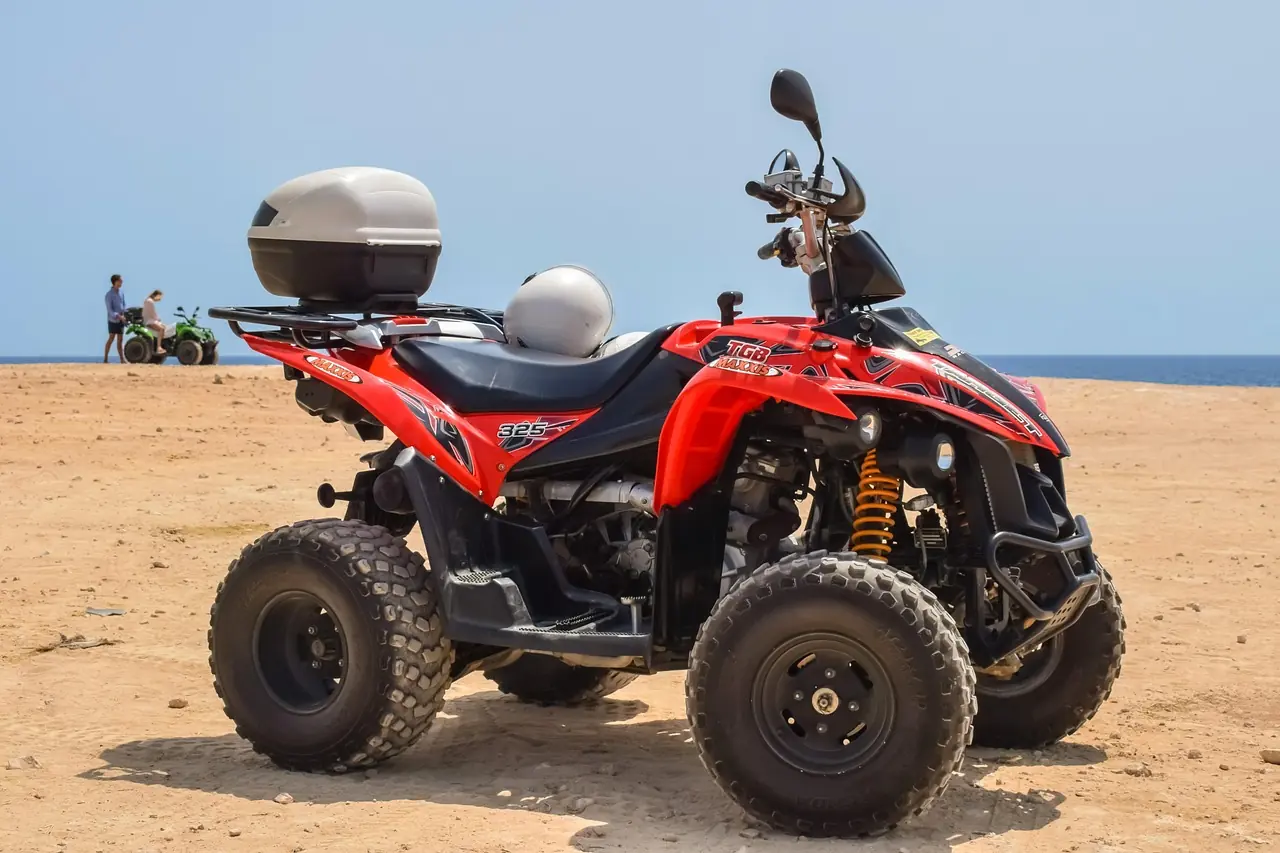
Honda lists restricted airflow to the radiator (mud is the classic cause), long idling, an oil or coolant leak, low oil or coolant, and long operation in severe conditions as reasons the light comes on. The light may also flicker briefly at startup or near idle without meaning anything is wrong.
If the gauge reaches H and the light stays on, stop and shut the engine off. Continuing to drive an overheated engine can cause serious damage.
- If steam is coming from the engine, shut it off and wait until the steaming stops. Do not touch the engine or radiator system until everything has cooled.
- Look for anything blocking airflow to the radiator, such as caked mud, and clear it.
- If nothing is obviously wrong, leave the engine idling with no load and watch whether the gauge and light return to normal.
- If the radiator fan is not running, turn the engine off, remove the battery cover and check the radiator fan fuse. Replace a blown fuse with a spare of the same rating.
- If the fan is working, check the coolant level in the reserve tank. If the light stays on, shut the engine off and see a dealer.
Some retailer blogs say early Talons left the factory with the radiator fans wired to blow the wrong way. We found no Honda notice about this, so treat it as an owner report. If you are unsure, ask your dealer to verify fan direction against the service manual. Coolant capacity is 4.3 US quarts (Honda Talon 2021 owner’s manual (ManualsLib copy)).
Battery, starter and warning lights
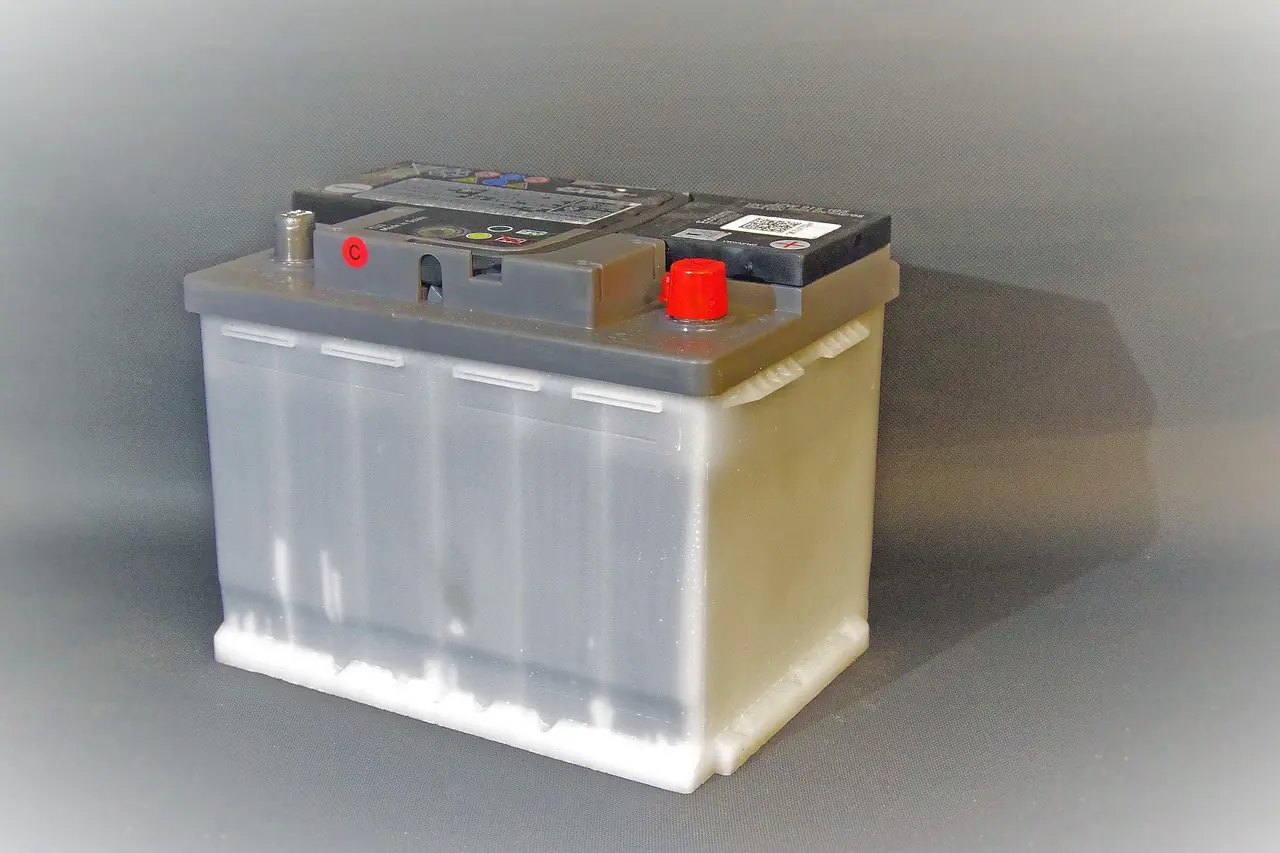
If the starter does not turn or turns weakly, Honda points to a low battery. The battery sits under the left rear fender: turn the ignition off, release the retainer clips and lift off the battery cover.
Honda’s manual says jump starting a Honda side-by-side should be avoided and tells you to remove the battery and recharge it instead. If it will not charge or hold a charge, see your dealer. The battery gives off explosive hydrogen gas, so keep sparks and flames away and wear protective clothing and a face shield (Honda Talon 2021 owner’s manual (ManualsLib copy)).
Check terminals and the cover clips while the battery is out. A loose or corroded connection can mimic a dead battery, and it costs nothing to rule out.
Rolling in Park
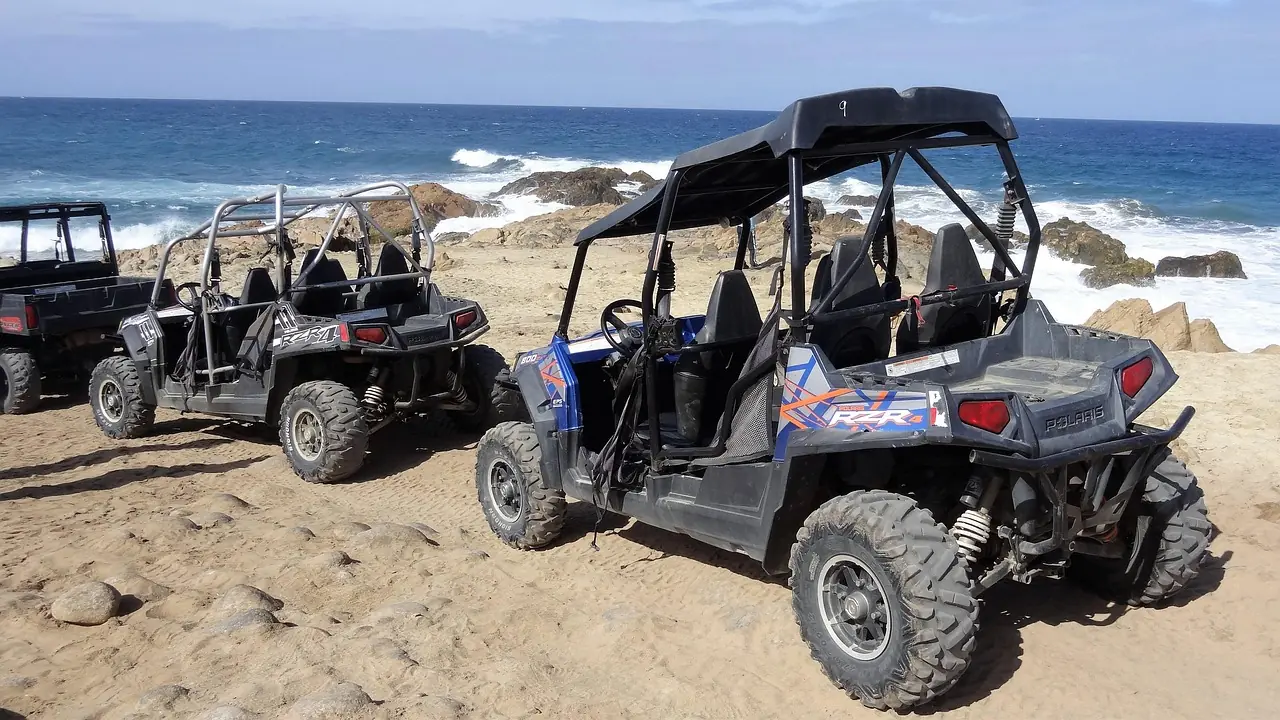
A 2020 recall covers 2019 and 2020 Talon 1000 models that can move or roll in the Park position. CPSC says to stop using the vehicle and contact a dealer for the free repair (CPSC recall 20-751). Even on a repaired machine, chock a wheel on a steep slope before you walk away.
Rear final drive oil: check it the right way
The rear final drive on a Talon has both a fill hole and a check hole, which is different from the front final drive and from Pioneer models. Honda’s dealer newsletter says to remove the fill cap and the check bolt, then confirm the oil is at the lower edge of the check hole (Honda’s dealer newsletter The Wrench (Jan–Mar 2020, posted by NHTSA)).
If it is low, add Honda shaft drive oil SAE 80W-90 GL-5 or an equivalent hypoid gear oil through the fill hole until it reaches that edge. Honda warns that judging the level through the fill hole makes the oil look low and can overfill the differential by double the specification.
Owner-reported issues Honda has not confirmed
Several aftermarket sources report problems that Honda has not published notices about. They are listed here so you know what to ask a dealer, not as confirmed defects.
- Stiff or soft rear suspension. Retailer blogs say the factory setup suits some riders and terrain poorly. Check the shock damping adjusters first, which Honda’s manual describes as having 3 positions on the S2R and S2X front shocks.
- Prop shaft U-joints. Two aftermarket blogs (Trail and Summit and Everything Honda Offroad) report U-joint failures on early machines. Listen for a clunk when you get on and off the throttle and have the joints inspected.
- Front-wheel drive or Live Valve warnings on the 1000X-4. One owner report on a Talon forum describes the front wheels losing power with a flashing drive indicator, fixed by a dealer after sensor and switch checks. This needs a dealer scan tool.
- Fan direction. Covered above; unverified by Honda.
Service numbers and maintenance that prevent most of this
The Talon uses a maintenance minder. The first service indicator appears at 100 miles or 20 operating hours, and regular intervals follow every 600 miles or 100 operating hours. Honda says to service more often in dust, sand, snow and mud.
Most Talon warnings in this guide trace back to heat, mud or a weak battery, so washing the radiator after muddy rides and keeping the battery charged covers the common ones.
| Item | Capacity or spec | Source |
|---|---|---|
| Engine oil (drain and filter change) | 6.08 US qt (5.75 L) | 2021 owner’s manual, specifications |
| Engine oil (drain only) | 5.8 US qt (5.5 L) | 2021 owner’s manual, specifications |
| Coolant | 4.3 US qt (4.1 L) | 2021 owner’s manual, specifications |
| Sub-transmission oil (after draining) | 1.35 US qt (1.28 L) | 2021 owner’s manual, specifications |
| Fuel tank | 7.27 US gal (27.5 L) | 2021 owner’s manual, specifications |
| Rear final drive oil | Honda shaft drive oil SAE 80W-90 GL-5, to the lower edge of the check hole | Honda The Wrench, Jan–Mar 2020 |
| Maintenance minder | Initial: 100 miles or 20 hours; regular: every 600 miles or 100 hours | 2021 owner’s manual, maintenance |
Is the Honda Talon reliable?
The documented problems are three recalls, all repaired for free, plus heat-related warnings that Honda’s manual explains how to handle. The DCT means there is no drive belt to wear out. Before buying a used Talon, run the VIN through Honda’s recall lookup, check the radiator and battery, and look for bent suspension parts from hard use.
For other Honda side-by-sides, see our Honda Pioneer 1000 problems guide, the Can-Am Defender problems guide for a rival, and our ATV and UTV troubleshooting guide. New to the category? Here is what a side-by-side is.
Honda Talon FAQ
Was the Honda Talon recalled?
Yes, several times. About 34,000 2019–2021 Talon 1000 S2 and S4 models were recalled in 2022 and 2023 for the intake funnel band screw. 2019–2020 Talons were recalled in 2020 for rolling in Park, and an accessory heater was recalled in 2025.
Does the Honda Talon have a belt?
No. It uses a 6-speed dual-clutch transmission, so there is no CVT drive belt.
What does the Talon clutch temperature indicator mean?
The clutch temperature is unusually high. Release the throttle, brake, shift to N or P and idle until it stops flashing. See a dealer if it keeps flashing.
Can I jump start a Honda Talon?
Honda says jump starting should be avoided. Remove the battery and recharge it, and see a dealer if it will not hold a charge.

I'm Suryashankar Dasgupta, the founder of Off-Road Handbook. I've been off-roading for years in the USA, including California and Texas, and have ridden mountain and desert terrain abroad. I've also driven a Jeep Compass for more than seven years, so I know the day-to-day side of Jeep ownership first-hand, from the Uconnect screen to the warning lights. Every guide here is researched from manufacturer owner's manuals, NHTSA recall and service-bulletin records and other trusted sources, checked against them before it is published, and corrected when we find a mistake. You can read how we work in our editorial policy: https://offroadhandbook.com/editorial-policy/
Like our off-road guides? Add Off-Road Handbook as a Google Preferred Source so our latest Jeep, ATV, UTV, trail, recovery, and off-road troubleshooting articles can appear more often in your Google Search experience.
Add us as a Preferred Source