Top 7 Honda Pioneer 1000 Problems and How to Fix Each One
Last updated on October 19th, 2026 at 12:35 am
The most common Honda Pioneer 1000 problems are clutch slip or shudder from heat, a blinking gear display, engine cut-outs and overheating, no-starts with simple causes, drive-mode confusion, soft brakes and a run of federal recalls. Check your VIN for recalls first, because six CPSC recalls touched 2016 to 2021 machines and every repair is free.
The checks below follow the order a good mechanic works: free first, dealer last. Anything quoted comes from a Honda owner's manual or a CPSC notice and is linked, and anything owners report without a Honda document behind it is labeled that way. For other brands, our ATV and UTV troubleshooting guide covers bogging, no-start and heat.
Honda Pioneer 1000 problems at a glance
| Symptom | Check first (free) | Likely cause | Fix and who does it |
|---|---|---|---|
| Clutch shudder, burning smell, clutch temperature light flashing | Ease off, brake, shift to N or P and idle | Overheated No. 1 clutch packs from slow, loaded work in high range or from mud (Honda's explanation, relayed by UTV Action) | Use low range for slow work, no moly or graphite oil; dealer if it keeps slipping |
| Blinking gear display, stuck gear, hard shifting | Stop, shift to P, restart; check engine and sub-transmission oil levels | A transmission fault the manual says to stop for; loose linkage bolts or grounds (owner-reported) | Dealer if the display keeps blinking |
| Cuts out, loses power under load, runs hot | Radiator fins for mud, coolant and oil levels, fuses, battery leads | Packed radiator, low fluids, electrical fault; injector connector (owner-reported) | Cleaning and checks are free; dealer reads codes |
| Will not crank or start | Lever in P or N (or brake pedal), fuse, battery leads | Start interlock, blown fuse, loose or weak battery | Low cost; avoid jump starts |
| 4WD light off, MT or AT lights always on | Drive-mode lever position; which trim you own | Normal indicator behavior | Nothing to fix in most cases |
| Muffler heat shield, throttle body, pedal, park roll, steering | Recall status by VIN | Six CPSC recalls, 2018 to 2021 | Free dealer repair |
| Soft or long brake pedal | Pad wear (metallic noise), fluid level against MIN | Worn pads, a leak or air in the lines | Pads are a driveway job; fluid and bleeding go to a dealer |
Sources: Honda Pioneer 1000 2023 owner's manual; 2017 manual; 2016 manual; UTV Action, Pioneer 1000 clutch issues; CPSC notices linked in the recall section.
Read the symptom column, not the model year. Most of these problems show up on every year, and the differences that matter, like spark plug type and the drive-mode lever, are in the table further down.
If you only have a minute, use the checker below. It walks through the same free-first order as the rest of the guide.
What is your Pioneer 1000 doing?
Built from Honda's owner's manuals (2016, 2017 and 2023 editions) and the CPSC recall notices in this guide. It is a checklist, not a diagnosis, and your own manual overrides it.
Honda sells the Pioneer 1000 in three-seat and five-seat versions, and the CPSC recall tables list them as model codes SXS10M3 and SXS10M5. The certification label on your machine has the code and the VIN you need for the recall check.
Which check comes first?
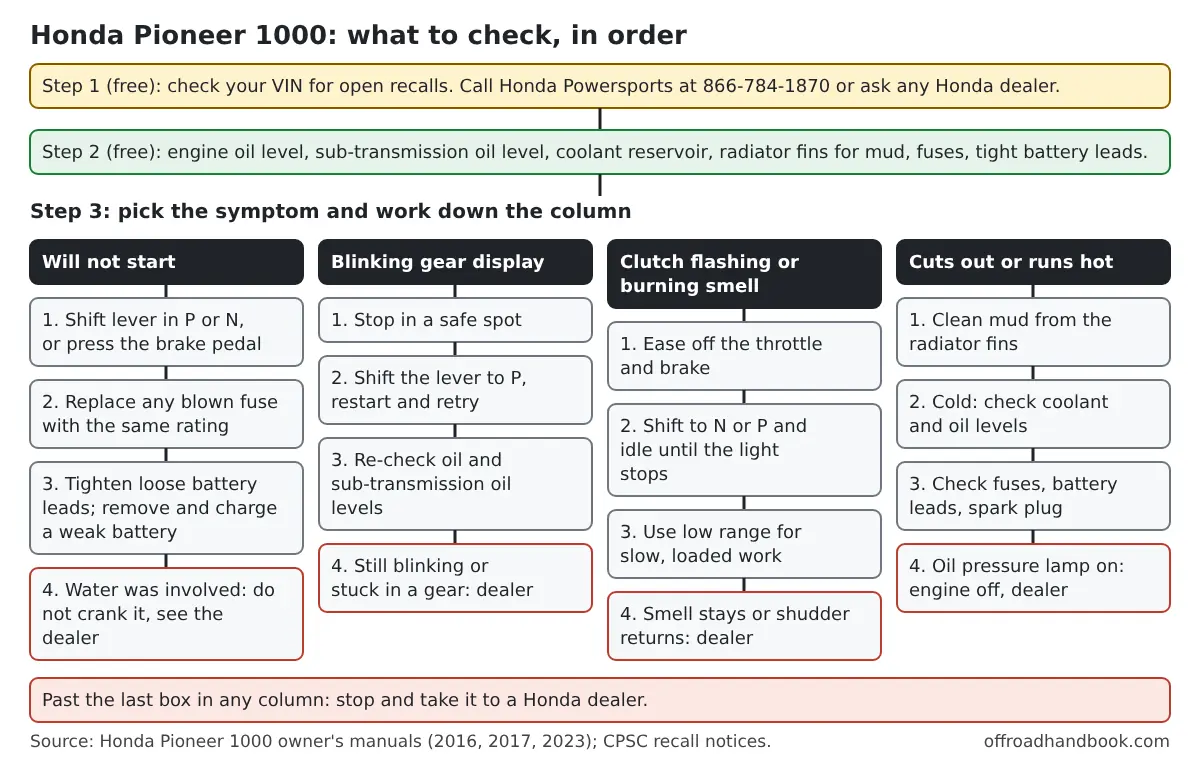
Work the first two steps for every problem. They cost a phone call, a flashlight and a few minutes, and they catch the causes Honda's own manual lists first.
Then pick the column that matches the symptom and stop at the first step that finds something. Fix it, retest, and only move down if the problem is still there.
1. Clutch slipping, shuddering or flashing hot
Clutch trouble has the most paper behind it of any Pioneer 1000 complaint. A wet-plate clutch that overheats glazes, then slips or shudders when you pull away, and the plates can smell like charcoal, according to the UTV Action troubleshooting column (updated Oct 2018).
Honda's position, as UTV Action relays it, is that this is operator-induced. Slow work in high range with passengers, cargo or a trailer overheats the No. 1 clutch packs, and so does trying to power out of gumbo mud. Honda's approved remedy for a stuck machine is a tow or a winch, not backing out in reverse.
When the clutch temperature indicator flashes, Honda's 2023 manual (p. 272) gives this sequence:
- Release the accelerator as soon as it is safe and apply the brakes.
- Shift to neutral or park.
- Let the engine idle until the indicator stops flashing.
Then change how you drive. Honda's 2017 manual says to shift to low range (L) when ascending steep hills (p. 122). It also says not to use oil with graphite or molybdenum additives, which may affect clutch operation (p. 157). The oil Honda specifies is SAE 10W-30 meeting JASO T 903 MA, not the 10W-40 some retailer guides mention.
UTV Action also reports that Honda offered an updated clutch cover feeding extra cooling oil to the twin clutch packs. Ask a dealer whether your VIN qualifies, because that offer may have ended. The sport sibling has its own warnings, covered in our Honda Talon problems guide.
See a dealer when the burnt smell returns after a cool-down, the shudder shows up on every start, or the indicator keeps flashing. No Honda price or labor time for clutch work turned up in the sources used here, so ask for a written quote. If you fit different tires, the tire size calculator shows the speedometer error.
2. Blinking gear display and hard shifting
The Pioneer 1000 has a dual-clutch six-speed transmission. Its gear display shows P, N, R, H or L, plus gear numbers 1 to 6 when you use the paddles (2023 manual, p. 51). A dash or a blinking number tells you the transmission is not engaged properly.
The 2017 and 2023 manuals agree on the first move: stop in a safe place and shift the select lever to park (P). Do that, switch off, and restart before you touch anything else.
- Stop safely, shift to P, switch off and restart.
- Check the engine oil level and the sub-transmission oil level. Honda's 2017 manual says to check engine oil daily and sub-transmission oil before riding (pp. 159, 169).
- Look at the shift linkage bolts and the ground wires under the driver's seat. Owners report hard shifting from a missing linkage bolt or a loose ground. That is owner-reported, not a Honda bulletin, but it costs only a wrench.
- If a dash or an E keeps blinking, the 2023 manual (pp. 262-266) describes a limp procedure with the gear change tool and the emergency valve. Use it only to get off the trail, then call a dealer.
Some owners also report stiff shifting until the machine warms up. Let it idle for a minute before you load it, and treat anything that does not clear as a dealer job. Honda lists no owner-serviceable transmission repair in the pages checked.
3. Engine cuts out, loses power or runs hot
When a Pioneer 1000 quits under load or runs poorly, Honda's manual starts with the high coolant temperature indicator. That lamp should only light briefly at key-on. The manual lists restricted airflow to the radiator, such as caked mud, and low oil or coolant as causes (2023 manual, pp. 261, 270-271).
Work through these in order and never open a radiator cap on a hot engine:
- Let it cool, then wash mud and grass out of the radiator fins from the engine side.
- With the engine cold, check coolant at the reserve tank and the engine oil level. If the oil pressure indicator lights while driving, Honda says to stop, switch off and check for leaks and oil level (2017 manual, p. 30).
- Check fuses. Honda's 2017 manual calls a blown fuse the first thing to check when something electrical quits (p. 256). Replace it with the same rating. A blown EPS fuse is a dealer visit (2023 manual, p. 276).
- Tighten the battery leads and look for corrosion.
- Pull the spark plug and compare it with the table below, then check the air cleaner element. Honda says to use a genuine element or one of equal quality (2023 manual, p. 197).
Owners also report code 12-1, a front injector circuit fault, from poor contact at the injector connector or wires backing out of it. No Honda document within reach confirms that code, so treat it as owner-reported.
Ask the dealer to read the stored codes before replacing parts. The first four checks are free, and Honda publishes no price for harness repair.
4. Will not crank or start
Honda's manuals list the same first checks when the starter will not turn. The shift select lever must be in park (P) or neutral (N), or you must press the brake pedal. Replace a blown fuse with the same rating, and tighten a loose battery lead (2017 manual, pp. 244-245; 2023 manual, pp. 259-260).
Honda says jump starting should be avoided. Remove the battery and recharge it instead (2017 manual, p. 264; 2023 manual, p. 281). The 2023 manual lists a GYZ16H battery, 12 volts and 16 Ah, and says to charge a stored battery every 30 days (pp. 236, 295).
Spark is the next free check, and the plug changed between manual editions. The table below shows what Honda lists, plus a few other numbers that differ by year and trim.
| Item | What Honda lists | Manual |
|---|---|---|
| Engine oil | SAE 10W-30, JASO T 903 MA. Honda's own capacity figures differ between editions, so fill to the level mark in your manual. | 2016 p. 250; 2023 p. 291 |
| Spark plug, 2016 and 2017 | NGK SILMAR7A9S. Replace it if a 0.04 in (1.0 mm) wire gauge fits in the gap. Used plug: 1/12 turn after it seats; new plug: ¼ turn. | 2016 pp. 176, 282; 2017 pp. 192-194 |
| Spark plug, 2023 | NGK LMAR7M-9S, gap 0.03 to 0.04 in (0.8 to 0.9 mm) | 2023 pp. 209, 328 |
| Drive-mode lever, SXS1000M3, M3P, M5P, M5D | Turf, 2WD, 4WD and 4WD Diff Lock | 2017 p. 52 |
| Drive-mode lever, SXS1000M3L and M5L | Turf, 2WD and I-4WD | 2017 p. 54 |
| AT and MT indicators | Not fitted to the base SXS1000M3 | 2016 manual |
| Wheel nuts | 80 lbf-ft, crisscross pattern (confirm in your year) | 2016 p. 232 |
Sources: Honda 2016 owner's manual, 2017 and 2023 editions. Page numbers are the manual's own and can differ by a few pages in online viewers.
If the machine went under water, do not crank it. Honda's manual has an immersion section, and its notice says not to start the engine and to take the machine to a dealer. Our hydrolock guide explains why.
5. 4WD light off, stuck in diff lock, MT and AT lights
A dark 4WD light is usually normal. The 4WD differential lock indicator comes on only when the differential gears are engaged (2016 manual, p. 40; 2017, p. 46). In Turf, 2WD, or 4WD without lock it stays off.
Honda says to change drive modes only when the vehicle is stopped and the engine is idling, because changing while moving could damage the drivetrain (2017 manual, pp. 53-55).
If the lever will not go where you want it, stop, let it idle and try again. If it still binds, see a dealer, since the pages checked give no other release procedure.
The AT and MT lights show the current shift mode, automatic or paddle-shifted, so one of them is normally lit on models that have both. The AT/MT switch works only in H or L, and SPORT will not turn on in low range (2016 manual p. 46; 2017 manual p. 57).
Owners say the I-4WD light stays on when the control unit sees a fault. Honda's pages checked do not explain that light, so a lit I-4WD light is a dealer scan.
6. Recalls: muffler, throttle body, pedal, park roll and steering
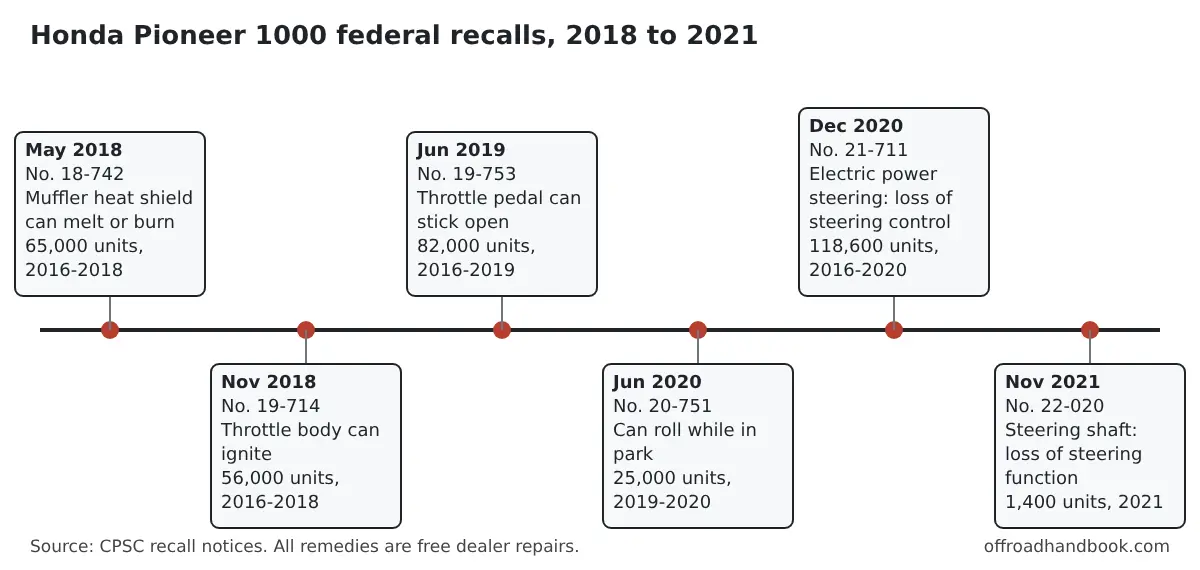
Older advice mentions two recalls. The CPSC lists six that name the Pioneer 1000 between 2018 and 2021, and each one is a free repair at a Honda Powersports dealer. Honda's customer line is 866-784-1870, and a dealer can check your VIN against every open campaign.
CPSC tells owners of recalled machines to stop using them until the repair is done, and recalls can be added later, so ask the dealer for the current list rather than relying on this one.
| Date | CPSC no. | Models | Hazard | Reports |
|---|---|---|---|---|
| May 2018 | 18-742 | 2016-2017 and some 2018 (65,000) | Muffler can overheat and melt or ignite the plastic heat shield | 22 melting, 3 fires, no injuries |
| Nov 2018 | 19-714 | 2016-2017 and some 2018 (56,000) | Incorrectly installed throttle body can ignite | 5 ignitions, no injuries |
| Jun 2019 | 19-753 | 2016-2019 (82,000) | Throttle pedal can stick open | 15 stuck pedals, 6 crashes, 1 concussion, 1 broken nose |
| Jun 2020 | 20-751 | Certain 2019-2020, also Talon 1000 (25,000) | Vehicle can move or roll in park | 3 reports, no injuries |
| Dec 2020 | 21-711 | 2016-2019 and certain 2020 with EPS, plus Pioneer 700 (118,600) | Loss of steering control | 8 reports of play or lost steering |
| Nov 2021 | 22-020 | 2021 with EPS, plus Pioneer 700 and Talon 1000 (1,400) | Loss of steering function | 1 report, no injuries |
Sources: the CPSC notices linked in the Models column. Honda also announced the June 2019 pedal recall in its newsroom.
The December 2020 steering recall also covered the Pioneer 700, so check both if you own one of each.
One correction: some articles list a May 2016 door-latch recall as a Pioneer 1000 recall. The CPSC notice for it (16-741) covers the 2014 Pioneer 700 and its front door striker plates.
7. Soft or long brake pedal
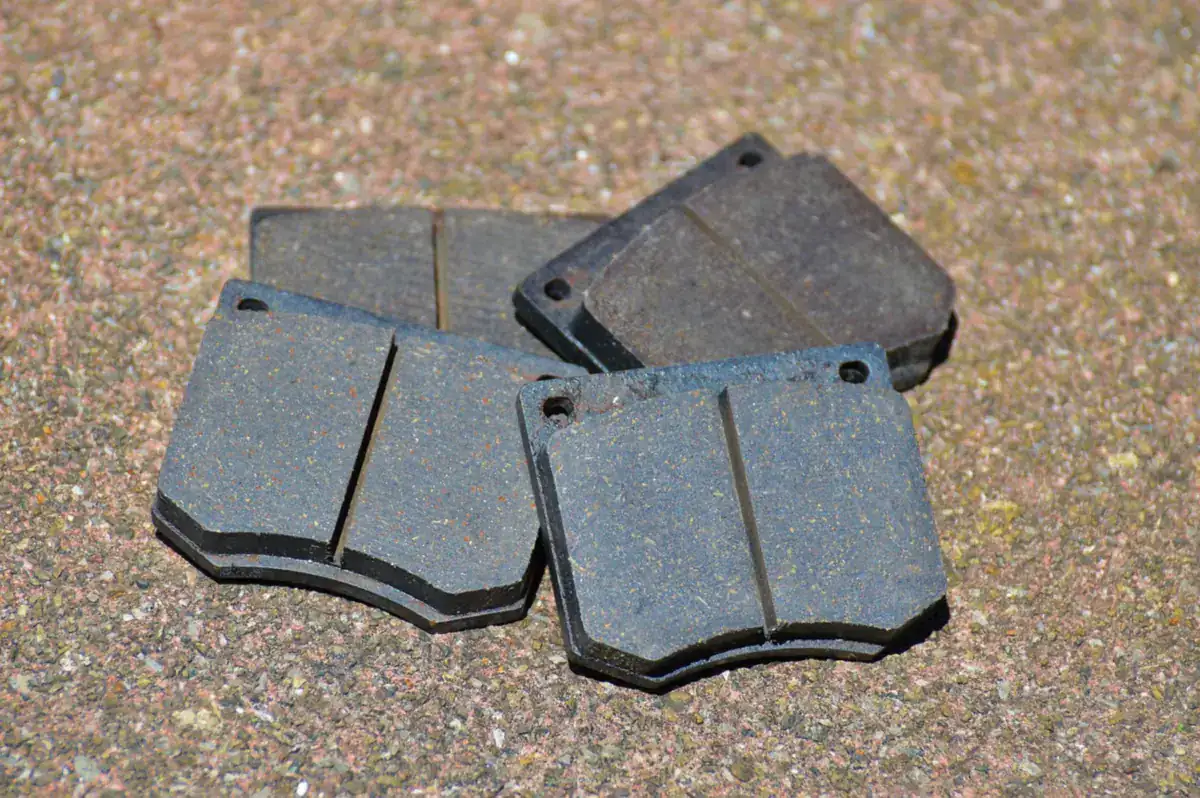
Honda says to use Honda DOT 4 brake fluid or an equal. Keep the reservoir between the MIN and MAX marks, and if it sits at or below MIN, check the pads, because the level drops as they wear (2023 manual, pp. 219-220).
The pads make a continuous metallic friction sound when you brake once they reach the wear limit, and that means replace them (2023 manual, p. 222; 2016 manual, p. 188). Check pad thickness at every wheel, and torque the wheel nuts in a crisscross pattern afterward.
A pedal that sinks toward the floor points to worn pads, a leak or air in the lines. Honda's 2017 manual says not to add or replace brake fluid except in an emergency, so leave bleeding and fluid changes to a dealer. Do not ride with a pedal near the floor. Honda publishes no pad or labor price.
FAQs
Yes. The CPSC lists six recalls between May 2018 and November 2021: muffler heat shield, throttle body, throttle pedal, rolling in park and two steering recalls. All repairs are free at a Honda Powersports dealer.
Honda's manuals specify SAE 10W-30 meeting JASO T 903 MA. Capacity figures differ between manual editions, so fill to the level mark in your own manual.
Honda's first checks are the shift lever in P or N or the brake pedal pressed, a blown fuse, and loose battery leads. Honda says to avoid jump starting and to recharge the battery instead.
The 4WD differential lock light comes on only when the differential gears are engaged, so it stays dark in Turf, 2WD and plain 4WD. Change modes only when stopped with the engine idling.
Related guides
- Honda Pioneer 700 Problems: 8 Common Issues and How to Fix Them
- ATV and UTV Troubleshooting: Bogging, No-Start, Heat and Belts
- Free off-road calculators
- Honda Big Red UTV Problems: Causes and Fixes by Symptom

I'm Suryashankar Dasgupta, the founder of Off-Road Handbook. I've been off-roading for years in the USA, including California and Texas, and have ridden mountain and desert terrain abroad. I've also driven a Jeep Compass for more than seven years, so I know the day-to-day side of Jeep ownership first-hand, from the Uconnect screen to the warning lights. Every guide here is researched from manufacturer owner's manuals, NHTSA recall and service-bulletin records and other trusted sources, checked against them before it is published, and corrected when we find a mistake. You can read how we work in our editorial policy: https://offroadhandbook.com/editorial-policy/
Like our off-road guides? Add Off-Road Handbook as a Google Preferred Source so our latest Jeep, ATV, UTV, trail, recovery, and off-road troubleshooting articles can appear more often in your Google Search experience.
Add us as a Preferred Source