Are Jeep Patriots Good in Snow? 4WD, Tires and Winter Tips
Last updated on October 26th, 2026 at 08:03 pm
This post contains Amazon affiliate links. As an Amazon Associate I earn from qualifying purchases, at no extra cost to you.
A Jeep Patriot is a decent snow vehicle for a compact crossover, as long as it has one of the optional 4WD systems and good tires. Front-wheel-drive Patriots on worn all-season tires struggle on hills and unplowed roads. Jeep lists 8.1 inches of ground clearance on 2WD and 9.1 inches on 4WD (2014 buyer's guide), so deep drifts are where it stops.
The sections below cover what each drivetrain really is, why tires matter more than drive wheels, how deep is too deep, and what to check on a used Patriot before winter. A small checker lets you plug in your own setup.
What each Patriot drivetrain can do in snow
Jeep sold the Patriot (model years 2007 to 2017) as front-wheel drive, with 4WD as an option. The figures below come from Jeep's 2014 buyer's guide, so check the manual for other model years.
| Setup | Ground clearance | Approach / breakover / departure | Base curb weight | What Jeep says |
|---|---|---|---|---|
| Front-wheel drive (2.0L or 2.4L) | 8.1 in | 26.4° / 20.9° / 28.5° | 3,133 lb (5-speed manual), 3,211 lb (6-speed automatic) | Standard |
| Freedom Drive I 4WD (2.4L only) | 9.1 in | 29° / 23.7° / 33.9° | 3,296 lb (manual), 3,365 lb (6-speed automatic) | Active full-time 4WD with selectable LOCK mode |
| Freedom Drive II 4WD (2.4L, Off-Road Group) | 9.1 in | 29° / 23.7° / 33.9° | 3,381 lb (CVT2L automatic) | Adds Off-Road mode with Hill Descent Control and grade sensing; the CVT has a 19:1 crawl ratio |
Two things surprise most buyers. The 2.0L engine was not offered with either 4WD system in 2014, so a 2.0L Patriot is front-wheel drive only. And the clearance gain of an inch on 4WD models matters in snow more than it sounds.
Jeep's guide lists 4-channel ABS with electronic stability control on the safety page, and Freedom Drive II adds traction control to its package. The guide does not list a locking differential on any Patriot setup.
Tires matter more than the drivetrain
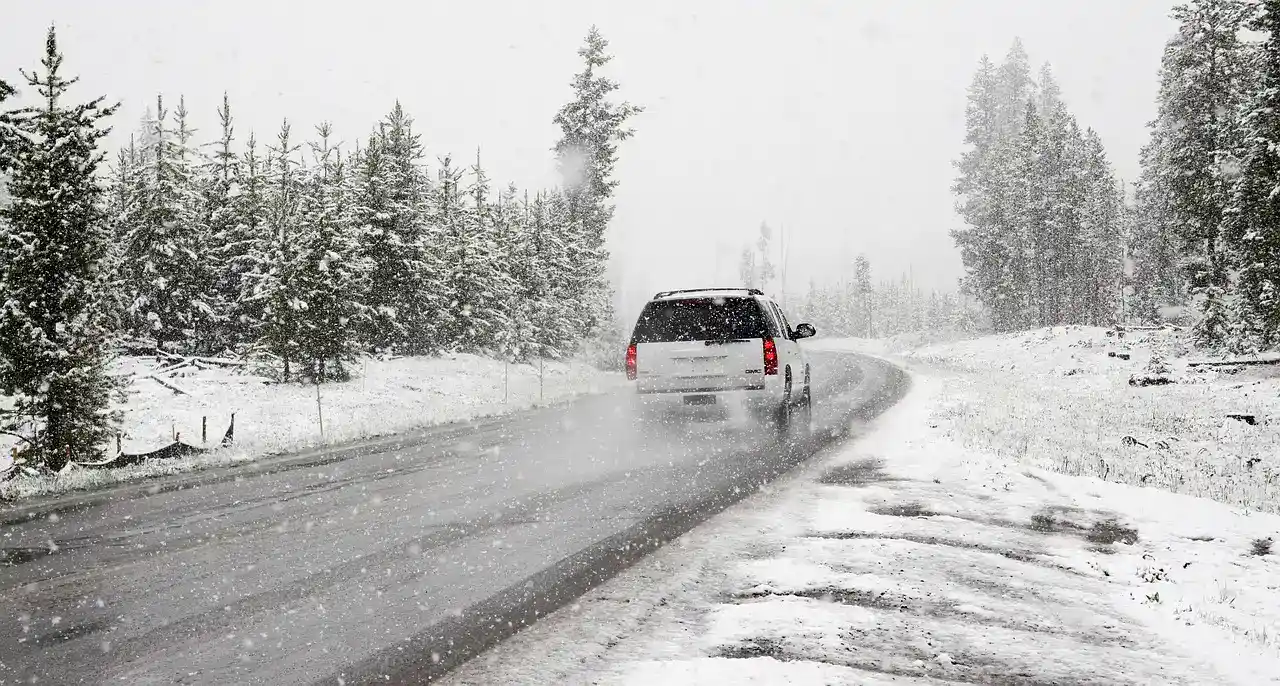
All-season and summer tires start to lose elasticity below about 45°F (7°C), according to Transport Canada. Winter tires keep their grip at much lower temperatures. The peaked-mountain-with-snowflake symbol marks tires that meet a severe-snow traction standard.
Four-wheel drive helps a Patriot accelerate, but every Patriot brakes and turns on four tires. On ice and packed snow the rubber sets the limit, so a front-wheel-drive Patriot on winter tires can out-stop a 4WD one on tired all-seasons. The same logic is why mountain chain rules don't give 4WD a free pass; here is when a 4WD can skip chains in five western states.
Transport Canada also advises against using tires worn close to 4 mm (5/32 in) of tread on snow-covered roads, and recommends winter tires in sets of four of the same size and type, with the deepest tread on the rear axle. Tire sizes are on the label in the driver's door jamb.
Before buying new tires or wheels, run the numbers in the tire size calculator to see how a different diameter affects your speedometer and clearance.
How deep is too deep for a Patriot?
Ground clearance sets a hard limit. Once snow reaches the underside of the body it packs under the car and lifts the tires off the surface, which is how a crossover gets high-centered in a drift.
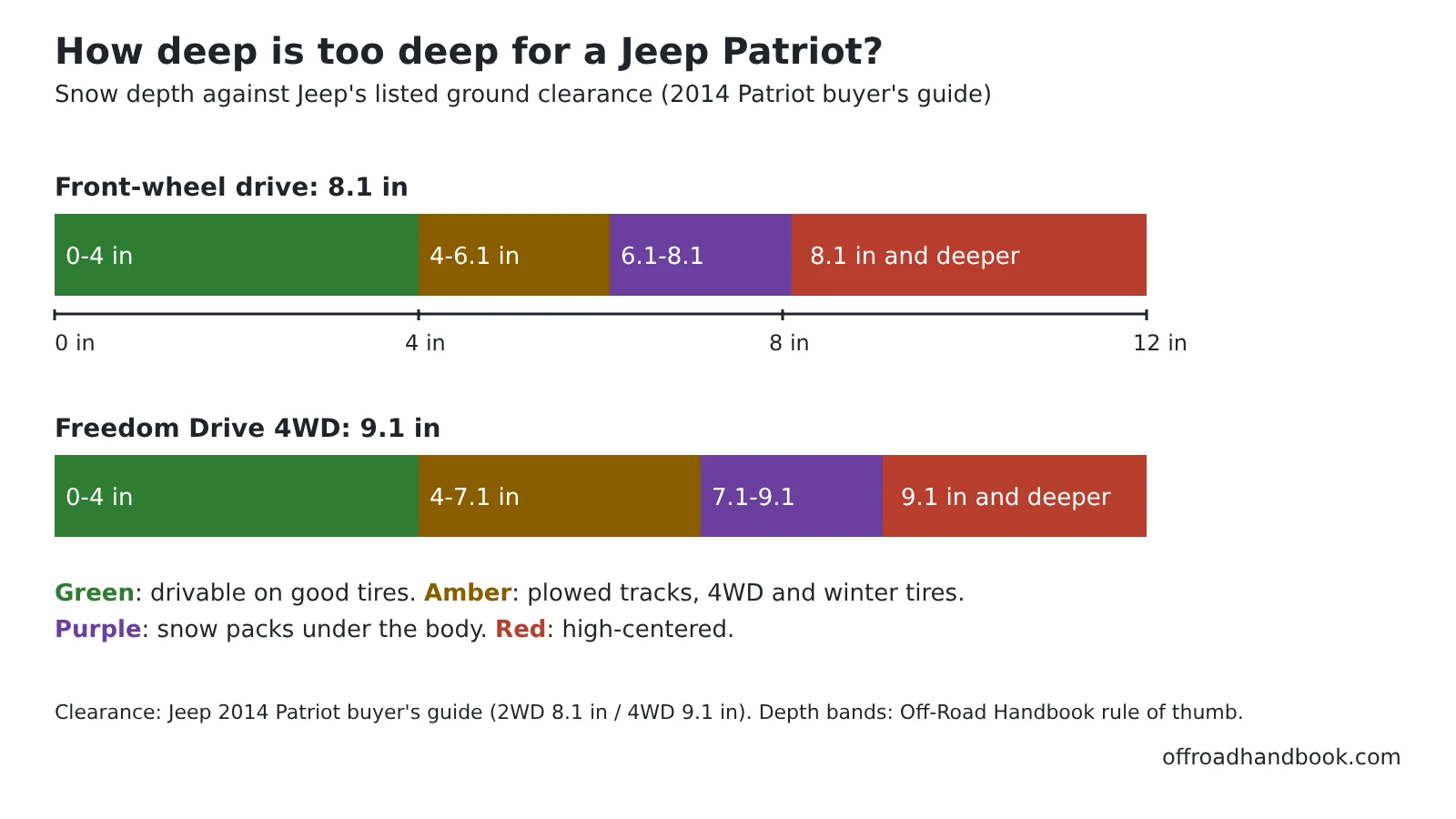
The bands are a conservative rule of thumb, not a Jeep rating. Up to about 4 inches on a plowed or packed road is normal winter driving. Beyond that, plan on plowed tracks and the 4WD system, and stop well short of the clearance figure.
For how the center-coupling modes on other vehicles compare, see 4WD vs AWD vs 4A. To check a lifted or leveled Patriot, the approach angle calculator helps with drifts and plow ridges.
Check your own Patriot's snow setup
Is your Patriot ready for this snow?
Based on Jeep's 2014 Patriot buyer's guide (clearance 8.1 in on 2WD, 9.1 in on 4WD) and Transport Canada winter tire guidance. The depth bands are Off-Road Handbook's rule of thumb. It is a planning aid, not a rating.
The checker uses the clearance and drivetrain facts from Jeep's guide and the tire guidance from Transport Canada. The depth bands are our rule of thumb. It is a planning aid, not a promise about any particular road.
Buying a used Patriot for snow country
Production ended with the 2017 model year, so every Patriot is used. Confirm what the vehicle really has before paying a 4WD price.
- Look for the 4WD LOCK switch. Without one the Patriot is front-wheel drive, whatever the seller says.
- Check the engine: a 2.0L cannot be 4WD in the 2014 guide.
- Run the VIN at nhtsa.gov/recalls and have open campaigns done before winter.
- Inspect the rocker panels, wheel arches and underbody for rust if the car lived where roads are salted.
- Pay a mechanic to check the cooling system, brakes and the 4WD rear drive unit before you buy.
- Ask what tires are on it and look at the tread, because new winter tires are a real extra cost.
A few NHTSA recalls matter most for cold-weather driving because they involve stalling or steering. This list is not complete for every build date, so the VIN lookup is the final word.
| Campaign | Model years | Issue (NHTSA summary) |
|---|---|---|
| 08V528 | 2009 | Power train control module circuit board could break, which can stall the engine |
| 13V120 | 2012 | Fuel transfer tube may interrupt fuel transfer inside the tank and stall the engine |
| 15V878 | 2015 | Power steering return hose clamp may be misplaced, allowing the hose to detach and leak fluid |
| 16V907 | 2016 | Crankshaft or camshaft sensor may work intermittently and stall the engine |
If the ABS, traction control or 4WD lights are already on, read Jeep Patriot ABS and traction control lights on before you decide.
Start it cold if you can. A Patriot that cranks slowly or idles roughly on a cold morning is telling you about the battery or fuel system before the first snowfall does.
Winter prep checklist
- Mount four matching winter tires, or at least all-seasons with more than 5/32 in of tread.
- Check the battery. Old batteries fail first in cold weather.
- Check tire pressure when the tires are cold. Pressure drops with the temperature, and Transport Canada says never to exceed the sidewall maximum.
- Use freeze-rated washer fluid and replace worn wiper blades.
- Find the LOCK switch and know what it does before you need it.
- Keep the fuel tank at least half full.
The 2014 guide lists an engine block heater in the 4x4-only All-Weather Capability Group, so some 4WD Patriots already have one. Pack a folding shovel and traction boards too: folding snow shovel on Amazon and traction boards on Amazon. For a longer packing list, use the free printable checklists.
FAQ
Is a Jeep Patriot AWD or 4WD?
Jeep calls it 4WD. Freedom Drive I is described in the 2014 buyer's guide as active, full-time four-wheel drive with a selectable LOCK mode, so it behaves like an on-demand AWD system that you can lock.
Do all Jeep Patriots have 4WD?
No. Front-wheel drive was standard, and the 2014 guide says 4WD requires the 2.4L engine. A Patriot with the 2.0L engine is front-wheel drive only.
Should I put winter tires on a Patriot?
Yes, if you drive on snow or ice regularly. Transport Canada says winter tires keep their elasticity below 7°C where all-seasons stiffen, and tires matter more than drive wheels for braking and cornering.
Is the Patriot better in snow than a Bronco Sport?
They are different vehicles. The Bronco Sport has a modern AWD system and different clearance figures, covered in Is the Bronco Sport good in snow?

I'm Suryashankar Dasgupta, the founder of Off-Road Handbook. I've been off-roading for years in the USA, including California and Texas, and have ridden mountain and desert terrain abroad. I've also driven a Jeep Compass for more than seven years, so I know the day-to-day side of Jeep ownership first-hand, from the Uconnect screen to the warning lights. Every guide here is researched from manufacturer owner's manuals, NHTSA recall and service-bulletin records and other trusted sources, checked against them before it is published, and corrected when we find a mistake. You can read how we work in our editorial policy: https://offroadhandbook.com/editorial-policy/
Like our off-road guides? Add Off-Road Handbook as a Google Preferred Source so our latest Jeep, ATV, UTV, trail, recovery, and off-road troubleshooting articles can appear more often in your Google Search experience.
Add us as a Preferred Source