8 Common Kawasaki Mule 4010 Problems and How to Fix Them
Last updated on October 19th, 2026 at 03:48 pm
This post contains Amazon affiliate links. As an Amazon Associate I earn from qualifying purchases, at no extra cost to you.
The most common Kawasaki Mule 4010 problems are rough idle, power loss, a lit DFI light, a battery that will not crank, a lever that will not shift, a slipping belt, overheating and weak brakes. Most trace back to basics: stale fuel, a clogged air cleaner, a low battery or a plugged tank vent. Check those first, then give the DFI light, valves and belt to a dealer.
Every number below comes from Kawasaki’s 2023 MULE 4010 and 4000 owner’s manual (KAF620M/P/Z), with page numbers in the captions. Older machines and the four-passenger Trans4x4 have their own manuals, so confirm a figure for your model year before you fill or torque anything. For other machines, see our ATV and UTV troubleshooting guide.
Mule 4010 problems at a glance
| What you see | Check first (free) | Then | Who fixes it |
|---|---|---|---|
| 1. Rough idle, surging or stalling | Oil level, air cleaner, throttle pedal play of 0.2 to 0.4 in | Spark plug clean and gap, fresh fuel | Dealer for throttle body and valves |
| 2. Hesitates or loses power under load | Fuel age, tank vent and hoses, both air cleaners | Low range for heavy work, coolant and radiator | Dealer for fuel pump filter and compression |
| 3. DFI light stays on | Note when it comes on | Nothing to adjust at home | Dealer reads the fault |
| 4. Clicks, cranks slowly or will not start | Lever in N, battery terminals, voltage under 12.6 V | Fuses, fuel, plug wire | Dealer if battery and fuses are good |
| 5. Will not go into gear | Full stop, engine at idle, lever in N | Roll a few feet after a 4WD or diff change | Dealer for linkage |
| 6. Burning smell or no drive | Low range for heavy work | Drain and clean the converter housing and filter | Dealer for belt and pulley shoes |
| 7. TEMP light or running hot | Stop, cool down, check reserve tank level | Fan free of mud, fan breaker, radiator fins | Dealer for leaks and coolant change |
| 8. Brake noise, soft or low pedal | Pedal free play 0.1 to 0.4 in, fluid between MIN and MAX | Parking brake fully released | Dealer for drum shoes, right away if soft |
Start at the top of your symptom row and stop at the first thing that explains it. The first column is free and takes minutes. The last column is where Kawasaki’s own manual tells you to stop and book the shop.
One gap is worth knowing about. The manual has no owner procedure for cleaning the throttle body or adjusting the shift linkage, so those are dealer jobs here rather than guesses.
Check in this order
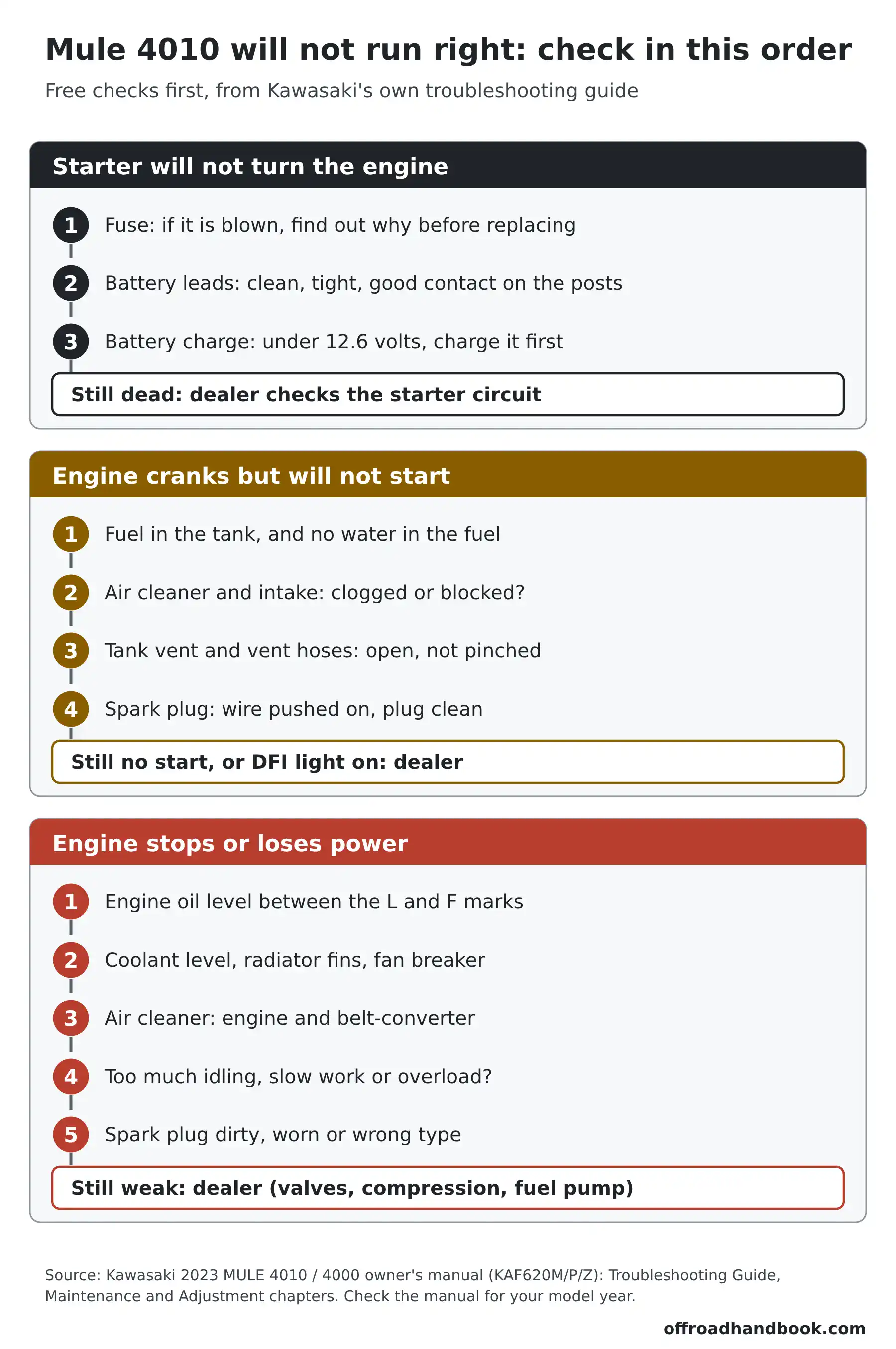
The three panels follow the cause lists in Kawasaki’s troubleshooting guide, reordered so the free checks come first. Work down one panel only.
Never run the engine with a warning light on. Kawasaki warns that prolonged running with one lit can cause engine damage from overheating.
What is your Mule doing?
The checker repeats steps from the owner’s manual and the flowchart above. It cannot read codes or inspect the machine, so treat it as an ordered checklist.
Gasoline fumes and hot exhaust are the real hazards on this job. Work outside with the engine off and cool, the key out, and no smoking nearby.
1. Rough idle, surging or stalling
The ECU sets idle at 950 ± 50 rpm, and the owner cannot adjust it. Kawasaki says high-altitude adjustment is not needed because the ECU manages the mixture. If idle is unstable, the manual’s answer is to have the dealer inspect the throttle body.
Before booking, run the free checks in this order:
- Check the engine oil. Park level with the engine cold, and the dipstick should read between L and F. If it is above F, draw the extra out with a syringe.
- Check throttle pedal free play. It should be 0.2 to 0.4 in (5 to 10 mm). With no play, Kawasaki says the idle may be erratic.
- Clean the air cleaner element and drain the housing hose. A clogged cleaner can let dirt into the fuel injection system and stick the throttle.
- Pull the spark plugs. Clean oily or carboned plugs, set the gap to 0.028 to 0.032 in, and replace any plug with a cracked insulator.
Long idling matters too. The troubleshooting guide lists too much idling or low-speed running, with too little airflow, as a reason the engine stops.
Valve clearance is a dealer job at the first 50 hours and every 500 hours. The spec is 0.010 in for intake and exhaust, and tight valves cost power.
2. Hesitates or loses power under load
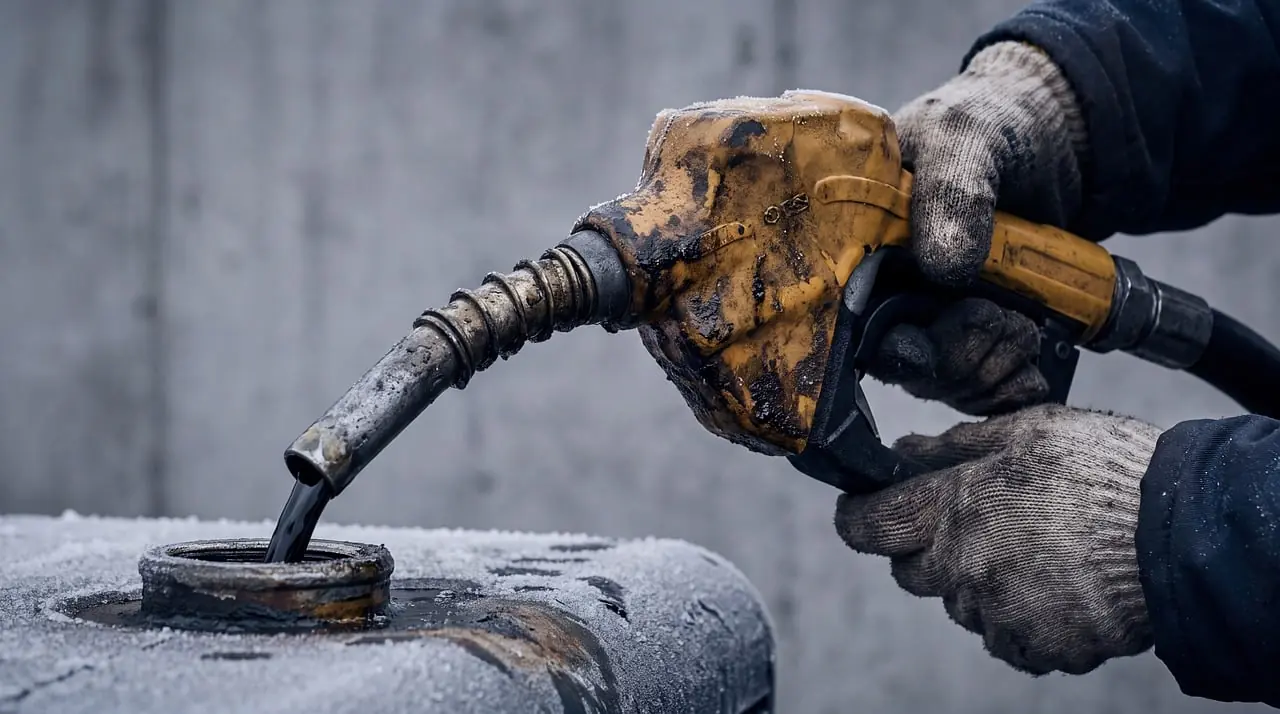
Fuel comes first. Kawasaki specifies fresh unleaded gasoline of 87 anti-knock index or higher, with up to 10 percent ethanol. It says never to use more than 10 percent ethanol or more than 5 percent methanol. If the engine knocks, switch to a different brand with a higher octane.
For storage of 30 to 60 days, Kawasaki recommends a fuel stabilizer. Clean the cap area before filling, and never fill the tank to the top, because heat can push fuel out through the cap vent.
Free checks, then the dealer
- Look at the tank vent hoses. A plugged vent or pinched hose can stall the engine or cost power. If the tank is full but it feels out of fuel, check the vent first.
- Clean the engine air cleaner and the belt-converter air cleaner. A clogged converter filter causes a loss of driving power.
- Use low range for heavy loads and hills. Kawasaki says high range under load wears the belt and pulleys early.
- Ask the dealer to inspect the fuel pump filter. If dirt, mud or water reaches the tank it can block, and the engine may hesitate or lose power.
Fuel hoses are on the schedule too: the dealer inspects them at the first 50 hours and every 250 hours, and replaces them every five years. The same guide also lists low compression and insufficient valve clearance behind a no-power complaint, both shop work.
3. DFI warning light stays on
The DFI light comes on with the key on and should go out soon after. If it stays on or comes on later, there is trouble in the digital fuel injection system. Kawasaki’s instruction is to have an authorized dealer check the system.
The manual publishes no owner-level fault codes, so there is no list of codes to chase at home. Note whether it came on at key-on, under load or after crossing water, and tell the dealer.
A DFI light that returns after a fuel stop or a wash points to the same dealer check, so say when it started.
4. Clicks, cranks slowly or will not start
Start with the lever. The starter lockout switch blocks the starter unless the gearshift lever is in N, so a Mule in H, L or R will not crank. Then look at the battery.
- Put the gear lever in N and set the parking brake.
- Check both battery terminals for tightness and corrosion. The battery sits under the left end of the front seat.
- Measure voltage. If it reads under 12.6 volts, charge it. Kawasaki warns against an automotive quick charger, which can overcharge a sealed battery.
- Check the fuses under the seat. Replace a blown fuse with the same rating, and find the cause if it blows again.
A bench charger sized for a 12-volt, 14 Ah sealed battery does the job. Kawasaki lists the BatteryMate 150-9, OptiMate 4, Yuasa MB-2040/2060 and Christie C10122S, and a OptiMate 4 charger is one of them. A digital multimeter shows the voltage in seconds.
Do not crank for more than 5 seconds at a time, and wait 15 seconds between tries. If the Mule sits four weeks or more, disconnect the battery. Kawasaki says a battery left connected and run flat is not covered by warranty. When reconnecting, positives go on first and the negative last.
If it cranks but will not start, the guide lists no fuel, water in the fuel, a clogged air cleaner, a blocked tank vent, a plug wire that is off, and a dirty plug. Work through them in that order.
5. Will not go into gear
The gearshift lever moves between H, N and R, with an extra L on the 4x4 models. Kawasaki says to stop completely with the engine at idle before moving the lever between forward and reverse. Shifting while rolling can damage the transmission.
- Stop fully, let the engine drop to idle, and try again.
- For a Hi-Lo change, stop completely and put the gear lever in N first. The Hi-Lo lever cannot be moved while rolling.
- After moving the 2WD-4WD lever back to 2WD, roll a short distance. Kawasaki says the transmission may not finish the shift until the Mule moves.
- The differential lever works the same way, and must not be moved above 5 mph.
If the lever still binds after a clean stop at idle, the cause is a linkage or transmission fault that the manual leaves to the dealer. Do not force it, and check the transmission oil level first: the dipstick should read between H and L.
6. Burning smell, slipping or no drive
The Mule uses a belt-drive torque converter. Kawasaki says high range with heavy loads, hill climbs or a trailer wears the belt and pulleys early, so use low range for those jobs.
- Drain the converter housing. Remove the drain hose at the bottom of the housing and let dust or water out, then refit it. The chart calls for this every 500 hours, and more often in mud or dust.
- Clean the converter air cleaner element at 50 hours and every 250 hours. Wash the foam in high-flash-point solvent and squeeze it dry, and replace it after five cleanings or if it is torn.
- Leave belt checks to the dealer. The chart lists belt and deflection inspection every 250 hours and pulley shoe inspection every 500, all dealer work.
A blocked converter cleaner can cause a malfunction and a loss of driving power. Kawasaki’s warranty also lists drive belts as normal wear items, so budget for a replacement.
7. TEMP light or running hot
The TEMP light comes on at key-on, then should go out. If it stays lit, stop the engine, let it cool, and check the coolant level in the reserve tank. Do not open the radiator cap while hot.
- Check the reserve tank when cold. The level should sit between F and L.
- Look at the radiator fan for mud, and clean the fins with low-pressure water. A high-pressure washer can bend the fins.
- Check the fan breaker under the seat near the fuse box. Clear the cause, then press the reset button on the breaker case.
- Disconnect the negative battery cable before touching the fan, because it can start on its own with the key off.
The coolant is a 50/50 mix of water and permanent ethylene glycol antifreeze made for aluminum engines, and the system holds 4.5 qt. In an emergency you can top up with water alone, but return it to 50/50 soon. If you keep adding coolant, there is a leak, so see the dealer.
Do not mount accessories in front of the radiator or behind the fan. The manual says they can block airflow and cause overheating.
Debris matters too: Kawasaki says built-up debris or flammable material such as grass around the engine and exhaust raises the risk of mechanical problems and fire, so park outside and clear it once the engine is cool.
8. Brake noise, soft pedal or low pedal
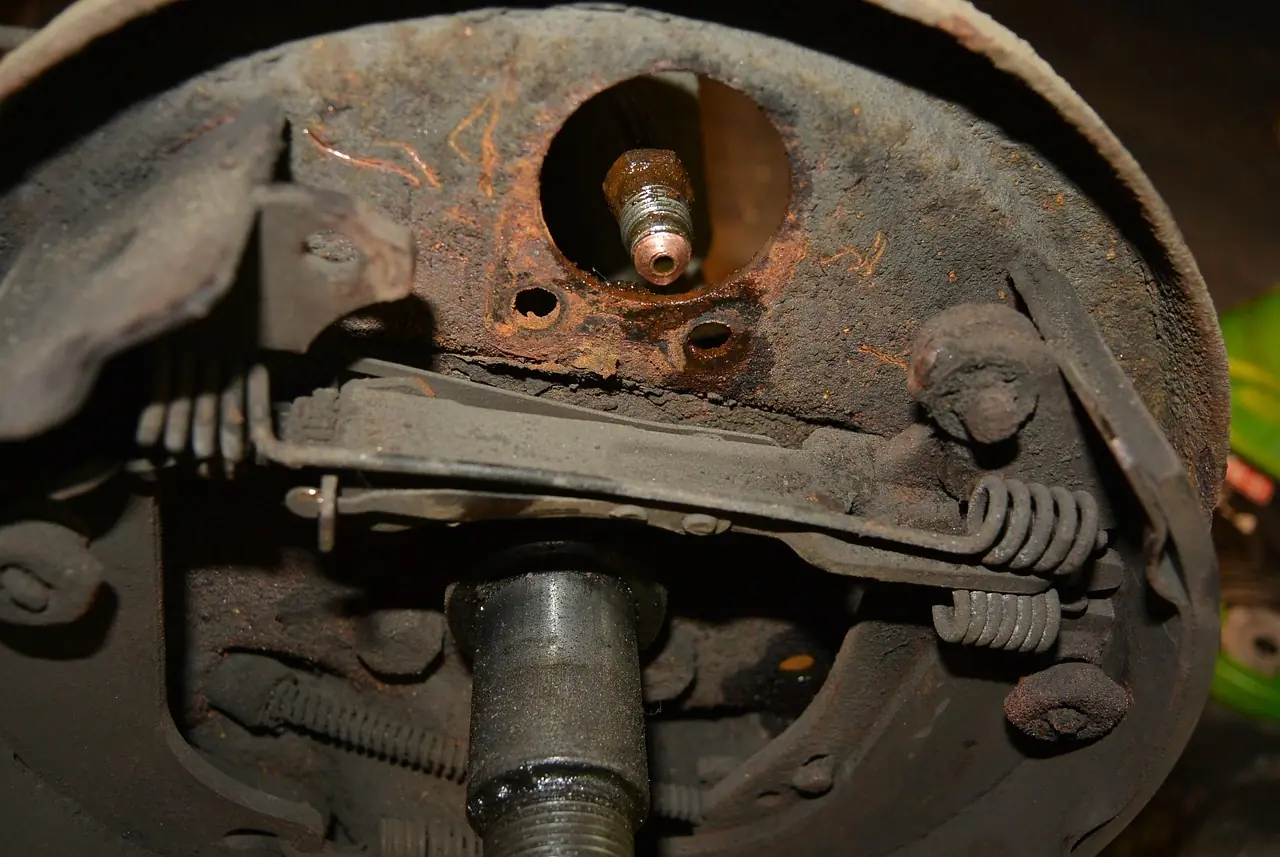
The Mule 4010 has hydraulically actuated drum brakes on all four wheels, not discs. Brake shoe lining wear is a dealer inspection every 250 hours, and the manual does not diagnose squeal.
- Check pedal free play. It should be 0.1 to 0.4 in (2 to 10 mm).
- Check the fluid level through the inspection hole in the dash. It should sit between MIN and MAX.
- Check the parking brake lever. After 8 to 12 clicks of travel the Mule should not roll while parked.
- Keep degreaser off the brakes. Kawasaki says to avoid applying degreaser to seals, brake pads and tires.
Use DOT 3 fluid from a fresh, sealed container only, and never mix brands. Brake fluid is a dealer change every two years. If you top up, a bottle of DOT 3 brake fluid is the right type.
A soft, mushy or long pedal means air or a leak. Kawasaki says to have the system inspected immediately, so skip the free checks and stop driving it.
After water, brakes get less effective. Press the brakes lightly as you drive until the linings dry. Wet brakes may also wear faster, so check them more often if you cross water.
There is also no engine braking near idle. When the pedal is fully released and rpm drop to idle, the automatic transmission lets the engine go, so use the brakes on descents.
Service schedule: what is due next
Kawasaki’s chart runs on hours or miles, whichever comes first, with a first service at 50 hours and regular services every 250 and 500 hours. A “dealer” item means a Kawasaki dealer or someone equally competent should do it.
Enter the hour meter reading to see the next milestone and what the chart lists for it.
The checker uses the 2023 chart on pages 81 to 83. It does not know your riding conditions, and the chart says to service more often in mud, dust or hard use.
For calendar items, the chart also asks for oil, front gear case and transmission oil each year, coolant and brake fluid every two years, and fuel hoses every five. Those run on time regardless of hours.
| Item | Spec |
|---|---|
| Engine oil | SAE 10W-40, API SG to SM with JASO MA, MA1 or MA2. 1.1 US qt without filter, 1.3 qt with. Drain plug 24 ft-lb |
| Transmission case oil | API GL-5 hypoid gear oil, SAE 90 above 41°F, SAE 80 below. 2.64 US qt. Drain plug 11 ft-lb |
| Front final gear case | 0.42 US qt. Filler cap 21 ft-lb, drain plug 15 ft-lb. Oil grade is on p. 91 of the manual |
| Coolant | 50/50 water and permanent ethylene glycol antifreeze for aluminum engines, 4.5 US qt |
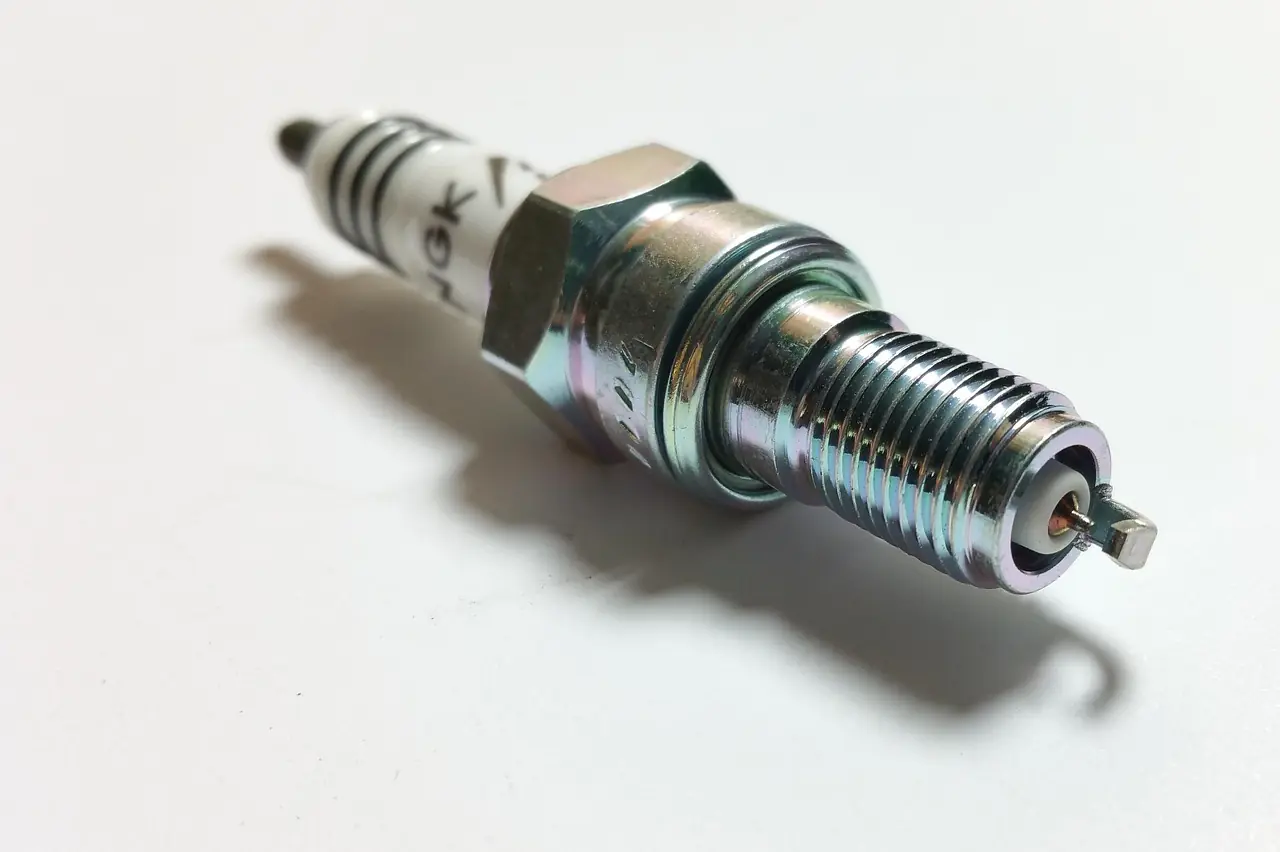
| Spark plug | NGK BPR2ES, gap 0.028 to 0.032 in, torque 18 ft-lb |
| Valve clearance | 0.010 in intake and exhaust, dealer service |
| Idle speed | 950 ± 50 rpm, set by the ECU, not adjustable |
| Free play | Throttle pedal 0.2 to 0.4 in, brake pedal 0.1 to 0.4 in, steering wheel 0 to 0.8 in, parking brake 8 to 12 clicks |
| Tires, cold | Front 10 psi, rear 24 psi on 23x11.00-10 tires. Wheel nuts 81 ft-lb, minimum tread 0.12 in |
| Fuel and battery | 6.3 US gal tank, 87 AKI minimum, no more than 10% ethanol. Sealed 12 V 14 Ah battery |
| Load | 1,327 lb total with riders, cargo and accessories on the 4010 (1,311 lb for the Z model). 800 lb in the bed |
Check recalls before chasing gremlins
In 2017, the U.S. Consumer Product Safety Commission announced recall 17-751 for 2017 Mule 4010 4x4 and Trans4x4 models, including the Camo and SE versions. The fuel gauge retainer can collapse and leak fuel, a fire hazard, and Kawasaki offered a free repair.
The notice listed about 6,600 units across several models and no separate VIN range for the 4010.
If a 2017 smells of fuel, stop using it and call Kawasaki. Any other Mule can be checked by VIN on Kawasaki’s recall page.
Mule 4010 FAQ
Does the Mule 4010 have engine braking?
Not near idle. With the pedal fully released and rpm at idle, the transmission lets the engine go to prevent stalling. Use the brakes to control speed.
Does the Mule 4010 have a belt?
Yes. It has a belt-drive torque converter and an automatic transmission. The belt and pulley shoes are dealer inspections on the service chart.
What fuel does it take?
Fresh unleaded gasoline of 87 anti-knock index or higher. Up to 10 percent ethanol is fine, and the manual says never to exceed that.
What tire pressure should it run?
Cold pressure is 10 psi in front and 24 psi in the rear on the stock tires. For trail air-down on other rigs, try our tire pressure calculator.
Related guides
- Kawasaki Mule Pro FXT problems and fixes
- Kawasaki Teryx4 problems and fixes
- What a side-by-side is and how it differs from an ATV

I'm Suryashankar Dasgupta, the founder of Off-Road Handbook. I've been off-roading for years on mountain and desert terrain. I've also driven a Jeep Compass for more than seven years, so I know the day-to-day side of Jeep ownership first-hand, from the Uconnect screen to the warning lights. Every guide here is researched from manufacturer owner's manuals, NHTSA recall and service-bulletin records and other trusted sources, checked against them before it is published, and corrected when we find a mistake. You can read how we work in our editorial policy: https://offroadhandbook.com/editorial-policy/
Like our off-road guides? Add Off-Road Handbook as a Google Preferred Source so our latest Jeep, ATV, UTV, trail, recovery, and off-road troubleshooting articles can appear more often in your Google Search experience.
Add us as a Preferred Source