Is the Bronco Sport 4x4? How Its AWD System Works on the Trail
Last updated on October 18th, 2026 at 11:00 am
Yes. Every trim of the Ford Bronco Sport has 4x4 as standard equipment. It is not the same hardware as a full-size Bronco: the Bronco Sport drives the front wheels and sends torque to the rear through a clutch-equipped rear drive unit, and it has no low range.
What changes by trim is that rear unit. Most trims have a single-clutch version, while the Badlands and the Sasquatch Packages have a twin-clutch version that can lock the rear axle. That makes it a good snow, gravel and light-trail SUV, not a rock crawler. Specs below come from Ford's 2025 technical specifications and owner's manuals.
Is the Bronco Sport 4x4, AWD or 4WD?
Ford uses all three words. The 2025 owner’s manual says “Four-wheel drive is also called 4WD and 4x4,” yet its maintenance section calls the power transfer unit and rear axle “AWD only” parts.
Mechanically it behaves like a front-biased all-wheel-drive system. Ford's spec sheet lists a power transfer unit (PTU) at the front axle, a disconnectable driveshaft and a rear drive unit (RDU). It lists no transfer case and no low range gear.
The sheet's crawl ratio is 18:1, which is first gear (4.69) times the final drive (3.81). Ford's 2026 full-size Bronco spec sheet shows 57.19:1 to 94.75:1. For how 4WD, AWD and 4A differ in general, see our guide to 4WD vs AWD vs 4A.
How the Bronco Sport's 4x4 system works
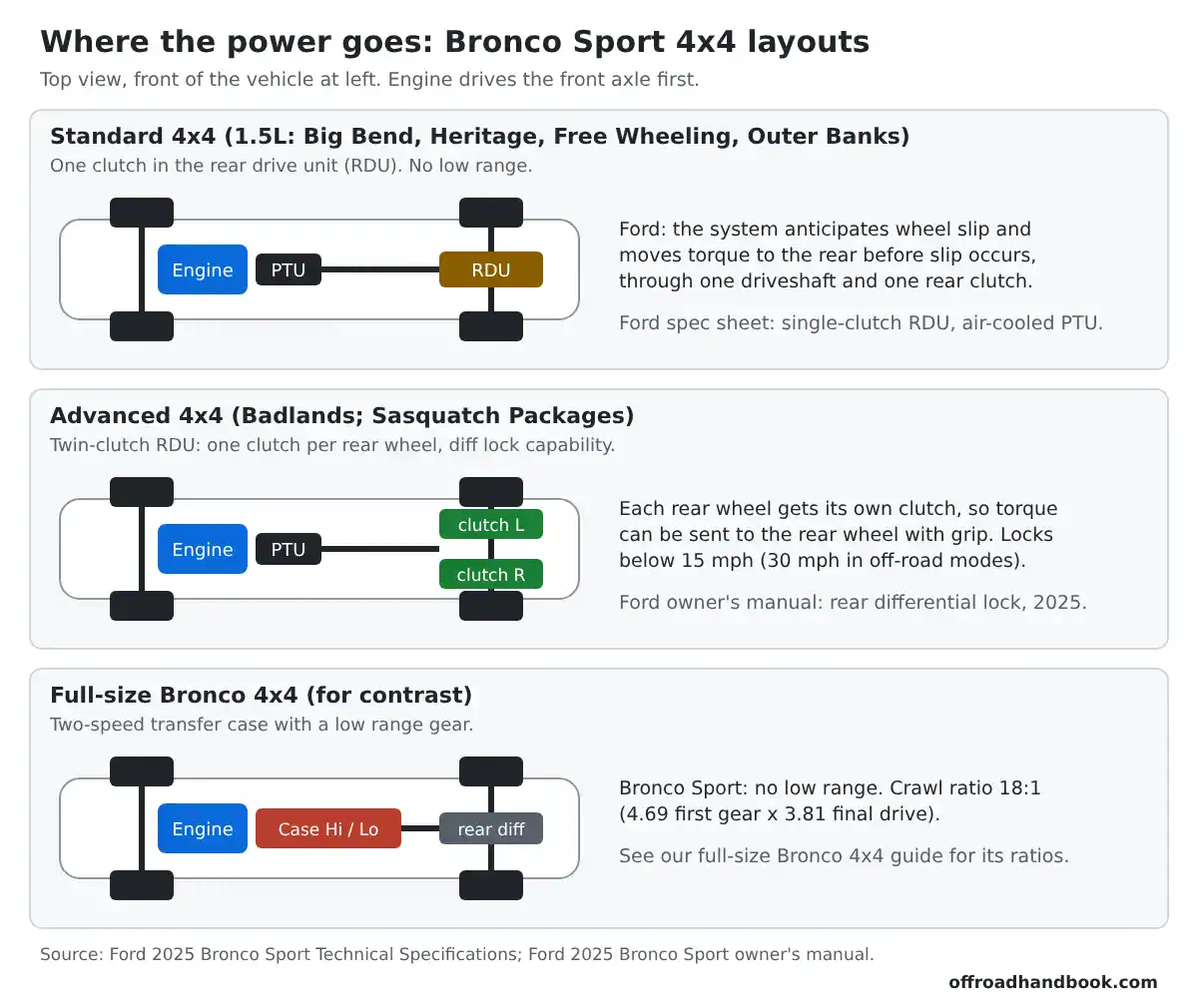
The manual calls the system proactive. It can anticipate wheel slip and move torque to the rear wheels before slip occurs, and it keeps adjusting the split even when nothing is slipping.
The system switches on every time you start the vehicle. A graphic in the instrument cluster shows how much power is going to each end.
Standard 4x4
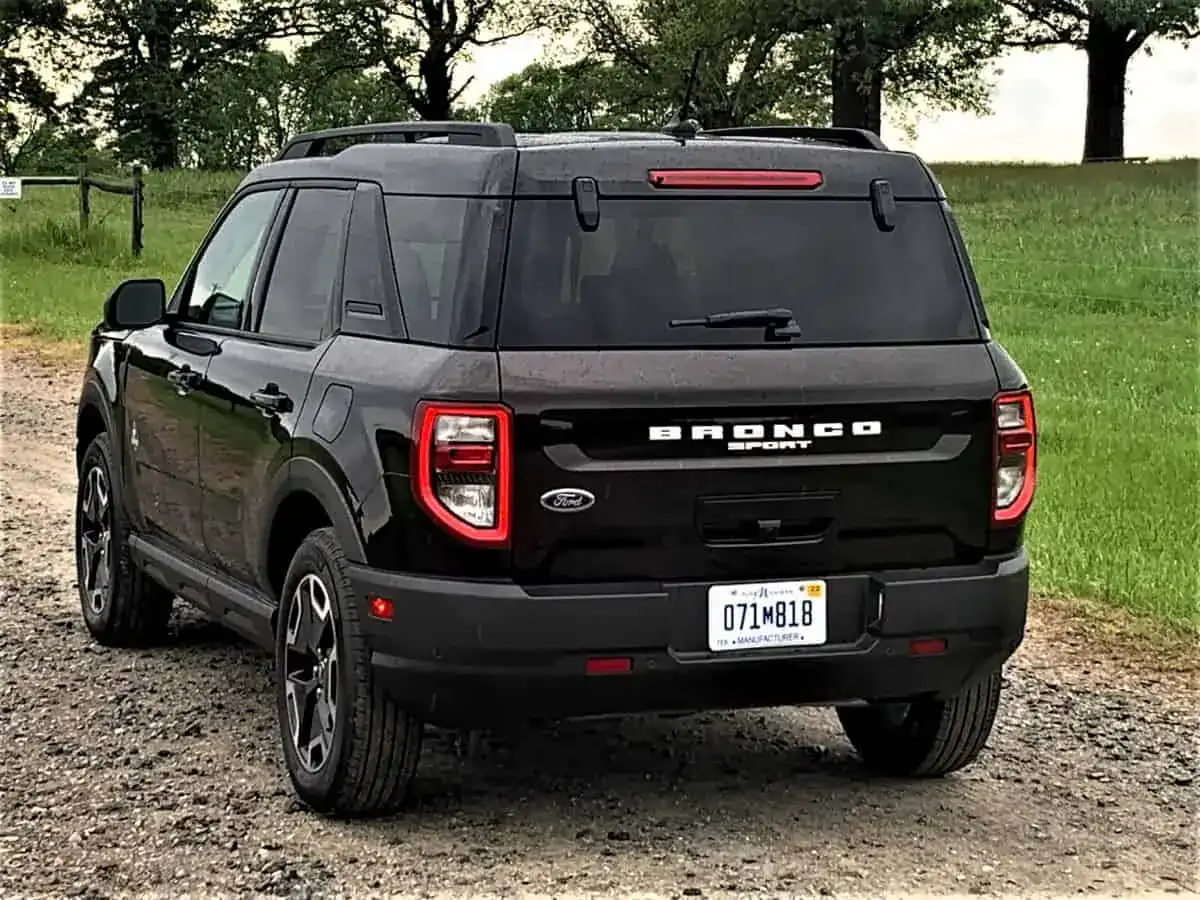
Big Bend, Heritage, Free Wheeling and Outer Banks (all 1.5L) use an air-cooled PTU, a disconnectable driveshaft and a single-clutch RDU, according to Ford's 2025 sheet. That layout suits snow, wet pavement, gravel and graded dirt roads.
Ford lists diff-lock capability only for the dual-clutch unit. Expect no rear differential lock on these trims.
Advanced 4x4
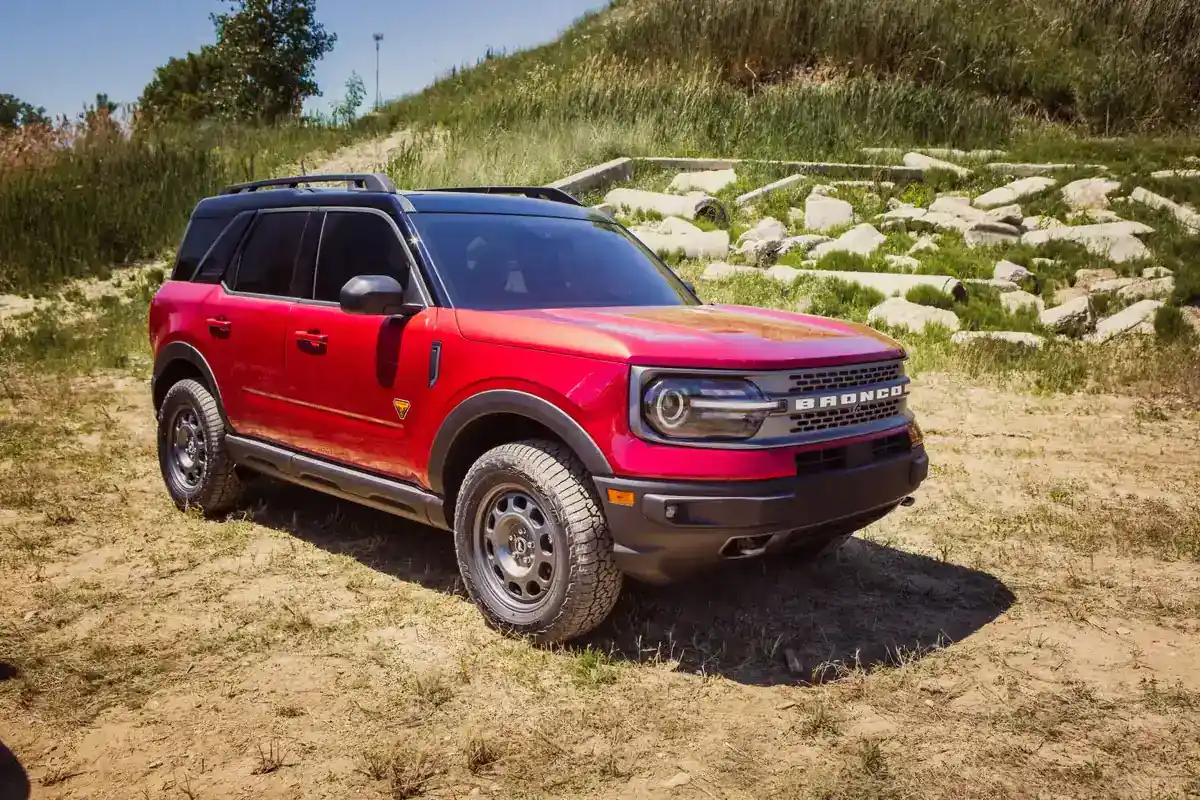
The Badlands (2.0L) adds a water-cooled PTU, a 4WD lock and a dual-clutch RDU “with Diff Lock Capability,” per the spec sheet. Ford's Badlands page calls it Advanced 4x4 with Twin-Clutch Rear Drive Unit.
Many pages say only the Badlands has it. Ford's Outer Banks page says Advanced 4x4 comes with the Sasquatch Outer Banks Package, and the 2025 sheet lists the dual-clutch RDU for the 1.5L with Sasquatch as well.
Ford's manual calls the feature a rear differential lock. It releases above a set speed and re-engages below it, and it is for off-road use only.
Bronco Sport 4x4 by trim: clearance, angles, wading and towing
| Setup | 4x4 system | Ground clearance | Approach / departure / breakover | Wading depth | Max towing |
|---|---|---|---|---|---|
| Big Bend, Heritage, Free Wheeling, Outer Banks (1.5L) | Standard 4x4, single-clutch RDU | 7.8 in | 22.1° / 30.8° / 18.6° | 17.7 in | 2,200 lb |
| Outer Banks with Sasquatch Package (1.5L) | Advanced 4x4, dual-clutch RDU | 8.8 in | 24.1° / 27.3° / 21.0° | 20.7 in | 2,200 lb |
| Badlands (2.0L) | Advanced 4x4, dual-clutch RDU | 8.1 in | 30.0° / 26.7° / 20.4° | 23.6 in | 2,700 lb |
| Badlands with Sasquatch Package (2.0L) | Advanced 4x4, dual-clutch RDU | 8.7 in | 31.2° / 27.9° / 21.7° | 23.6 in | 2,700 lb |
Ford's sheet gives two figures per column, standard and “optional.” The optional packages it names are the two Sasquatch Packages, so that is how the table reads. The sheet shows 20.6 inches of wading for the Outer Banks Sasquatch where the manual says 20.7 in (525 mm).
Ford's undated vehicle architecture page still lists the earlier Badlands numbers: up to 8.8 inches of clearance and 30.4, 33.1 and 20.4 degrees with available tires. Ford's 2026 lineup page lists 7.8 inches for Big Bend, Heritage and Outer Banks, and 8.1 for Badlands.
Tire size and bumper changes move these angles. Our approach angle calculator shows how a different setup shifts the numbers.
What changed by model year
The names of the off-road modes changed between the early and current manuals, so a used Badlands may not show the same menu as a new one.
| Model year | 2.0L Badlands drive modes | Wading depth | Max towing |
|---|---|---|---|
| 2021 | Normal, Eco, Sport, Slippery, Sand, Mud/Ruts, Rock Crawl | 17.7 in base, 23.6 in Badlands | 2,000 lb (1.5L), 2,200 lb (2.0L) |
| 2022 | Normal, Eco, Sport, Slippery, Sand, Mud/Ruts, Rock Crawl | 17.7 in Base, Big Bend, Outer Banks; 23.6 in Badlands | Not checked |
| 2025 | Normal, Eco, Sport, Slippery, Off-Road, Rally, Rock Crawl | 17.7 in; 20.7 in Outer Banks Sasquatch; 23.6 in Badlands | 2,200 lb (1.5L), 2,700 lb (2.0L) |
Ford's 2025 sheet lists the two Sasquatch Packages as optional packages. The wading tables in the 2021 and 2022 manuals have no Sasquatch entry.
The 1.5L trims have five modes: Normal, Eco, Sport, Slippery and Off-Road in the 2025 manual. The 2021 and 2022 manuals list Sand where the 2025 manual lists Off-Road.
G.O.A.T. modes and what they do to the 4x4 system
Ford calls its drive modes G.O.A.T., for “Goes Over Any-type of Terrain.” Turn the console controller once to open the menu and again to select. The vehicle returns to Normal at every start, with a prompt to restore your last mode.
| Mode | Where | What Ford says it is for | Rear diff lock speed limit |
|---|---|---|---|
| Normal | All trims | Everyday driving; base settings | 15 mph |
| Eco | All trims | Fuel economy; softer pedal response | 15 mph |
| Sport | All trims | Quicker pedal, holds lower gears | 15 mph |
| Slippery | All trims | Snow and ice, or firm surfaces covered with loose or slippery material | 15 mph |
| Off-Road | All trims | Soft, dry sand or deep conditions; lower gears hold longer; engages the 4WD lock where fitted | 30 mph |
| Rally | Badlands | Soft, dry sand or deep snow | 30 mph |
| Rock Crawl | Badlands | Rocks and slow, uneven ground; engages the 4WD lock, damps the throttle, lightens steering | 30 mph |
Ford says Off-Road and Rally are not for firm, slippery surfaces like packed snow or ice. Use Slippery there. Our guide to the Bronco Sport in snow covers that case: Is the Bronco Sport good in snow?
The manual also warns against using the 4WD lock, the rear differential lock or off-road modes on dry, hard roads. The effects it lists are noise, extra tire wear and possible drivetrain damage that may not be covered by the warranty.
Pick your trim and trail
This selector turns the tables above into a quick answer. Choose your setup and the ground in front of you.
Bronco Sport trail capability selector
Pick your trim and the ground you are about to drive. You get the G.O.A.T. mode, lock behavior and limits Ford lists for that setup.
Based on Ford's 2025 Bronco Sport technical specifications and 2025 owner's manual, as cited in the tables above. It is a summary, not a replacement for your own manual.
Treat every number as a limit for a stock vehicle on stock tires. Check your model year in the owner's manual before you rely on it.
Limits Ford puts on the Bronco Sport's 4x4
- Overheating: in extreme load or heavy wheel slip, such as deep sand, the system can switch to front-wheel drive and show a message. Stop safely and switch the ignition off for at least 10 minutes. Normal 4x4 resumes after it cools.
- Mismatched tires: Ford says major differences in tire size can damage the system or default it to front-wheel drive. The message “4x4 Performance Reduced” points to mismatched tires.
- Temporary spare: using it turns the 4x4 system off. Refit the repaired or replaced road tire, then cycle the key.
- Service: Ford lists no scheduled maintenance for the PTU and rear axle. Check or change the PTU lubricant after submersion in water or if it leaks, and note that severe duty may bring a fluid change sooner.
- Towing the vehicle: no flat towing. All four wheels must be off the ground.
None of this is a reason to avoid trails. It is a reason to know what the system is built for.
How to set up a Bronco Sport for a trail
- Check that all four tires match in size and that pressures follow the placard.
- Pick the G.O.A.T. mode before you reach the obstacle, using the table above.
- Use the 4WD lock or rear differential lock buttons only on slippery or loose ground, and only where your trim has them.
- For slow climbs and descents, press the Trail Control button where fitted and set a speed with the steering wheel toggle. It works from 1 to 20 mph forward and 1 to 5 mph in reverse.
- Before any water crossing, measure depth against the wading column above and stay at 4 mph or less. Our water fording depth guide covers the checks in more detail.
- Afterward, inspect the wheels, tires and underbody, and clear mud from the radiator.
Bronco Sport vs full-size Bronco
The full-size Bronco is body-on-frame with a two-speed transfer case and a true low range. The Bronco Sport is a unibody compact SUV with no low range. Our guide to which Broncos are 4x4, AWD or 2WD lays out the full family.
Pick the Bronco Sport for snow, dirt roads, beach access and mild trails. Pick the full-size Bronco if your route has steep technical climbs where low range matters.
FAQs
Yes. Ford lists 4x4 as standard on every current trim. The standard version has a single-clutch rear drive unit, and the Badlands and Sasquatch Packages have a twin-clutch unit.
Ford calls it 4x4 and its manual says 4WD and 4x4 mean the same thing. It behaves like an on-demand all-wheel-drive system and has no low range.
Vehicles with the twin-clutch rear drive unit have a rear differential lock feature. It is for off-road use only and releases above 15 mph in Normal, Eco, Sport and Slippery, or 30 mph in the off-road modes.
Only with the Sasquatch Outer Banks Package, according to Ford's Outer Banks page. The standard Outer Banks has the single-clutch unit.
No. Ford says you cannot tow it with all wheels on the ground. All four wheels must be off the ground, such as on a car-hauling trailer.

I'm Suryashankar Dasgupta, the founder of Off-Road Handbook. I've been off-roading for years in the USA, including California and Texas, and have ridden mountain and desert terrain abroad. I've also driven a Jeep Compass for more than seven years, so I know the day-to-day side of Jeep ownership first-hand, from the Uconnect screen to the warning lights. Every guide here is researched from manufacturer owner's manuals, NHTSA recall and service-bulletin records and other trusted sources, checked against them before it is published, and corrected when we find a mistake. You can read how we work in our editorial policy: https://offroadhandbook.com/editorial-policy/
Like our off-road guides? Add Off-Road Handbook as a Google Preferred Source so our latest Jeep, ATV, UTV, trail, recovery, and off-road troubleshooting articles can appear more often in your Google Search experience.
Add us as a Preferred Source