Coleman 550 UTV Problems and How to Fix Them
Last updated on October 25th, 2026 at 01:39 pm
This post contains Amazon affiliate links. As an Amazon Associate I earn from qualifying purchases, at no extra cost to you.
The most common Coleman 550 UTV problems are a crawl caused by an unlatched driver seat belt, hard starting from a weak battery or old fuel, rough idle from a dirty throttle body or clogged fuel filter, overheating from a mud-packed radiator, and stiff shifting. Run the free checks first: buckle the belt, test the battery, replace stale fuel and rinse the radiator.
The Outfitter 550 is a Hisun-platform machine sold by Coleman. Coleman’s own parts store lists a “Coleman HS550/750UTV” service manual and HS-series part names in its UT550 parts catalog.
Coleman’s UT550 owner’s manual could not be opened for this guide, so procedures and intervals come from a Cub Cadet 550/750 operator’s manual. Hisun is the manufacturer named by the CPSC for the 2016 Cub Cadet Challenger utility vehicles, and Hisun’s own 550 models use the same 546 cc engine size. Treat those numbers as platform references and confirm them in your own manual.
Coleman 550 problems at a glance
| Symptom | Check first (free) | Likely cause | Next step | Section |
|---|---|---|---|---|
| Runs, but will not go faster than a crawl | Driver seat belt latched | Seat belt speed limit active | Clean buckle, check switch connector; parts if it persists | 1 |
| Clicks or cranks slowly | Battery cables, battery voltage | Weak battery or loose cable | Charge, retest, replace if it will not hold | 2 |
| Cranks but will not start | Lever in N or P, fuel age, fuses | Stale fuel, clogged filter, fouled plug | Fresh fuel, filter, new plug; dealer for spark or fuel pressure | 2 |
| Rough idle, stalls or bogs | Air filter, in-line fuel filter | Dirty throttle body, filter or injector | Clean throttle body, replace filter; dealer for pressure test | 3 |
| Runs hot or boils over | Radiator fins, coolant level (cold) | Mud, low coolant, air in system, fan not running | Rinse, top up, burp the system, test the fan | 4 |
| Grinds, will not shift or no reverse | Full stop, brake pedal, idle speed | Shifting while moving, linkage or cable out of adjustment | Adjust per service manual; dealer if it still grinds | 5 |
| Feels stuck in 4WD, or will not move | Parking brake, 2WD/4WD and diff lock switches | Switch left on, belt or connector fault | Reset switches; belt or switch if needed | 6 |
| Battery light on or battery dies | Cables, accessories, charging voltage | Regulator, stator, wiring or tired battery | Meter test; dealer for stator and harness | 7 |
Each section below runs free checks first, then parts, then the point where a dealer is the better call.
Part prices in this guide are Coleman’s catalog list prices as seen on October 17, 2026. Some parts show low stock or UPS-only shipping, and Coleman does not list labor, so ask a dealer for installed pricing.
Diagnosis order for four common complaints
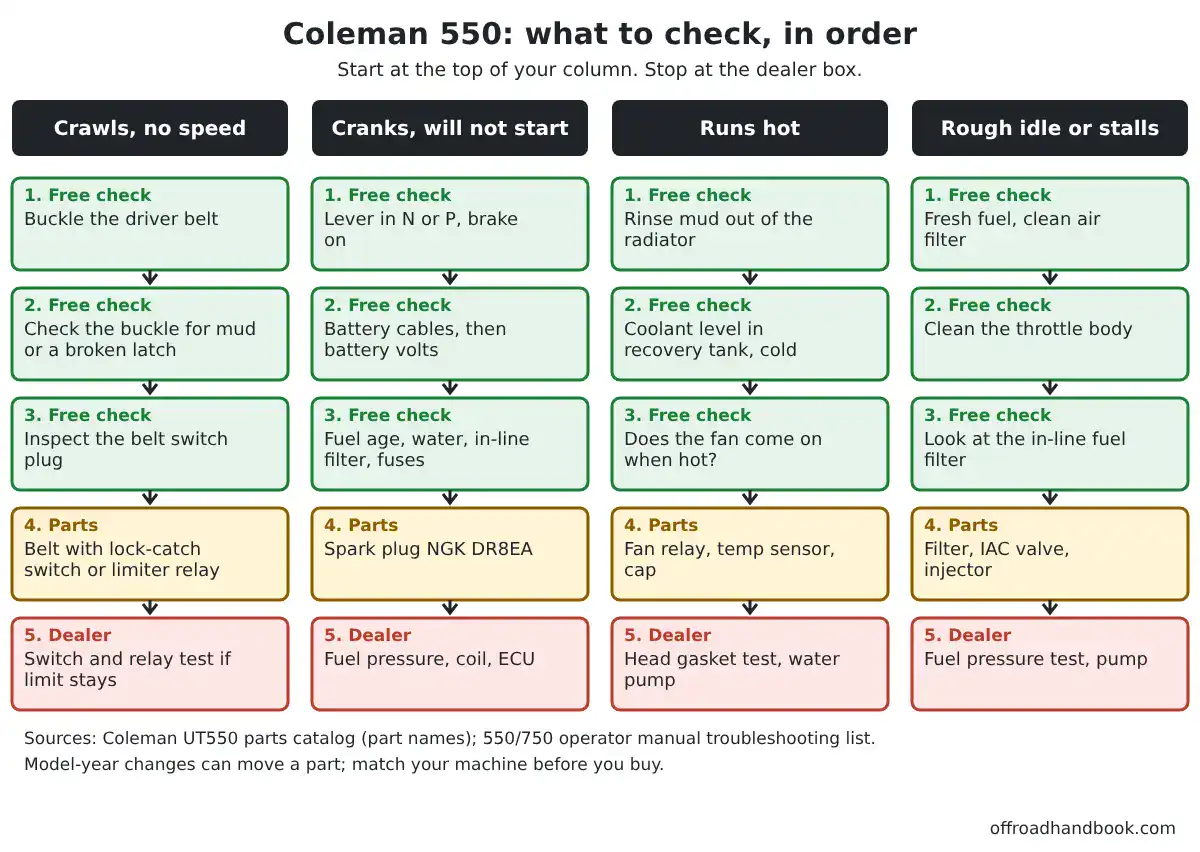
Green boxes cost nothing, yellow boxes cost parts, and red boxes mean the next test needs a shop’s gauges or scan tools.
Stop at the first box that fixes it. Skipping to parts is how a $14.97 spark plug problem turns into a $459.97 fuel pump purchase.
What is your Coleman 550 doing?
Based on the Coleman UT550 parts catalog (part names and list prices, October 17, 2026) and the troubleshooting list in a Cub Cadet 550/750 operator’s manual. Items that come from owners say so.
A few numbers make diagnosis faster: low idle speed, battery size, oil capacity and top speed.
They come from the Cub Cadet 550/750 operator’s manual for the same platform. Many pages quote “22.5 hp” for this engine, but the manual lists 22.5 in kilowatts, which is 30.17 hp.
Coleman 550 numbers worth knowing before you diagnose
| Item | Platform manual value |
|---|---|
| Engine | 1-cylinder, 4-stroke, SOHC, liquid cooled, 546 cc (550 model) |
| Power | 22.5 kW (30.17 hp) at 6,000 rpm |
| Low idle | 1,350 to 1,500 rpm |
| Fuel tank | 7.4 US gal |
| Engine oil capacity | 2.1 L (2.22 qt), API SJ or higher, JASO MA |
| Battery | 12V 32Ah, nonrefillable |
| Top speed | High range 44.7 mph, low range 37.9 mph, reverse 24.8 mph |
| Towing and bed | 1,200 lb max rolling weight, 110 lb tongue weight, 500 lb cargo bed |
| Tires | 26x9.00-14 front, 26x11.00-14 rear |
1. Why does my Coleman 550 only crawl?
A 550 that runs but will not pick up speed is usually held back by its seat belt circuit. Coleman’s catalog lists a speed limiter relay (2018 to current) and a seat belt with a lock-catch switch for the UT550.
Owners describe a speed cap until the driver’s belt is latched, as in this UTV Board reply. Two sites that cover it put the cap near 6 mph (10 km/h), but no Coleman manual page stating the figure could be opened, so treat that number as owner-reported.
- Free: Latch the driver’s belt until it clicks, then try again.
- Free: Look inside the buckle for mud, grit or a cracked latch, and clear it out. The platform manual’s dash cluster includes a seat belt indicator, so see whether it stays lit.
- Free: Turn the key off, disconnect the negative battery cable, and check the belt switch connector for loose or corroded pins.
- Parts: A seat belt with the lock-catch switch lists at $45.97, the buckle at $36.97 and the limiter relay at $159.97.
Do not fit a belt blank or buckle the belt behind the seat. The platform manual says never to operate the vehicle without the occupant protective structure in place and the seat belt fastened.
Stop and see a dealer if the limit stays with the belt latched. Have the switch and relay tested before buying a $159.97 relay.
2. Why will my Coleman 550 not start?
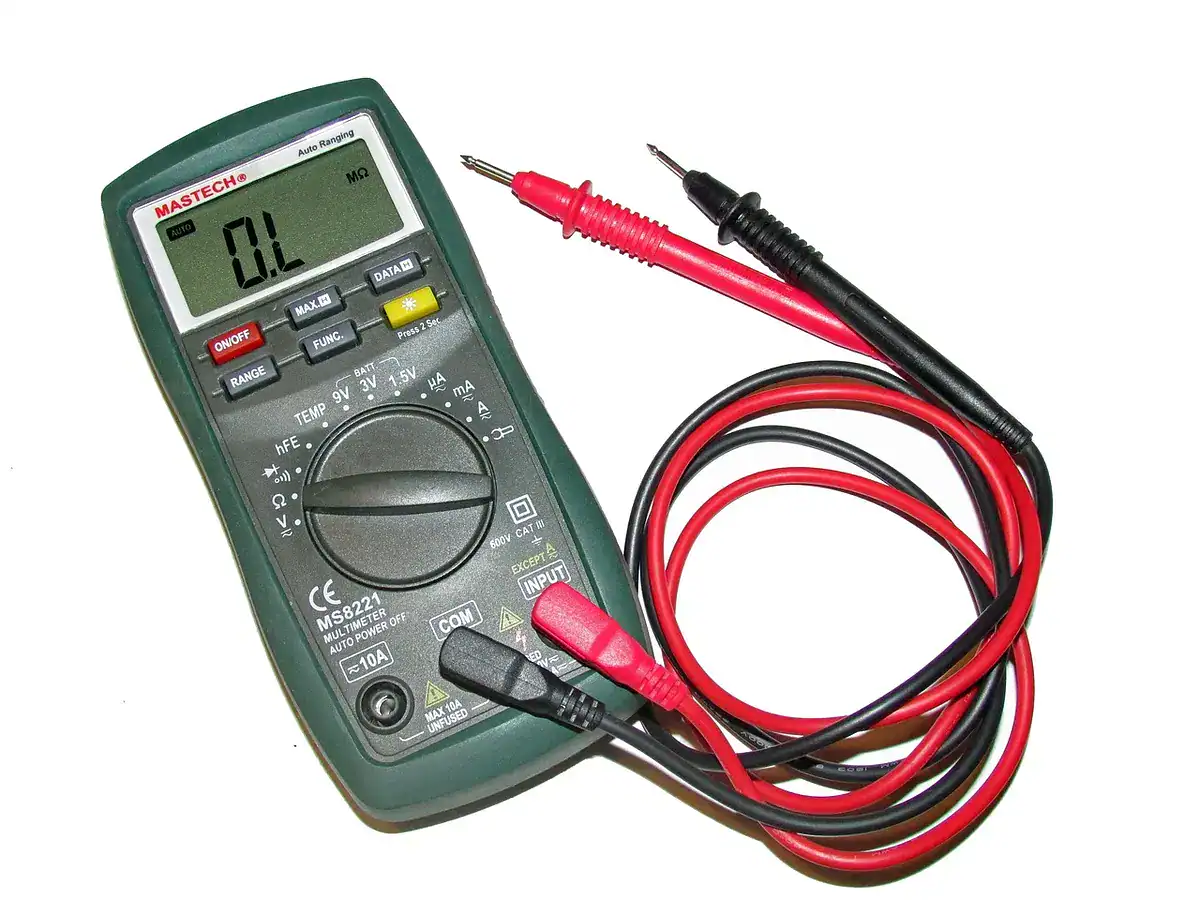
A click or slow crank points to the battery. Normal cranking that never fires points to fuel or spark.
- Free: Put the lever in N or P with the brake on. The manual says the engine will not start otherwise.
- Free: Clean and tighten both battery cable ends. The manual lists loose or corroded connections as a no-start cause.
- Free: Charge the battery, wait an hour for the surface charge to fade, and read it with a digital multimeter. Yuasa’s technical manual puts a charged conventional battery near 12.6 volts and 75 percent charge at 12.4, and an AGM battery at 12.8 to 13.0 volts.
- Free: Smell the fuel. Replace stale fuel and look for water in the tank. One owner’s no-start turned out to be water in the tank, as told in this UTV Board thread.
- Free: Check the in-line fuel filter between the tank and engine, and the primary filter on the tank. The manual says to replace either one if it is clogged or holds water.
- Free: Check the mini fuses. Disconnect the negative cable, open the fuse box cover, pull the fuse and fit a new one. If a fuse blew, find out why.
A battery that stays under 75 percent charge after charging is probably bad, and the factory battery is a nonrefillable 12V 32Ah unit. Never crank for more than 5 seconds at a time. At 5°F (-15°C) or colder, the manual says to turn the key off for 30 seconds after a failed 5-second try, then repeat.
Is it the spark plug?
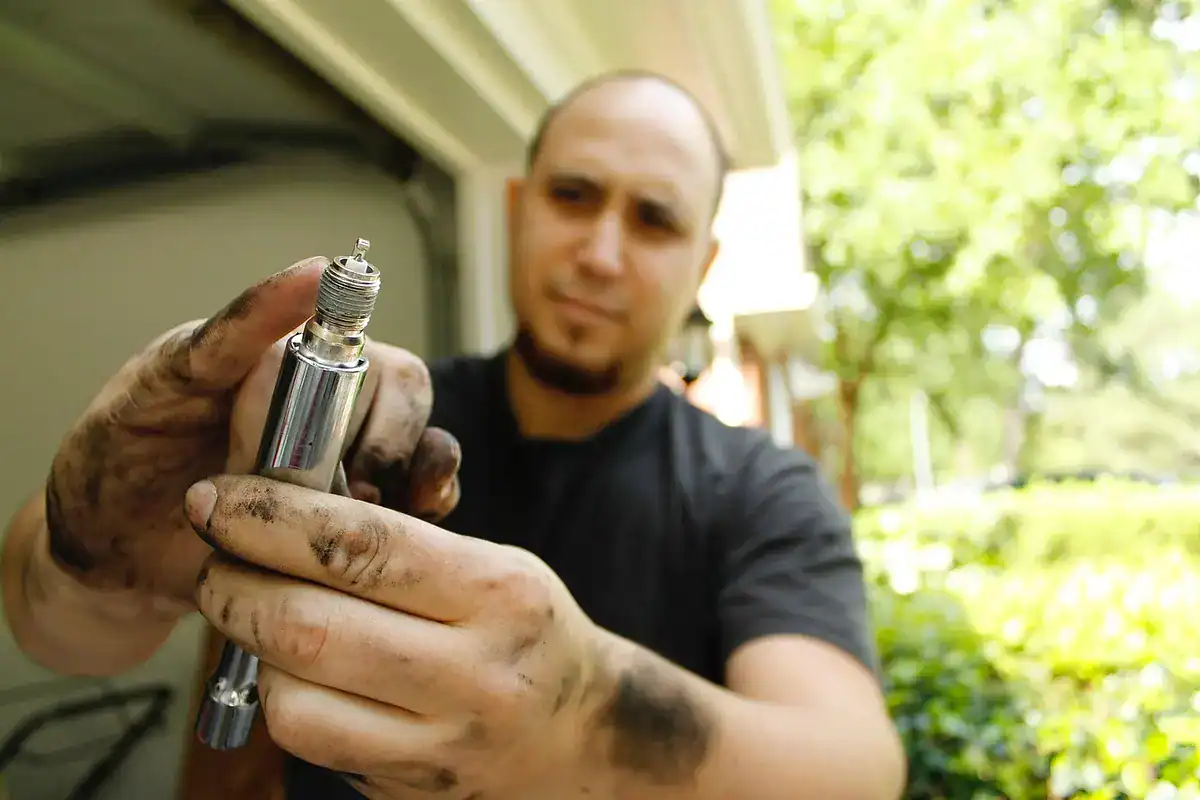
Pull the plug and look at it. A wet plug means flooding from long cranking, so dry it and wait before trying again. Coleman’s cylinder head page lists the plug as an NGK DR8EA, and a replacement NGK DR8EA spark plug is easy to find on Amazon.
Check the gap with a feeler gauge against the service manual figure. One owner found a plug that threaded in too easily and was fouled with carbon, as described in the same UTV Board thread, but a mechanic later traced that no-start to water in the tank. Owner reports are leads, not diagnoses.
Valve clearance and cold hard starts
The platform service chart puts valve clearance adjustment at every 800 hours. One owner reported that a 2019 Coleman 550 with hard cranking started perfectly after a valve adjustment, in a UTV Board thread.
The clearance values live in the service manual. Coleman sells the HS550/750UTV service manual for $57.97, and the numbers could not be verified for this guide.
Stop and see a dealer if fresh fuel, a good battery and a good plug still give no start. The ignition coil ($99.97), starter relay ($56.97) and engine controller need testing, not guessing.
3. Why does my Coleman 550 idle rough, stall or bog?
The 550 is fuel injected, so rough running is a fuel, air or sensor problem, not a carburetor jet problem. Coleman’s intake page lists the injector, idle air control valve and throttle body as separate parts.
- Free: Replace stale fuel.
- Free: Check the air filter element. The manual says to open the cover weekly in ordinary use and daily in dust, and never to run the engine without the element.
- Free: Check the in-line filter and the primary filter on the tank for debris or water.
- Free: Clean the throttle body. Remove it, spray throttle-body cleaner on a rag, wipe the bore and plate, and reconnect every plug before the key goes on.
- Free: Check low idle on the dash tach against the 1,350 to 1,500 rpm in the platform manual.
- Parts: The idle air control valve lists at $79.97, the injector at $139.97 and the filter at $21.97. A full throttle body assembly lists at $659.97, so cleaning comes first.
One long-time owner reported fouled injectors about every tank of gas until the tank was drained and cleaned, the fuel lines replaced and a 10-micron metal in-line filter fitted, in this UTV Board thread. Owners in the same thread say plastic in-line filters can leak or melt on an injected machine and recommend a metal one. These are owner reports only.
If the pump does need replacing, match it to your fuel cap thread, not just the model year. Coleman’s fuel tank page pairs the outer-thread cap with the 2019-or-older pump and the inner-thread cap with the 2020-and-newer pump, both listed at $459.97.
Do not loosen a fuel line to test the pump on a running engine. The manual warns that old fuel leaking onto a running engine can start a fire. Ask for a fuel pressure test at a shop instead.
4. Why does my Coleman 550 overheat?
Stop and idle at the first temperature warning. Most overheating starts with airflow, and the checks run from cheapest to dearest.
- Free: With the engine cool, rinse mud and grass out of the radiator from the engine side outward. The manual says not to wash the vehicle with a high-pressure washer.
- Free: Check the recovery tank level cold. It should sit between LOW and FULL. The manual says to top up with water only when the loss is from evaporation, and to use the antifreeze mix if the loss is from a leak.
- Free: Check the engine oil level and the air intake screen and filter. The manual’s overheating list includes low oil, a plugged air cleaner or intake, and long periods at slow engine speed.
- Free: Start the engine and confirm the cooling fan comes on as it warms. The manual’s pre-use check includes it. Do not bypass the fan circuit.
- Parts: The fan controller relay lists at $78.97, the water temperature sensor at $39.97 and the radiator cap at $14.97.
Never open the radiator cap on a hot engine. When it is cool, turn the cap slowly to the first stop and let the pressure out before removing it.
How do you burp the air out of the cooling system?
Do this every time the system was drained or refilled from empty. The manual says air left in the system is an overheating risk, and not to start the engine without coolant.
- Chock the rear wheels, set the parking brake, put the lever in N or P, and jack up the front about 6 inches.
- With the engine cold, remove the radiator bleeder screw (reached through the front right wheel well). Fill the radiator until coolant comes out of the bleeder hole, then refit the screw.
- Start the engine and let it idle.
- Remove the second bleeder screw where the radiator hose meets the engine. Let the engine run until a steady stream of coolant comes out with no air, then refit the screw.
- Stop the engine, let it cool, and recheck the recovery tank level.
The manual calls for an ethylene glycol coolant mixed 50-50 with water, never mixed with another type, and a coolant change every 2 years.
If it still overheats with a clean radiator, correct level, working fan and a burped system, stop driving. Have a shop test for combustion gases in the coolant and inspect the water pump, which lists at $229.97. For the same checks on other Hisun-platform machines, see this guide to Hisun UTV problems.
5. Why is my Coleman 550 hard to shift or stuck in reverse?
Shifting trouble is often technique and idle speed before it is a linkage fault.
- Free: Come to a complete stop and press the brake pedal all the way down before moving the lever to H, L or R. The manual requires it.
- Free: Let the engine settle to idle. The manual’s troubleshooting list names idle speed too fast, and says to tap the throttle and let it return to idle if the gears are not lined up.
- Free: Compare the dash gear indicator with the lever position.
- Free: No reverse: one owner found the brake pedal cable and its torsion spring were not pulling the cable far enough to release reverse, as described on UTV Board. Inspect that cable path. This is an owner report.
- Parts: The gearshift cable lists at $91.97 and the gearshift arm at $29.97.
Use oil the manual specifies: API SJ or higher with a JASO MA rating, 2.22 quarts. Coleman’s clutch page lists a wet clutch housing for 2019 and newer machines.
Linkage adjustment follows the service manual. Grinding, clunking or jumping out of gear after that is internal transmission or clutch work for a dealer.
6. Why does my Coleman 550 feel stuck in 4WD or not move?
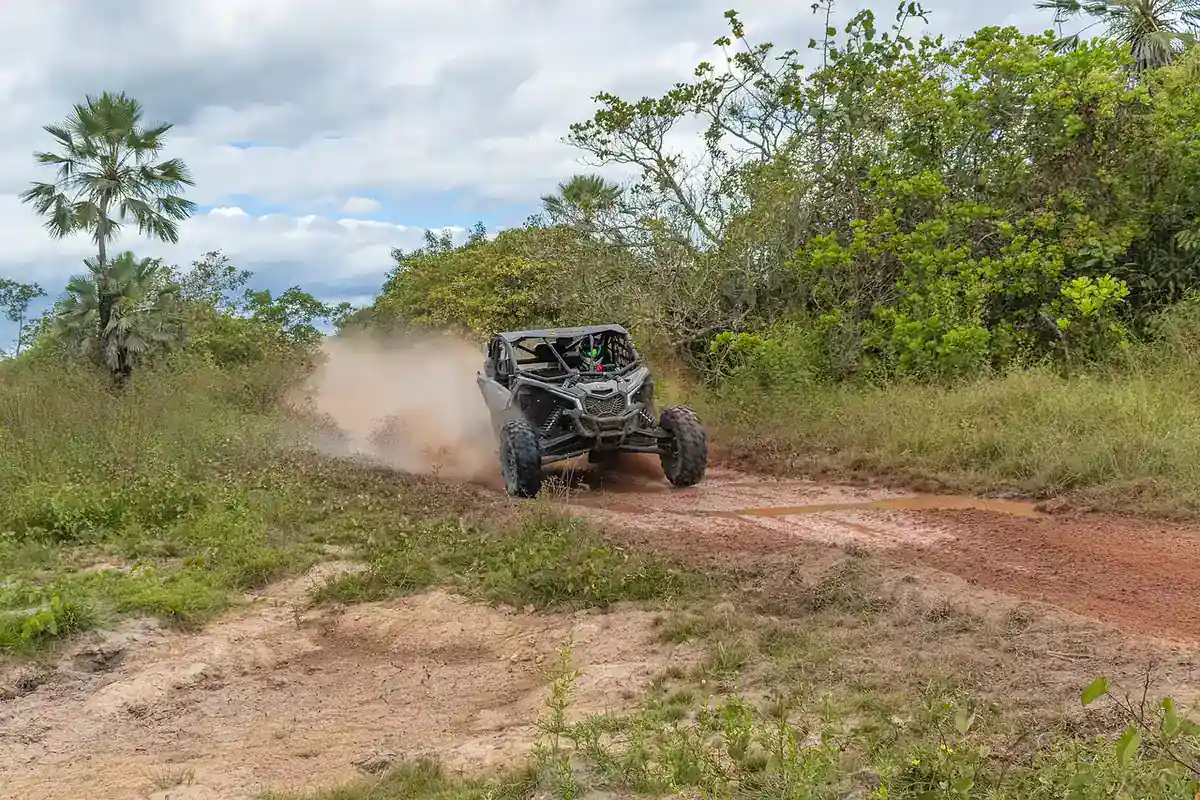
Check the switches before blaming the drivetrain. A differential lock left on feels like a machine fighting you, especially on pavement.
- Free: Release the parking brake fully and confirm the dash parking brake lamp is off. Make sure the lever is not still in neutral.
- Free: Stop, then press the upper half of the 2WD/4WD switch for 2WD. The dash shows two filled tires in 2WD and four in 4WD.
- Free: If your machine has differential lock switches, check them. In the platform manual the dash shows an X when a lock is on, locks engage only while stopped in neutral, steering response drops noticeably, and they are not for concrete, asphalt or other high-traction surfaces.
- Free: Engine revs but nothing moves: the manual lists a shift lever still in neutral, a parking brake still set and a broken or cut drive belt.
- Parts: The 2WD/4WD selector switch lists at $24.97 and the CVT belt at $249.97.
If the wheels stay locked with the brake released and both locks off, or you hear clunking under load, stop driving and have the driveline inspected.
7. Why does my Coleman 550 battery keep dying?
The manual’s battery-light list is short: low engine speed, a faulty voltage regulator, a faulty battery, a faulty rotor or stator, or a damaged wiring harness.
- Free: Clean and tighten the battery cables.
- Free: Unplug anything wired straight to the battery, such as lights, a winch or a radio, and see whether the drain stops.
- Free: Meter the battery with the engine at fast idle. Yuasa’s manual cites 14.0 to 14.8 volts as the regulated charging output a battery should see, so a reading near resting voltage means the machine is not charging.
- Free: If the machine sits, recharge the battery every 3 months in hot seasons and every 6 months in cold seasons, per the manual.
- Parts: The voltage regulator lists at $219.97 and the battery at $259.97.
Rotor, stator and wiring harness faults need a shop’s tests, so stop there.
8. Loose bolts, tire pressure and lug nuts
Check lug nut torque after the first 50 hours and every 100 hours after that, tightening in a diagonal pattern to 65 to 75 lb-ft, per the platform manual. Coleman sells a 550 UTV hardware kit for $56.97 if bolts keep working loose.
The same manual lists 14 psi for all four tires, and up to 18 psi at the rear at maximum load. Check your tire placard first. If you change tire size, the tire size calculator shows the speedometer error, and more free tools are on the off-road calculators page.
Coleman UT550 parts and listed prices
Prices change, and some parts are model-year specific, so match the part to your machine before ordering.
The table groups the parts named in this guide by the problem they usually solve.
| Problem | Part (Coleman catalog name) | List price | Catalog page |
|---|---|---|---|
| Crawl | Safety Belt, with "Lock Catch" Switch | $45.97 | Seat |
| Crawl | Safety Belt Buckle | $36.97 | Seat |
| Crawl | Speed Limiter Relay (2018 to Current) | $159.97 | Electrical Components |
| No start | Spark Plug, NGK DR8EA | $14.97 | Cylinder Head |
| No start | Ignition Coil | $99.97 | Electrical Components |
| No start | Starter Relay (Starter Solenoid) | $56.97 | Electrical Components |
| No start | Battery | $259.97 | Electrical Components |
| Fuel | Fuel Filter | $21.97 | Fuel Tank |
| Fuel | Fuel Pump, 2019 or older (outer-thread cap) | $459.97 | Fuel Tank |
| Fuel | Fuel Pump, 2020+ (inner-thread cap) | $459.97 | Fuel Tank |
| Rough idle | Fuel Injector | $139.97 | Intake Assy |
| Rough idle | IACV (IAC Sensor) | $79.97 | Intake Assy |
| Overheating | Radiator Cap Assembly | $14.97 | Radiator |
| Overheating | Fan Controller: Relay Radiator Fan | $78.97 | Electrical Components |
| Overheating | Water Temp Sensor | $39.97 | Radiator |
| Overheating | Water Pump Assembly | $229.97 | Water Pump |
| Shifting | Gearshift Cable, UT550/750 | $91.97 | Shift Operating System |
| 4WD | 2WD/4WD Selector Switch | $24.97 | Electrical Components |
| No movement | CVT Belt 450cc to 750cc | $249.97 | Clutch |
| Charging | Voltage Regulator | $219.97 | Electrical Components |
| Manuals | Owners Manual 550/750 | $16.97 | Owners Manual SKU |
| Manuals | Service Manual, Coleman HS550/750UTV | $57.97 | Hardware Kit |
Most of the problems above come back to a missed service. The platform manual’s maintenance chart sets the intervals below.
Hours are engine hours from the dash hour meter. Dusty or muddy use calls for shorter intervals.
Service intervals that head off most Coleman 550 problems
| Job | Interval |
|---|---|
| Engine oil change | First 50 hours, then every 200 hours |
| Air filter element (clean) | Every 100 hours and yearly, more often in dust |
| Lug nut torque check | First 50 hours, then every 100 hours |
| Battery condition check | Every 100 hours |
| Fuel line check | Every 100 hours or yearly, whichever comes first |
| Fuel line replacement | Every 500 hours |
| Axle case oil change | Every 400 hours |
| Spark arrester cleaning | Every 100 hours |
| Radiator hose and clamp check | Every 200 hours |
| Engine valve clearance adjustment | Every 800 hours |
| Fuel injection check | Every 1,500 hours |
| Coolant flush and change | Every 2 years |
Coleman 550 FAQ
Who makes the Coleman 550?
Coleman sells it, and the platform is Hisun’s. Coleman’s parts catalog lists HS-series part names, and Hisun Motors Corp. U.S.A. of McKinney, Texas, is the manufacturer named on a CPSC recall for Cub Cadet’s Challenger UTVs. For general ATV and UTV symptoms, see the ATV and UTV troubleshooting guide, and for another budget brand see the Massimo UTV problems guide.
Has the Coleman 550 been recalled?
A search of the CPSC recall database for Coleman and Hisun in October 2026 found no recall naming the Coleman Outfitter 550. Hisun’s own recall there covers 250cc utility vehicles sold at Rural King, which is a different machine. Ask a Coleman dealer to check your serial number.
Where do I get a Coleman 550 manual?
Coleman’s parts store sells the 550/750 owner’s manual for $16.97 and the HS550/750UTV service manual for $57.97.
How fast is a Coleman 550?
The platform manual lists 44.7 mph in high range, 37.9 mph in low range and 24.8 mph in reverse. A machine well below that is worth checking against sections 1 and 3.

I'm Suryashankar Dasgupta, the founder of Off-Road Handbook. I've been off-roading for years in the USA, including California and Texas, and have ridden mountain and desert terrain abroad. I've also driven a Jeep Compass for more than seven years, so I know the day-to-day side of Jeep ownership first-hand, from the Uconnect screen to the warning lights. Every guide here is researched from manufacturer owner's manuals, NHTSA recall and service-bulletin records and other trusted sources, checked against them before it is published, and corrected when we find a mistake. You can read how we work in our editorial policy: https://offroadhandbook.com/editorial-policy/
Like our off-road guides? Add Off-Road Handbook as a Google Preferred Source so our latest Jeep, ATV, UTV, trail, recovery, and off-road troubleshooting articles can appear more often in your Google Search experience.
Add us as a Preferred Source