4Runner Trailhunter vs TRD Pro vs TRD Off-Road: Which to Buy
This post contains Amazon affiliate links. As an Amazon Associate I earn from qualifying purchases, at no extra cost to you.
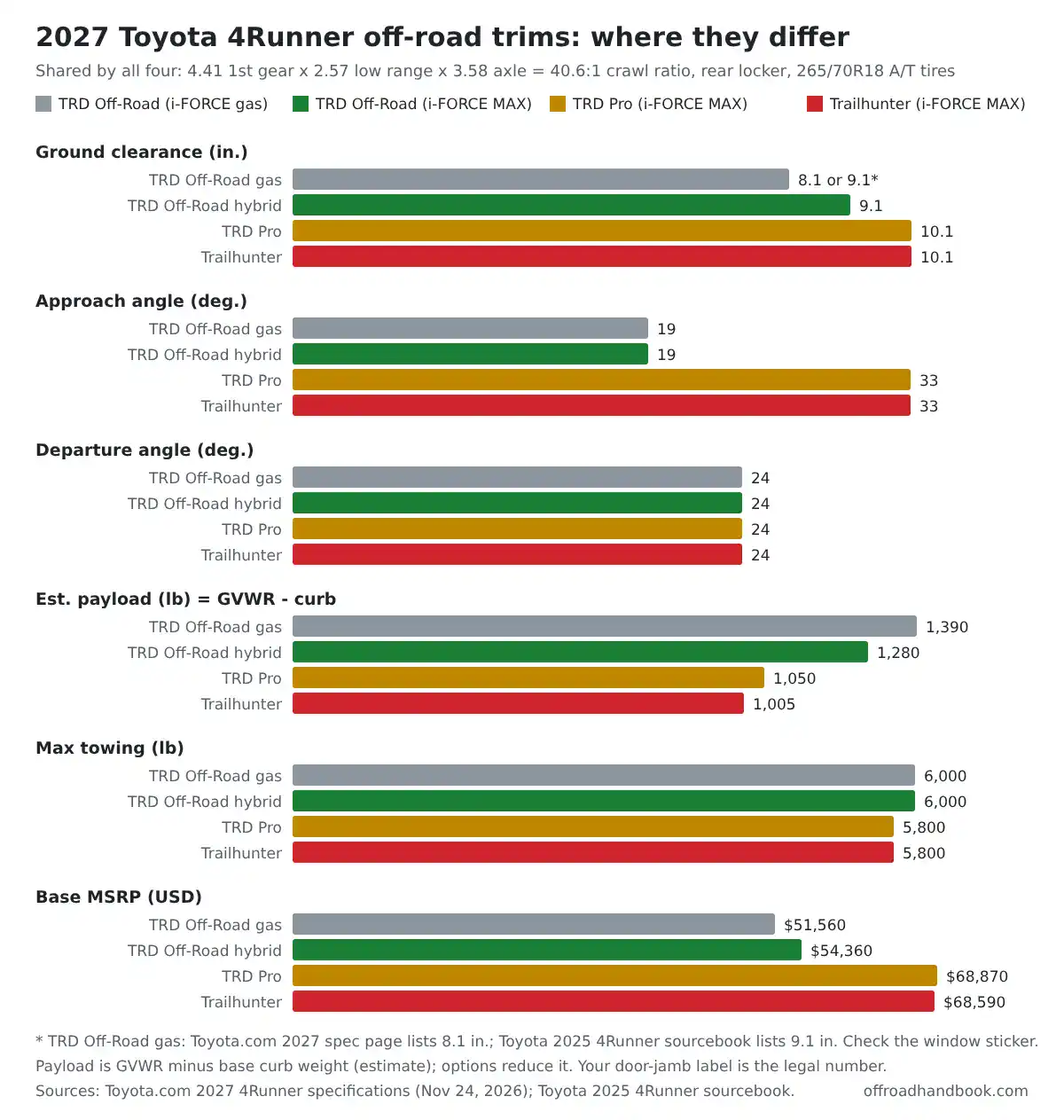
On the 2027 Toyota 4Runner, the TRD Pro and Trailhunter share the same off-road numbers: 10.1 inches of ground clearance, 33/24-degree approach and departure angles and 5,800 lb of towing. They differ in shocks and armor. The TRD Off-Road costs about $14,200 to $17,300 less, keeps the rear locker and low range, and carries up to roughly 385 lb more payload.
So pick the TRD Pro for fast dirt, the Trailhunter for slow, remote travel, and the TRD Off-Road if you plan to build it yourself. Below are the numbers side by side, a payload calculator for loaded builds and a three-question picker. Every spec comes from Toyota's own spec sheets.
2027 4Runner TRD Off-Road vs TRD Pro vs Trailhunter: spec table
| Spec (2027) | TRD Off-Road (i-FORCE gas) | TRD Off-Road (i-FORCE MAX hybrid) | TRD Pro | Trailhunter |
|---|---|---|---|---|
| Base MSRP | $51,560 | $54,360 | $68,870 | $68,590 |
| Power / torque | 278 hp / 317 lb-ft | 326 hp / 465 lb-ft | 326 hp / 465 lb-ft | 323 hp / 465 lb-ft |
| Ground clearance | 8.1 in. (2027 spec page) or 9.1 in. (2025 sourcebook) | 9.1 in. | 10.1 in. | 10.1 in. |
| Approach / departure angle | 19° / 24° | 19° / 24° | 33° / 24° | 33° / 24° |
| Track width (front / rear) | 66.0 / 66.1 in. | 66.0 / 66.1 in. | 68.8 / 68.8 in. | 68.8 / 68.8 in. |
| Overall width (no mirrors) | 78.0 in. | 78.0 in. | 79.9 in. | 79.9 in. |
| Shocks | Bilstein monotube | Bilstein monotube | FOX QS3 adjustable, internal bypass, rear piggyback reservoirs | Old Man Emu monotube, end stop control, rear piggyback reservoirs |
| Stabilizer Disconnect (SDM) | Optional | Optional | Standard | Standard |
| Underbody protection | Composite front skid, transfer case and fuel tank protection | Composite front skid, transfer case and fuel tank protection | Aluminum front skid, transfer case and fuel tank protection | Steel skid plate, transfer case and rear differential protectors, composite fuel tank protector, steel rock rails |
| Tires | 265/70R18 all-terrain | 265/70R18 all-terrain | 265/70R18 Toyo Open Country A/T III | 265/70R18 Toyo Open Country A/T III |
| Curb weight / GVWR | 4,850 / 6,240 lb | 5,225 / 6,505 lb | 5,455 / 6,505 lb | 5,500 / 6,505 lb |
| Estimated payload (GVWR − curb) | ~1,390 lb | ~1,280 lb | ~1,050 lb | ~1,005 lb |
| Max towing | 6,000 lb | 6,000 lb | 5,800 lb | 5,800 lb |
| Cargo, behind 1st / 2nd row | 90.2 / 48.4 cu ft | 82.6 / 42.6 cu ft | 82.6 / 42.6 cu ft | 82.6 / 42.6 cu ft |
| EPA mpg (city/hwy/comb.) | 19 / 25 / 21 | 23 / 24 / 23 | 23 / 24 / 23 | 23 / 24 / 23 |
I pulled every figure in this table from Toyota's 2027 spec page and checked it against Toyota's 2025 4Runner sourcebook. They match everywhere except one cell: the gas TRD Off-Road's ground clearance, listed at 8.1 inches on the 2027 page and 9.1 inches in the sourcebook.
Neither source explains the gap, so both numbers are shown. The window sticker on the truck you're looking at settles it.
Payload isn't on Toyota's spec page (the sourcebook lists it as "TBD"), so the payload row is GVWR minus base curb weight. That's the most a base truck could carry. Options and dealer add-ons bring it down. The yellow Tire and Loading Information label on the driver's door jamb gives the real number for that exact vehicle.
What the extra $14,000 buys on the TRD Pro and Trailhunter
Both flagships use the hybrid i-FORCE MAX, so the fair price comparison is against the hybrid TRD Off-Road at $54,360. That's a gap of $14,230 to the Trailhunter and $14,510 to the TRD Pro. Here's the hardware that shows up on paper for that money:
- A much steeper approach angle. It goes from 19° to 33°. Both flagships get a high-clearance front bumper, so the nose clears ledges and creek banks that would catch a TRD Off-Road's lower front end.
- One more inch of clearance: 10.1 inches vs 9.1 on the hybrid TRD Off-Road, on the same 265/70R18 tire size.
- A wider stance. Track width grows 2.8 inches up front and 2.7 inches at the rear (68.8 vs 66.0/66.1 inches), with extended-width overfenders.
- Standard sway-bar disconnect. The Stabilizer Disconnect Mechanism (SDM) frees the front stabilizer bar for more wheel travel on uneven ground. It's optional on the TRD Off-Road.
- Better shocks and stronger skid plates. These are the parts that separate the two flagships from each other (next section).
- Multi-Terrain Monitor cameras with front, side and rear views, plus an integrated trailer brake controller.
What you don't get is more traction hardware. All three trims share the same part-time 4WD with a two-speed transfer case, an electronically locking rear differential, A-TRAC, Multi-Terrain Select, Crawl Control and Downhill Assist Control. If a rear diff lock and low range are all you need, the TRD Off-Road already has them.
The 14-degree approach-angle jump matters more than the inch of clearance. Plug your own obstacle heights into the approach angle calculator to see whether 19° or 33° is the difference on the trails you actually drive.
TRD Pro or Trailhunter? Shocks and armor decide it
The 2027 spec sheet shows the two flagships are nearly the same truck. Clearance, angles, track, towing, GVWR and tire size are identical, and base prices are $280 apart. The Trailhunter makes 3 hp less (323 vs 326) and weighs 45 lb more.
The TRD Pro is set up for speed. It gets adjustable FOX QS3 shocks with internal bypass and rear piggyback reservoirs. That's the kind of damping that keeps a heavy SUV composed on whoops and washboard. It also gets a TRD performance air intake and exhaust, an aluminum front skid plate, a hood scoop and a power moonroof.
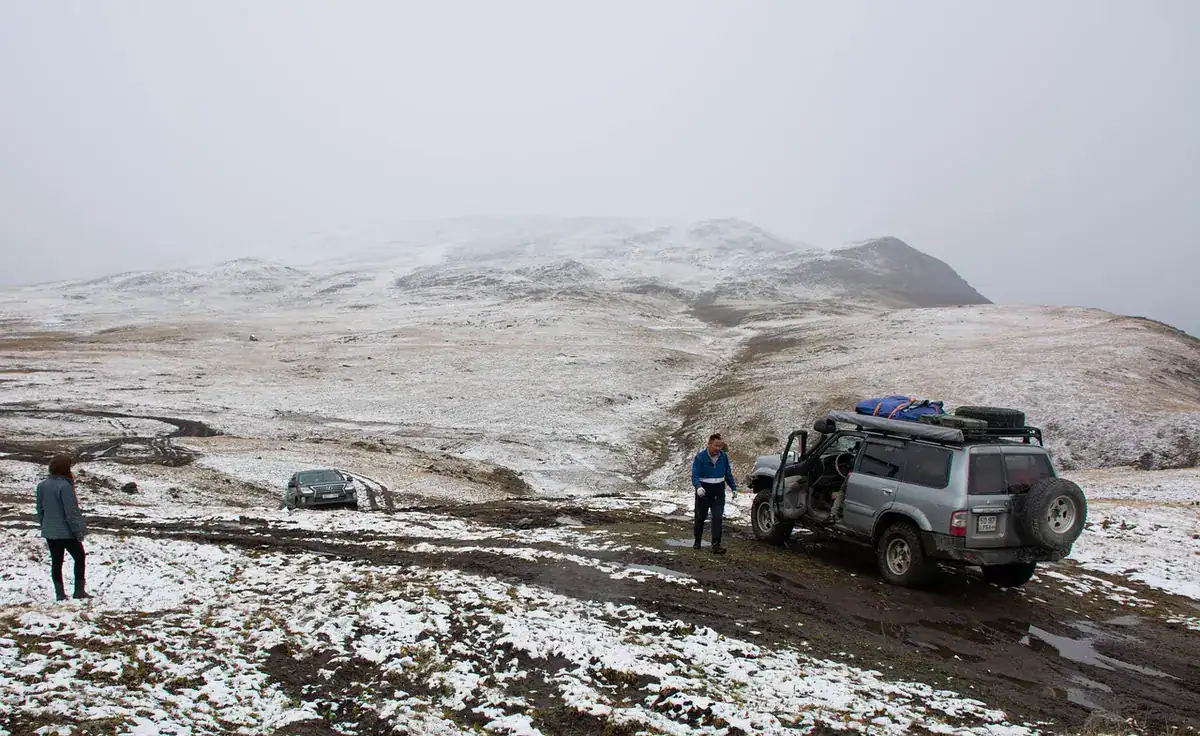
The Trailhunter is set up for distance and rocks. It gets Old Man Emu monotube shocks with end stop control, a steel skid plate, a rear differential protector and frame-mounted steel rock rails. On top of that come a high-mount air intake, an ARB roof rack and an onboard high-output air compressor. It also has white-and-amber switchable Rigid fog lights.
The compressor is easy to overlook. Airing down for sand or rock and airing back up for the highway is the routine that matters most on long trips.
On a TRD Off-Road or TRD Pro you'll add a portable compressor and a set of screw-on tire deflators (check the current price on Amazon). The compressor fill-time calculator shows how long a given unit takes to refill a set of tires.
A simple rule: if most of your dirt miles are fast graded roads and desert washes, the TRD Pro's adjustable bypass shocks are the reason to pay. If they're slow ledges, rocky two-tracks and multi-day trips far from help, the Trailhunter's steel armor, rock rails and compressor are the better fit.
Payload Left Calculator for the 4Runner off-road trims
The flagships carry the least. Hybrid hardware, armor and accessories push the TRD Pro and Trailhunter close to the shared 6,505 lb GVWR before anyone gets in. That leaves roughly 1,050 and 1,005 lb of payload. A rooftop tent, drawers, a steel bumper and four adults can use that up fast.
Enter your planned load below to see what's left on each trim.
How it works: each trim's capacity is Toyota's GVWR minus its base curb weight (6,240 − 4,850 lb for the gas TRD Off-Road, 6,505 − 5,225, − 5,455 and − 5,500 lb for the hybrid trims). Your load is subtracted from that.
It's an estimate for a base truck. Factory options reduce it, and the door-jamb label is the legal limit.
Count trailer tongue weight against payload. The towing footnote in Toyota's 2025 sourcebook says the most you can tow depends on base curb weight plus the total weight of cargo, occupants and added equipment.
For a fuller build list (bumpers, winch, sliders, spare), run the numbers in the 4x4 payload calculator. If a rooftop tent is part of the plan, check the roof side as well with the rooftop tent weight limit calculator.
Gas or hybrid TRD Off-Road?
The TRD Off-Road is the only off-road 4Runner you can still get with the non-hybrid 2.4L turbo. The $2,800 hybrid upgrade adds 148 lb-ft of torque (465 vs 317 lb-ft) and better city mileage (23 vs 19 mpg). It also swaps the 400 W AC outlets for 2,400 W outlets that can run real tools or a camp kitchen.
The hybrid costs space and payload. The gas truck has 90.2 cu ft of cargo room behind the front seats and 48.4 behind the second row, against 82.6 and 42.6 for every hybrid 4Runner. It's also 375 lb lighter and has about 110 lb more estimated payload. Both tow 6,000 lb, 200 lb more than the TRD Pro or Trailhunter.
Clearance is the open question. Toyota's 2027 spec page lists 8.1 inches for the gas TRD Off-Road and 9.1 for the hybrid. Toyota's 2025 sourcebook lists 9.1 for both. If that inch matters for your trails, read the window sticker or measure under the rear differential, the lowest point on most solid-axle trucks, before you buy.
Which off-road 4Runner should you buy?
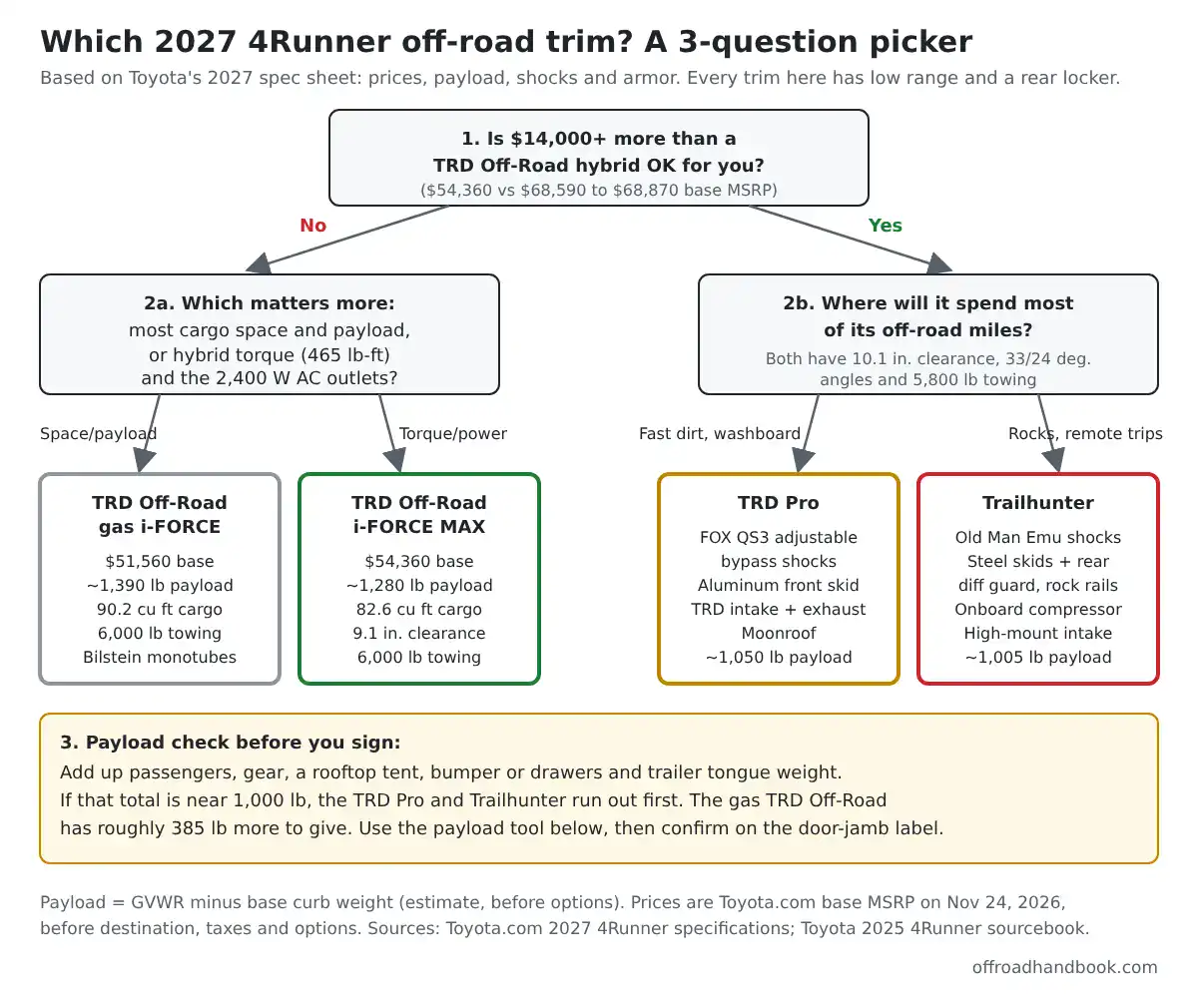
- Buy the TRD Off-Road (gas) if you want the most cargo space, the most payload and the lowest price, and plan to add your own bumper, sliders or lift later.
- Buy the TRD Off-Road (hybrid) if you want the flagships' powertrain, 2,400 W outlets and 9.1 inches of clearance for about $14,000 less, and can live with the 19° approach angle.
- Buy the TRD Pro if you drive fast on dirt and want adjustable bypass shocks, an aluminum skid and the wider track from the factory.
- Buy the Trailhunter if you travel far and slow over rock, and want steel armor, rock rails, an onboard compressor, a roof rack and a high-mount intake without building them yourself.
Whichever you pick, run question 3 from the chart. A Trailhunter loaded for a week can be closer to its GVWR than most owners expect.
Some of the most important trail numbers don't change at all between these trims. Toyota lists the same gearing for all of them: a 4.41:1 first gear in the 8-speed automatic, a 2.57:1 low range and a 3.58:1 final drive. Multiplied together, that's a 40.6:1 crawl ratio on every TRD Off-Road, TRD Pro and Trailhunter.
All of them ride on 265/70R18 tires. That works out to about 32.6 inches tall by the standard sidewall formula, so the 33-inch label you'll see is rounded up.
Turning radius (19.7 ft), fuel tank (19.0 gal), front and rear recovery points and the full-size underbody spare are shared too. Try bigger tires in the tire size calculator, then check what they do to gearing in the crawl ratio calculator.
Replacing the factory rubber on a TRD Pro or Trailhunter? The stock tire is the Toyo Open Country A/T III in 265/70R18 (check the current price on Amazon). Match the load index on your door placard.
FAQ
Is the Trailhunter more capable off-road than the TRD Pro?
Not on paper. Toyota lists identical clearance (10.1 in.), approach and departure angles (33°/24°), track width and towing for both. The Trailhunter adds more armor (steel skid, rear diff protector, rock rails) and an onboard compressor. The TRD Pro has adjustable bypass shocks tuned for speed.
Does the 4Runner TRD Off-Road have a locking rear differential?
Yes. Toyota lists an electronically controlled locking rear differential as standard on the TRD Off-Road, TRD Pro and Trailhunter, along with part-time 4WD, low range, A-TRAC, Multi-Terrain Select and Crawl Control.
Which off-road 4Runner tows the most?
The TRD Off-Road, gas or hybrid, is rated at 6,000 lb. The TRD Pro and Trailhunter are rated at 5,800 lb.
Does the 2025 4Runner have the same specs as the 2027?
For the TRD Pro and Trailhunter, Toyota's 2025 sourcebook lists the same clearance, angles, towing, curb weight and GVWR as the 2027 spec page. The one mismatch is the gas TRD Off-Road's ground clearance (9.1 in. in 2025, 8.1 in. on the 2027 page). Prices change every model year, so check that year's window sticker.
Can I add the sway-bar disconnect to a TRD Off-Road?
Toyota lists the Stabilizer Disconnect Mechanism as an option on the TRD Off-Road and standard on the TRD Pro and Trailhunter. Order it on the truck or confirm it's on the window sticker of one in stock.

I'm Suryashankar Dasgupta, the founder of Off-Road Handbook. I've been off-roading for years on mountain and desert terrain. I've also driven a Jeep Compass for more than seven years, so I know the day-to-day side of Jeep ownership first-hand, from the Uconnect screen to the warning lights. Every guide here is researched from manufacturer owner's manuals, NHTSA recall and service-bulletin records and other trusted sources, checked against them before it is published, and corrected when we find a mistake. You can read how we work in our editorial policy: https://offroadhandbook.com/editorial-policy/
Like our off-road guides? Add Off-Road Handbook as a Google Preferred Source so our latest Jeep, ATV, UTV, trail, recovery, and off-road troubleshooting articles can appear more often in your Google Search experience.
Add us as a Preferred Source